A new approach to logging
p. 28 · Read in the full issue
Environment
Vanuatu’s Happy Land reserve sets the pace for safeguarding indigenous forests
By Patrick Decloitre
Diplomats and representatives of foreign
missions had to put on their trekking boots and walk for two hours to get to Happy Land in the hills of tiny timber-rich Erromango Island (in south Vanuatu), where traditional landowners and the gov ernment had just signed an agreement set ting up a national reserve protecting 3200 hectares of land from logging on May 1. It was the first on the island state.
“I am the green gold of this island,” “I have chosen Erromango to be my home forever,” said signs held by children dis guised as trees at the entrance of the village as the delegation arrived.
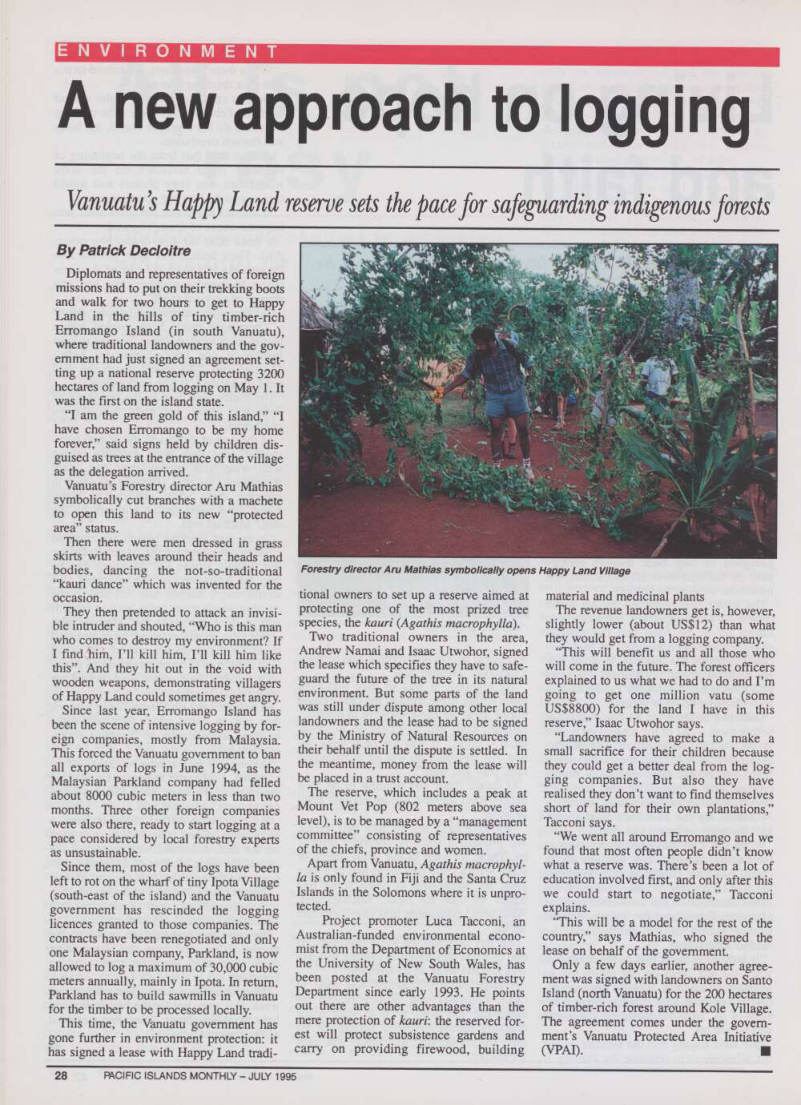
Vanuatu’s Forestry director Am Mathias symbolically cut branches with a machete to open this land to its new “protected area” status.
Then there were men dressed in grass skirts with leaves around their heads and bodies, dancing the not-so-traditional “kauri dance” which was invented for the occasion.
They then pretended to attack an invisi ble intruder and shouted, “Who is this man who comes to destroy my environment? If I find him, I’ll kill him. I’ll kill him like this”. And they hit out in the void with
wooden weapons, demonstrating villagers
of Happy Land could sometimes get angry.
Since last year, Erromango Island has been the scene of intensive logging by for
eign companies, mostly from Malaysia.
This forced the Vanuatu government to ban all exports of logs in June 1994, as the Malaysian Parkland company had felled about 8000 cubic meters in less than two months. Three other foreign companies were also there, ready to start logging at a pace considered by local forestry experts as unsustainable.
Since them, most of the logs have been left to rot on the wharf of tiny Ipota Village (south-east of the island) and the Vanuatu government has rescinded the logging licences granted to those companies. The contracts have been renegotiated and only one Malaysian company. Parkland, is now allowed to log a maximum of 30,000 cubic meters annually, mainly in Ipota. In return, Parkland has to build sawmills in Vanuatu for the timber to be processed locally.
This time, the Vanuatu government has gone further in environment protection: it has signed a lease with Happy Land tradi-
tional owners to set up a reserve aimed at protecting one of the most prized tree species, the kauri {Agathis macrophylla).
Two traditional owners in the area, Andrew Namai and Isaac Utwohor, signed the lease which specifies they have to safe guard the future of the tree in its natural environment. But some parts of the land was still under dispute among other local landowners and the lease had to be signed by the Ministry of Natural Resources on their behalf until the dispute is settled. In the meantime, money from the lease will be placed in a trust account.
TTie reserve, which includes a peak at Mount Vet Pop (802 meters above sea level), is to be managed by a “management committee” consisting of representatives of the chiefs, province and women.
Apart from Vanuatu, Agathis macrophyl la is only found in Fiji and the Santa Cruz Islands in the Solomons where it is unpro tected.
Project promoter Luca Tacconi, an Australian-funded environmental econo mist from the Department of Economics at the University of New South Wales, has been posted at the Vanuatu Forestry
Department since early 1993. He points
out there are other advantages than the mere protection of kauri : the reserved for est will protect subsistence gardens and carry on providing firewood, building
material and medicinal plants The revenue landowners get is, however, slightly lower (about US$l2) than what they would get from a logging company.
“This will benefit us and all those who will come in the future. The forest officers explained to us what we had to do and I’m going to get one million vatu (some US$8800) for the land I have in this reserve,” Isaac Utwohor says.
“Landowners have agreed to make a small sacrifice for their children because they could get a better deal from the log ging companies. But also they have realised they don’t want to find themselves short of land for their own plantations,”
Tacconi says.
“We went all around Erromango and we found that most often people didn’t know what a reserve was. There’s been a lot of education involved first, and only after this we could start to negotiate,” Tacconi explains.
“This will be a model for the rest of the country,” says Mathias, who signed the lease on behalf of the government.
Only a few days earlier, another agree ment was signed with landowners on Santo Island (north Vanuatu) for the 200 hectares of timber-rich forest around Kole Village.
The agreement comes under the govern ment’s Vanuatu Protected Area Initiative
(Vpai). ■
Forestry director Am Mathias symbolically opens Happy Land Village