Living on hope
p. 27 · Read in the full issue
and faith
Michael Maniel recounts his horrifying 84 days as he drifted in the open seas
“Rely on God’s love and never give up.”
That was the advice of a Papua New Guinean survivor of a boating tragedy, where four people died during 84-day ordeal in the open and inhospitable seas.
After 84 days adrift at sea with hardly any food and water, Michael Maniel, from Mahur Village on an outlying island off New Ireland north of Port Moresby, attrib uted his survival to the grace of God and his will to survive.
An avid Roman Catholic, Michael was in a party of eight in a fibre-glass, motor powered canoe from Masahet (another outlying island off New Ireland) who attended a traditional ceremony at Tabar on December 18, 1994. As the 21-footer ploughed its way back through choppy seas on the four-hour afternoon run, the inclement weather turned ugly.
The canoe was swarmed by six-metre waves. To avoid capsizing, the motor was turned off in the hope that the weather would clear before nightfall so that they could continue the journey. It never did.
By nightfall it was pitch-black; the wind was increasing in intensity by the minute and whipping up huge waves.
Unknown to them, an 84-day ordeal lay before them - one of the longest on record in the Pacific. Ironically, it was Sunday evening (March 12) that the canoe - their home for almost three months - finally crossed and capsized on the reef that ringed Tuvalu’s southern-most island of Niulakita. By the time they were found, half the party on board had died.
When the four survivors were taken to the capital, Funafuti, one was already in coma. After his condition was stabilised, the PNG Embassy in Suva arranged for their evacuation to Fiji for further medical attention. Throughout the ordeal, Michael kept a record of the dates. Here, he recounts the ordeal.
“It must have been two in the afternoon when we left Tabar on our return trip to Masahat. In midway, solwara i bakrap tru (the sea became very rough). There were eight of us. To avoid capsizing, the motor was turned off.
“We were hoping that the weather would lift, allowing us to continue the journey. It
was not to be. On hindsight, it was perhaps a mistake,” Michael said.
“By nightfall, it was so dark that even those sitting in the front of the canoe could not be seen. We knew we were in trouble,”
Michael said. But they held on to some thing - hope. “It was the only thing we had. All we could do was sit in pounding rain, pray and wait.”
At dawn, there was nothing to be seen ekcept what seemed like an endless body of water.
“We were okay for the first two weeks.
We grabbed a few dry coconuts drifting by. These we used as our main source of food. With a knife tied to the end of a long pole, we were able to catch some fish which we used for meat,” Michael said.
Weakness, exhaustion and over-exposure set in.
One day they lost the knife overboard as one of them was trying to catch a fish. He was just too weak to do anything.
A large piece of canvass was used to catch rainwater and bottles picked up along the way were used to store it for drinking during extended periods of no rain. During the day, the canvas was used for shelter.
“When there’s no water, we turned to sea water for drinking,” he said.
The first casualty occurred in the second week of February. As there was nothing we could do for a proper burial, the body was thrown overboard.
Michael said that from the beginning of February small scratches on the body would turn into huge blisters and would turn overnight into big open sores.
“It seemed to me that the sores were per haps the cause of death,” he said.
A week after the first death, two others died. Their bodies too were thrown into the sea. By this time the rest of the crew began to wonder whether “we had any chance of survival at all”.
Did they come across any passing ships?
“There were many. Some passed within metres of our canoe. None stopped to help inspite of mir frantic cries for help,”
Michael said. “We would watch the ship until it vanished. It was so hopeless.”
The fourth man died in the last week of
February. Again, his body was thrown
overboard.
At the end of February, the scared cere
monial gear they were carrying, along
with what little money they had, were thrown into the sea. “There is no sense in carrying these when chances of being found alive were getting slimmer by the day,” Michael said.
“In the first week of March, we came so close to one of the Pacific island countries.
We thought it was Fiji but there was no way of knowing. In the morning, we would watch aircraft take off and in the evening watch them come back to land. It was so close and yet so far,” Michael said.
“We were so desperate we were prepared to do anything. So we prayed and asked God to help us to come ashore on an island on a Sunday. This was a week before we were found,” he said.
At around 3pm, on March 12 (a Sunday), they saw an island which they later came to know as Niulakita on Tuvalu’s south
ernmost tip.
“Although I was almost too weak to do anything, I managed to put up a sail using the canvas. We knew God had answered our prayers,” Michael said.
“As our canoe drifted closer to land, a huge wave picked it up and threw it right on the reef. A second wave capsized the canoe, throwing all four of us in all direc tions. We thought that was the end of us.”
They managed to crawl to the beach. “We just kept falling over each time we attempted to walk,” Michael said.
One survivor managed to crawl to the nearby village and raise the alarm. Nine days later, they were on their way to Funafuti.
“We could have easily gone after that week, if it were not for the hospitality and help from Tuvaluans. They just went out of their way to help us.”
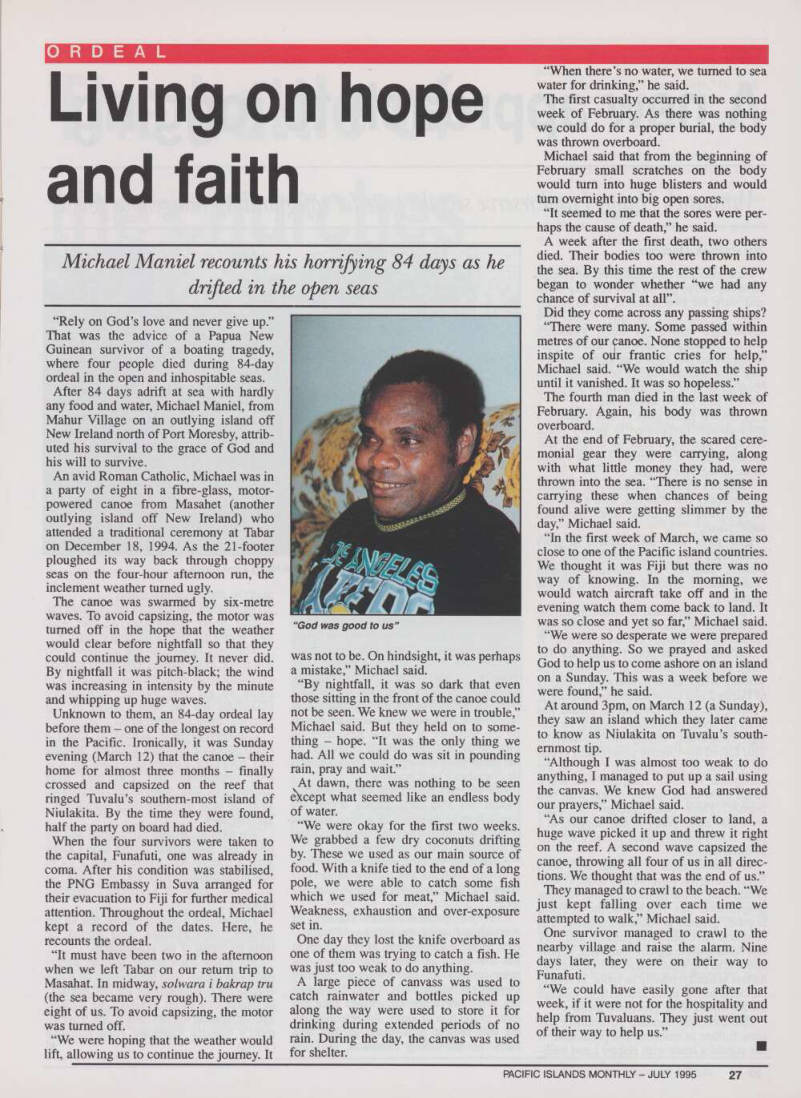
“God was good to us”