gaining side?
pp. 16-17 · Read in the full issue
Health
So, who is really on the gaining side?
By Robert Simms
Few health facilities in developing countries of the Pacific and Asia can compare to those taken for granted in Australia. Local medical spe cialists are scarce , surgeons are in short
supply, operating theatres have only the
bare necessities and support staff are lim ited.
Patients with serious complaints will often die for the lack of expertise to treat them. The seriousness in these regions is so massive that it elicits shrugs of resigna tion and “What can we do?” gestures.
However, there are those who are willing to provide help and are prepared to give their time to tackle the problems head on.
The Australian Society of Anaesthetists is one group that recognised how it could play a part in overcoming the shortage of specialists. Through their Overseas Aid Sub-committee they have devised a new scheme, in consultation with the Pacific Islanders, to ease the shortage of anaes thetists in the region. “In July we will be sending anaesthetist Dr Steve Kinnear to establish a two-year post-graduate diplo ma course in anaesthetics at the Fiji School of Medicine,” says chairman of the sub-committee Dr David Mawter. “This will help meet the need for about 20 anaes thetists in the south-west Pacific region over the next two or three years.”
This direct approach to health issues in developing countries is the way health aid works best: identify a need, liaise with the local people to ensure it has a high priori ty and provide the training so they can go on to solve their own problems.
The anaesthetists programme is being funded by Australia’s aid agency, AusAID (the Australian Agency for International
Development, formally AIDAB), which
will cover all costs associated with the course. While AusAID should be applaud ed for its support of this project, the total amount in assistance they offer to health
programmes generally is insufficient to cover more than a minority of those pro posed by health aid providers. In 1992-’93 almost $1.5 billion was spent in aid to developing countries through AusAID, yet only 5.2 percent was allocated to health.
This year, the budget for Australian health aid and population-related projects has been increased and will make up about 6.5 percent of total aid expenditure, according to Helena Hughes, the director of the Health and Population section of AusAID.
The increase in expenditure includes additional funding of $llO million over four years to help control malaria, polio, neo-natal tetanus and HIV/AIDS, four areas of particular concern in the Asia/Pacific region. Attention to popula tion issues, such as family planning, nutri tion and health education, raised spending in these areas by $2O million last year as part of a four-year, $ 130-million Population Initiative. These programmes will have the effect of focusing Australia’s health efforts but considering the extent of health problems in the region, the financial support offered for these and other pro grammes is grossly inadequate.
Health aid plays two roles in Australia’s relationships with developing countries.
The predominant philanthropic incentive is often augmented by commercial consid erations. If projects are selected carefully, giving aid becomes a way of enhancing the commercial association between Australia and the recipient country as well as addressing a health need. This seems to be a point underestimated by AusAID bureaucrats.
“Health should have a high priority not only for altruistic reasons but also as a way to further Australia’s foreign policy objec tives by creating an appropriate view of Australia in the region,” says Professor Cres Eastman, Director of the Australian Centre for Control of lodine Deficiency Disorders, who has had an association with aid projects for many years. “We
should choose projects from the point of view of need first but ought to take advan tage of commercial opportunities when they occur.”
Further advantage for Australia is gained when you consider the way aid funds are used. AusAID estimates that more than 85 percent of the aid budget is spent in Australia on goods and services.
Home-grown consultancies benefit sub stantially from the development, imple mentation and evaluation of aid projects.
Educational institutions are paid to train overseas students and equipment used dur
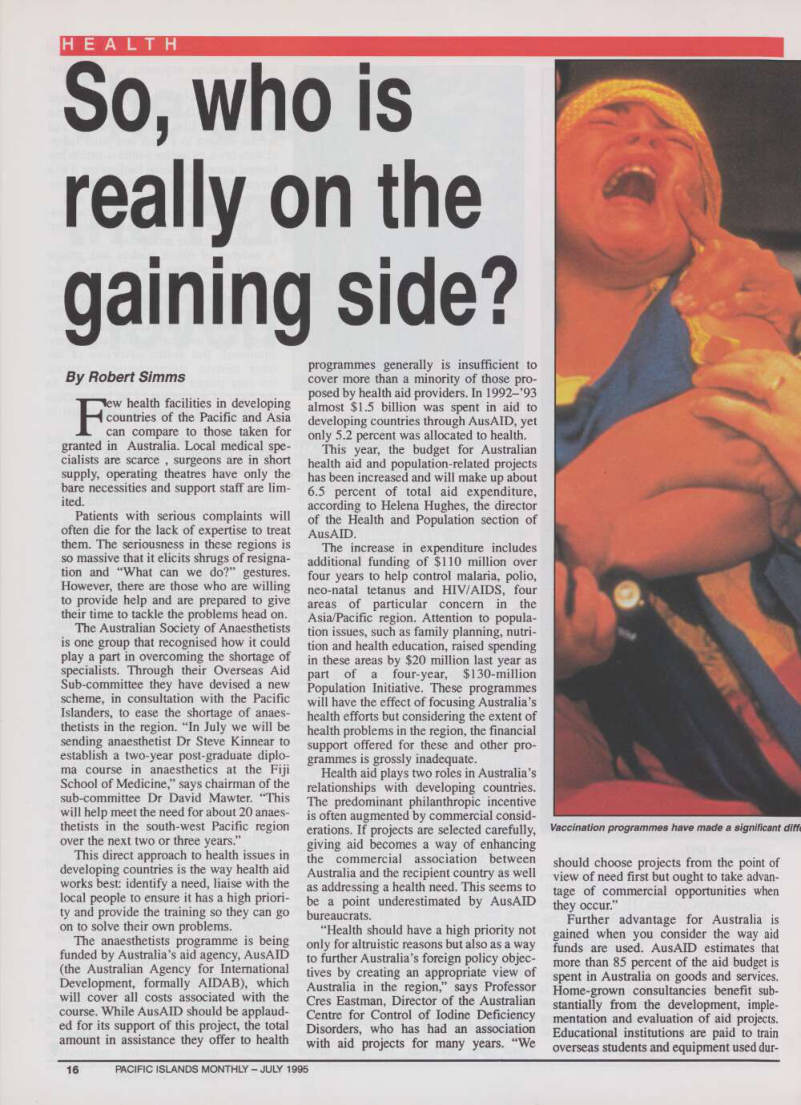
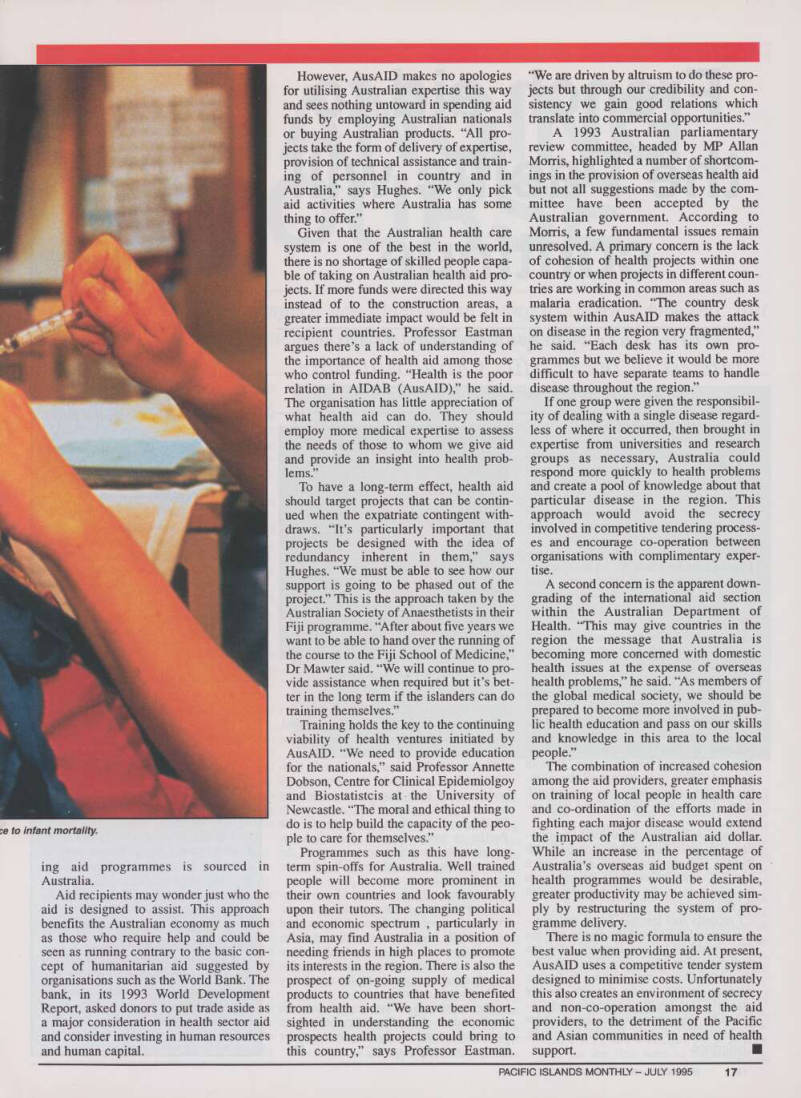
Vaccination programmes have made a significant diffe
ing aid programmes is sourced in Australia.
Aid recipients may wonder just who the aid is designed to assist. This approach benefits the Australian economy as much as those who require help and could be seen as running contrary to the basic con cept of humanitarian aid suggested by organisations such as the World Bank. The bank, in its 1993 World Development Report, asked donors to put trade aside as a major consideration in health sector aid and consider investing in human resources and human capital.
However, AusAID makes no apologies for utilising Australian expertise this way and sees nothing untoward in spending aid funds by employing Australian nationals or buying Australian products. “All pro jects take the form of delivery of expertise, provision of technical assistance and train ing of personnel in country and in Australia,” says Hughes. “We only pick aid activities where Australia has some thing to offer.”
Given that the Australian health care system is one of the best in the world, there is no shortage of skilled people capa ble of taking on Australian health aid pro jects. If more funds were directed this way instead of to the construction areas, a greater immediate impact would be felt in recipient countries. Professor Eastman argues there’s a lack of understanding of the importance of health aid among those who control funding. “Health is the poor relation in AIDAB (AusAID),” he said.
The organisation has little appreciation of what health aid can do. They should employ more medical expertise to assess the needs of those to whom we give aid and provide an insight into health prob lems.”
To have a long-term effect, health aid should target projects that can be contin ued when the expatriate contingent with draws. “It’s particularly important that projects be designed with the idea of redundancy inherent in them,” says Hughes. “We must be able to see how our support is going to be phased out of the project.” This is the approach taken by the Australian Society of Anaesthetists in their Fiji programme. “After about five years we want to be able to hand over the running of the course to the Fiji School of Medicine,”
Dr Mawter said. “We will continue to pro vide assistance when required but it’s bet ter in the long term if the islanders can do training themselves.”
Training holds the key to the continuing viability of health ventures initiated by AusAID. “We need to provide education for the nationals,” said Professor Annette Dobson, Centre for Clinical Epidemiolgoy and Biostatistcis at the University of Newcastle. “The moral and ethical thing to do is to help build the capacity of the peo ple to care for themselves.”
Programmes such as this have long term spin-offs for Australia. Well trained people will become more prominent in their own countries and look favourably upon their tutors. The changing political and economic spectrum , particularly in Asia, may find Australia in a position of needing friends in high places to promote its interests in the region. There is also the prospect of pn-going supply of medical products to countries that have benefited from health aid. “We have been short sighted in understanding the economic prospects health projects could bring to this country,” says Professor Eastman.
“We are driven by altruism to do these pro jects but through our credibility and con sistency we gain good relations which translate into commercial opportunities.”
A 1993 Australian parliamentary review committee, headed by MP Allan Morris, highlighted a number of shortcom ings in the provision of overseas health aid but not all suggestions made by the com mittee have been accepted by the Australian government. According to Morris, a few fundamental issues remain unresolved. A primary concern is the lack of cohesion of health projects within one country or when projects in different coun tries are working in common areas such as malaria eradication. “The country desk system within AusAID makes the attack on disease in the region very fragmented,” he said. “Each desk has its own pro grammes but we believe it would be more difficult to have separate teams to handle disease throughout the region.”
If one group were given the responsibil ity of dealing with a single disease regard less of where it occurred, then brought in expertise from universities and research groups as necessary, Australia could respond more quickly to health problems and create a pool of knowledge about that particular disease in the region. This approach would avoid the secrecy involved in competitive tendering process es and encourage co-operation between organisations with complimentary exper tise.
A second concern is the apparent down grading of the international aid section within the Australian Department of Health. “This may give countries in the region the message that Australia is becoming more concerned with domestic health issues at the expense of overseas health problems,” he said. “As members of the global medical society, we should be prepared to become more involved in pub lic health education and pass on our skills and knowledge in this area to the local people.”
The combination of increased cohesion among the aid providers, greater emphasis on training of local people in health care and co-ordination of the efforts made in fighting each major disease would extend the impact of the Australian aid dollar.
While an increase in the percentage of Australia’s overseas aid budget spent on health programmes would be desirable, greater productivity may be achieved sim ply by restructuring the system of pro gramme delivery.
There is no magic formula to ensure the best value when providing aid. At present, AusAID uses a competitive tender system designed to minimise costs. Unfortunately this also creates an environment of secrecy and non-co-operation amongst the aid providers, to the detriment of the Pacific and Asian communities in need of health support. ■
ce to infant mortality.