The state of
pp. 14-15 · Read in the full issue
Sovereignty
The state of the Hawaiian movement
Support for the cause appears to be dwindling as the group gets fragmented
By Ed Rampell
What is that state of the Hawaiian sover eignty cause?
A so-called “plebiscite” is scheduled from November 15 to December 29, 1995, via mail-in ballot, to ask: “Shall the Hawaiian people elect delegates to propose a native Hawaiian government?” Anyone 18 and older around the world, with at least one percent Hawaiian blood, can vote. The result is to be announced on January 17, 1996.
The proposed referendum is derived from two acts passed by Hawaii’s State Legislature - Senate Bill 1028 established the Sovereignty Advisory Commission (SAC) and House Bill 3630 established the Hawaiian Sovereignty Elections Council (HSEC).
As its name indicates, SAC was an adviso ry body and U 55420,000 was appropriated for it to advise the Legislature on “holding a referendum to determine the will of the native Hawaiian people to call a democra tically convened convention for the pur pose of achieving consensus on an organic document that will propose the means for native Hawaiians to operate under a gov ernment of their own choosing...” SAC evolved into HSEC which turned the advi sory body into a government organ with the power and funding to implement the referendum.
TThe SAC-HSEC plebiscite has generated a tremendous amount of controversy in the indigenous movement. Proponents tout it as a major educational, organisational and unifying step that could lead towards Hawaiian self-determination. Opponents
fear it’s a co-ordinated, counter-intelli gence conspiracy to sell-out sovereignty.
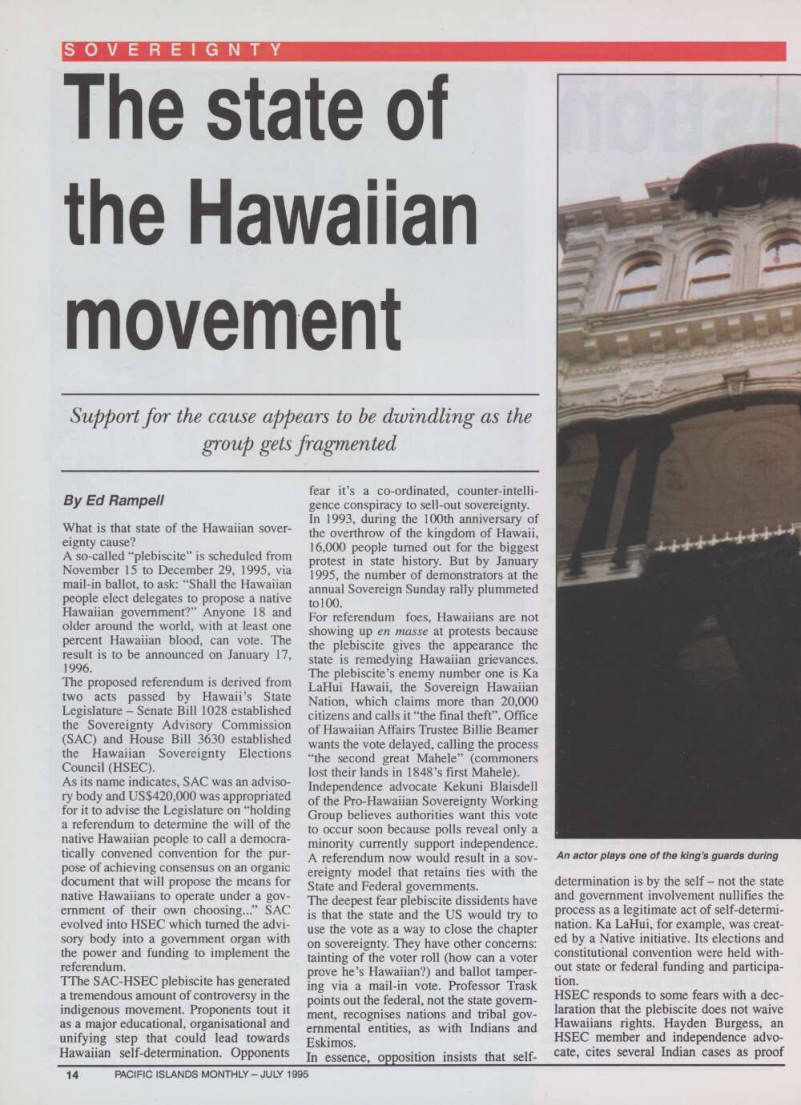
In 1993, during the 100th anniversary of the overthrow of the kingdom of Hawaii, 16,000 people turned out for the biggest protest in state history. But by January 1995, the number of demonstrators at the annual Sovereign Sunday rally plummeted to 100.
For referendum foes, Hawaiians are not showing up en masse at protests because the plebiscite gives the appearance the state is remedying Hawaiian grievances.
The plebiscite’s enemy number one is Ka LaHui Hawaii, the Sovereign Hawaiian Nation, which claims more than 20,000 citizens and calls it “the final theft”. Office of Hawaiian Affairs Trustee Billie Beamer wants the vote delayed, calling the process “the second great Mahele” (commoners lost their lands in 1848’s first Mahele).
Independence advocate Kekuni Blaisdell of the Pro-Hawaiian Sovereignty Working Group believes authorities want this vote to occur soon because polls reveal only a
minority currently support independence.
A referendum now would result in a sov ereignty model that retains ties with the State and Federal governments.
The deepest fear plebiscite dissidents have is that the state and the US would try to use the vote as a way to close the chapter on sovereignty. They have other concerns: tainting of the voter roll (how can a voter prove he’s Hawaiian?) and ballot tamper ing via a mail-in vote. Professor Trask points out the federal, not the state govern ment, recognises nations and tribal gov ernmental entities, as with Indians and Eskimos.
In essence, opposition insists that self-
determination is by the self - not the state and government involvement nullifies the process as a legitimate act of self-determi nation. Ka LaHui, for example, was creat ed by a Native initiative. Its elections and constitutional convention were held with out state or federal funding and participa tion.
HSEC responds to some fears with a dec laration that the plebiscite does not waive Hawaiians rights. Hayden Burgess, an HSEC member and independence advo cate, cites several Indian cases as proof
An actor plays one of the king’s guards during
that state and/or federal involvement does not necessarily invalidate the Native self determination process. He contends that blame for the low turnout at Ka LaHui ral lies is not due to HSEC but to the group’s own poor organising and sectarian divi siveness.
Whether or not the plebiscite was deliber ately created to divide Hawaiians, it is having exactly that effect. Instead of organising around land and other pressing issues, the vanguard is now embroiled in the HSEC imbroglio.
This divisiveness adds to the fractiousness of a movement already split into numerous groups with competing programmes. Most Hawaiians are pro-sovereignty. Broadly defined, sovereignty is native self-govern ment, providing Kanaka Maoli with polit ical, water, cultural, and religious rights, generally believed to require a land base.
But consensus and agreement over sover eignty end here and there are different ideas as to what form Hawaiian self-rule should take.
Mahealani Kamauu, executive director of the Native Hawaiian Legal Corp, describes the state-within-a-state sovereignty model as “a political subdivision ... it would be a
country-like entity”.
Proponents assert such an agency would act as a state government for a Hawaiian sovereign entity and would interact with state and federal governments on behalf of Hawaiians. It would function like common state governments with elected and appointed officials, and a variety of
departments governing lands, finances,
and so on. It would be another branch of government.
The nation-within-a-nation model holds Hawaiians must be accorded the same rights other Native Americans (Indians, Eskimos) have. This plan seeks tribal recognition for Hawaiians on something akin to a reservation-type system.
Hawaiians, on a land base, would become the restored Hawaiian nation within the American nation, with a govemment-to
govemment relationship with Washington.
This is similar to the treaty status 300 native nations in the US now have.
Hawaiians, uniquely, are the only major
Native American group which does not have this tribal set-up. Full voting rights would probably be restricted to Hawaiians, as might ownership of land and other resources. The main nation
within-a-nation exponent is Ka LaHui Hawaii.
Under nation-within-a-nation, Hawaiians would retain US citizenship and various entitlements, like social security, and remain subject to a draft and other feder al/state laws, as nation-within-a-nation has limited autonomy. Some backers see it as a pragmatic first step towards full indepen dent nationhood.
The independence model is total separa tion from the US as a separate country that includes the entire archipelago.
A number of native leaders and groups support independence (even if it’s in the long run). In a nutshell, like all sovereign ty exponents, “independentistas” contend the 1893 overthrow of the monarchy, the US annexation in 1898 and statehood were illegal under international law and uncon stitutional. But unlike advocates of the other models, independentistas contend the only proper recourse is restitution in the form of restoration of an independent nation state to replace the one stolen in 1893.
Interestingly, more indigenous leaders and groups advocate independence than any other sovereignty model ( although numer ically, this does not mean more Hawaiians do). One poll showed 12 percent of those polled favouring independence.
Independentistas divide over the kind of government a restored Hawaiian nation state would have. Some favour restoration of the monarchy. On June 7, 1992, dub bing himself King Kamehameha VI, Windyceslau Lorenzo declared the restoration of the Kingdom of Hawaii at an lolani Palace ceremony and then attempt ed a coup at Honolulu’s city hall in order to restore a monarchy in April, 1994.
The only independentista tendency to
attain mass following and public promi
nence is the Nation of Hawaii (formerly Ghana Council). On January 16, 1994, NOH declared independence from the US at an lolani Palace rally, and in October, 1994, held a constitutional convention. Its self-governance model emphasises the role of elders as perpetualors of Hawaiian culture and rule.
According to its attorney Francis Boyle (who represented the PLO, the ex-presi dent of Lithuania, and Bosnia), the US apology Bill (which called the 1893 over throw “illegal”) is “an admission of guilt giving Hawaiians the right under interna tional law to restitution in terms of return ing that which was taken from them - an independent nation - if they so desire”.
NOH follows a decolonisation process
prescribed by Professor Boyle.
The Nation of Hawaii is based at 50-plus acres it got from the state after a land struggle and likens its arrangement to Arafat’s deal with Israel giving Palestinians autonomy. To NOH, this is the embryonic start of a sovereign Hawaiian nation. ■
protests in 1993
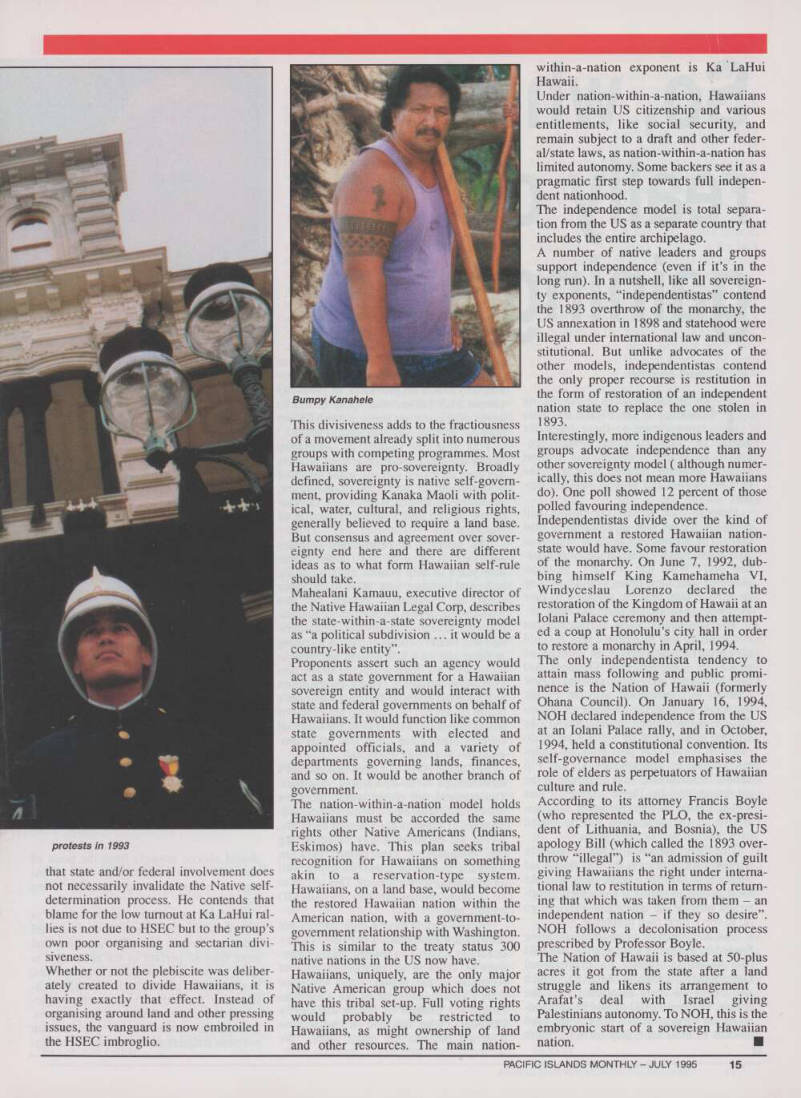
Bumpy Kanahele