and customs
pp. 57-58 · Read in the full issue
Yachting
Land of canoes and customs
By Sally Andrew
The arrival of a yacht at the island of Vao in north-eastern Malakula is an event that pushes the curiosity of local children to the limits. As if guided by some unseen force, they move into action, launch canoes, and paddle out en masse to welcome newcomers.
So we are barely anchored when an armada of children on canoes has us sur rounded. They are very curious about us and each brings a small gift - a few toma toes, a pawpaw or some mandarins or bananas.
“Attention le bateau! Watch the boat!”
In their excitement, some of the kids ram into our hull. When I remind them, gen tly, to be careful, they are. They hang onto the side of the boat with their fin gertips, outrigger outboard, and try not to scrape our sides. They can see I’m ner vous and they remind one another. I no longer have to fret.
Have they raided their family gardens?
I hope they won’t get into trouble. I accept each of their offerings, trying to communicate in Bislama and French.
Reciprocation is the hardest part, trying to come up with some small gift that is appropriate.
Sometimes the children have an idea of what they would like - a pen, some paper. Matches, cookies, candy, a few vatu, hair barrettes, soap. They must think we’re a floating store! An older boy with a hand of bananas asks for a “dee shirt”. I think he’s asking for dessert, but soon realise he wants a t-shirt! With the language barrier, we grope for words and
descriptions and eventually communi
cate.
Lacking a refrigerator, we eventually had to say “non, merci” to the budding entrepreneurs. The stream of eager traders dwindles off.
Next morning, a couple of coughs and soft whistles come from the side of the boat. I took my watch. Barely six ten. I get out of bed, throw on a sulu and a smile, and pop my head out the hatch. In the early morning light, I see that our vis itor is a middle-aged man in a canoe.
“Bonjour, monsieur. How are you?
On his way to the mainland to work his garden, he had stopped to see if we would like to purchase some seashells or
wood carvings. “Non, merci,” I answer and, with an “Allez, tata” he picks up his paddle and is off again. In Vanuatu, pad dling canoes are the primary method of local water transport. They are used, much like a bicycle, by men, women and children of all ages throughout the island group.
The “small islanders” of Vao have always used dugout canoes for daily trips to their mainland gardens and for fishing.
The trip in the morning is generally in light winds and in the direction of the prevailing trade winds. Coming back home at the end of the day, however, is
another story. Canoes loaded up with fresh produce don’t go well to windward and it is often a rough, wet ride.
Reinforced trade winds mean wet bums and bailers.
The inter island boat Kerulehi is anchored off the village when we row to shore. Immediately on landing, a gaggle of friendly kids surround us and help us pull our dinghy onto the white sand beach. Over 100 canoes park on the beach at Vao - a canoe parking lot!
An elder arranges for us to walk to the natsaro (ceremonial dancing area) with some of the older children. On the island
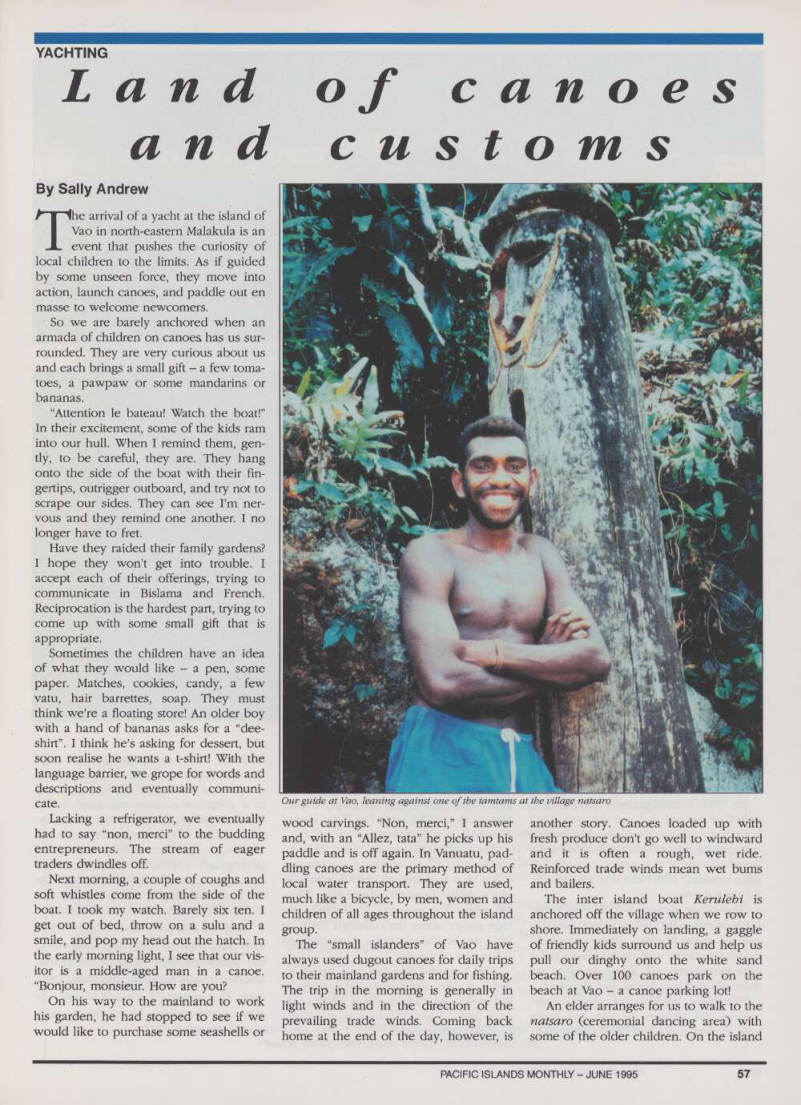
Our guide at Vao, leaning against one of the tamtams at the village natsaro
of Vao, some footpaths are for men only while others are reserved for women. A guide is mandatory.
In 1992, a teenager was appointed to escort us around and see that we didn’t breach any taboos. He allowed us to photograph the natsaro at Petehul. This year, however, one of our guides told me “No fotos missus!! when she saw my camera.
So I put it away.
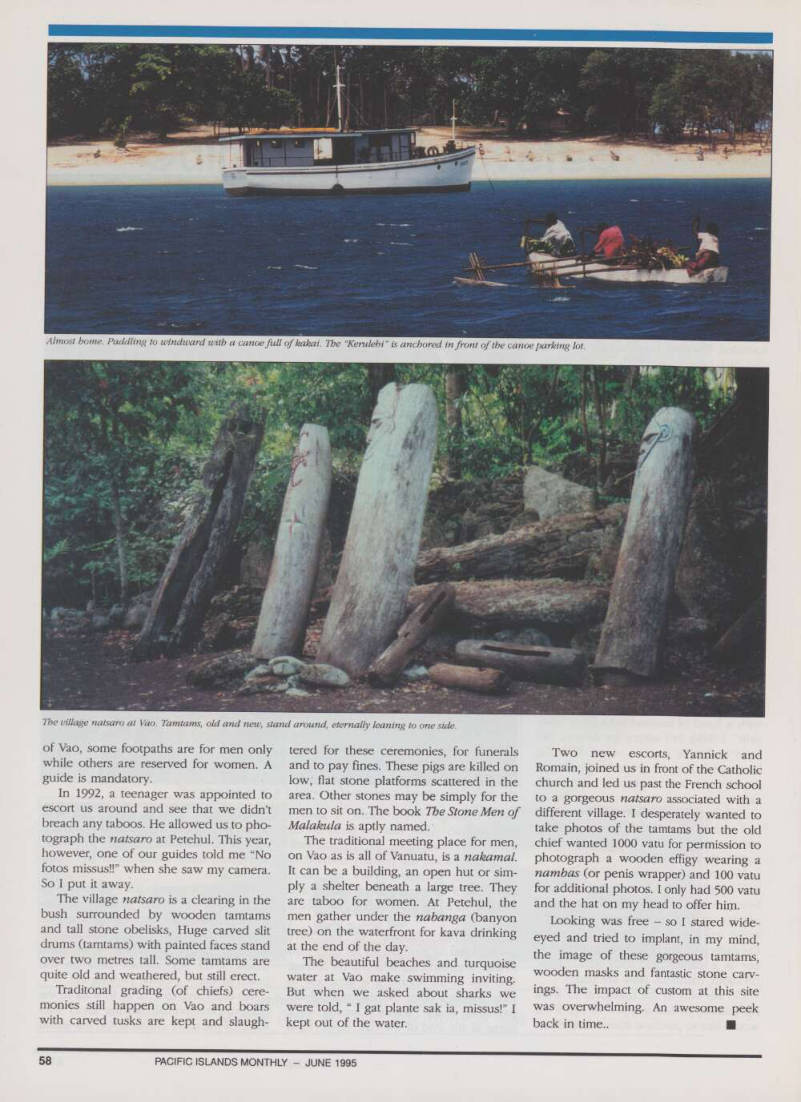
The village natsaro is a clearing in the bush surrounded by wooden tamtams and tall stone obelisks, Huge carved slit drums (tamtams) with painted faces stand over two metres tall. Some tamtams are quite old and weathered, but still erect.
Traditonal grading (of chiefs) ceremonies still happen on Vao and boars with carved tusks are kept and slaugh-
tered for these ceremonies, for funerals and to pay fines. These pigs are killed on low, flat stone platforms scattered in the area. Other stones may be simply for the men to sit on. The book The Stone Men of Malakula is aptly named.
The traditional meeting place for men, on Vao as is all of Vanuatu, is a nakamal.
It can be a building, an open hut or simply a shelter beneath a large tree. They are taboo for women. At Petehul, the men gather under the nabanga (banyon tree) on the waterfront for kava drinking at the end of the day.
The beautiful beaches and turquoise water at Vao make swimming inviting.
But when we asked about sharks we were told, “ I gat plante sak ia, missus!” I kept out of the water.
Two new escorts, Yannick and Romain, joined us in front of the Catholic church and led us past the French school to a gorgeous natsaro associated with a different village. I desperately wanted to take photos of the tamtams but the old chief wanted 1000 vatu for permission to photograph a wooden effigy wearing a nambas (or penis wrapper) and 100 vatu for additional photos. I only had 500 vatu and the hat on my head to offer him.
Looking was free - so I stared wide evefl j eyed and tried to tmplant, ,n my m.nd, thC image ° f theSe B or B eous tamtams, wooden masks and fantastic stone carv in 8 s - The impact of custom at this site was overwhelming. An awesome peek back in time.. ■
Almost home. Paddling to windward with a canoe full of kakai. The “Kerulehi” is anchored in front of the canoe parking lot.
The village natsaro at Vao. Tamtams, old and new, stand around, eternally leaning to one side.