kingdom
pp. 54-55 · Read in the full issue
Coup in the Sevens kingdom
atama raganivatu looks at how Tongan, Jonah Lomu displaced Fiji’s Waisale Serevi, the internationally acknowledged sevens master, in the Sevens arena.
The 1995 Hong Kong Sevens proved a sobering experience for Fijian rugby fans. Not only were Fiji, the pre-tournament favourites, beaten by New Zealand in the final but their idol, the universally acknowledged sevens master Waisale Serevi, was com
prehensively upstaged by
nineteen-year-old Tongan whose skill and power swept the Kiwis to victory. So awesome was Jonah Lomu’s display that media reports were almost universal in proclaiming “King Serevi is dead, long live King Lomu!”
Lomu had burst onto the international scene exactly a year earlier, apparently coming from nowhere to play an instru mental role in his team’s 1994 Hong Kong success. Yet, no observer of New Zealand schools sports would have been surprised by his almost instantaneous fame. Lomu was an exceptional performer in colle giate sports, excelling in athletics (many believe he had the potential to become a world class decathlete) as well as rugby union. Under his leadership, Wesley College won national titles in both the sevens and the fifteen-a-side versions of the game. He shone for New Zealand’s under 17XV when playing against their Australian and English counterparts.
Lomu was voted the Auckland Young Sportsman of the Year in 1993.
However, it was early in the following year and after leaving Wesley that he first made the sporting headlines. Any teenag er who stands 1.96 metres tall, weighs 118 kilograms and runs 100 metres in 10.8 seconds is bound to attract attention.
Lomu certainly did that at the national sevens tournament while helping his
team, Countries, win the title (scoring three tries in the final) and winning him self a place in the New Zealand team for Hong Kong.
Immediately after the first trip to the Crown Colony, Lomu found himself inun dated with offers from several prominent rugby league clubs and American “grid iron” football teams.
He was even approached by an
Australian professional beach volleyball
organisation.
The New Zealand media quickly recognised him as the nation’s flavour of the month. In quick succession, the Kiwi public learnt through television and mag azine features that Lomu’s favourite meal was taro flavoured with corned beef, he had a liking for Elvis Presley music and his girlfriend was named Alain.
Amazingly, all this occurred before Lomu had played a single game of senior rugby.
It was the fear of losing him to rugby league that prompted the New Zealand national rugby union selectors to name Lomu in their team to face France in the opening test of the 1994 season, even though he still only had a handful of first class games under his belt.
Forty two days after his 19th birthday, Lomu became the youngest ever Ail Black and the first Tongan to represent the world’s most illustrious rugby team.
Playing in the unaccustomed left wing position (he was a loose forward throughout his schoolboy rugby career), Lomu failed to make an impact against the rampant French, who gained their first series win in New Zealand, and was dropped after just two matches.
Returning to inter-provincial rugby, he experienced a mixed 1994 domestic cam
paign with the inconsistent Counties and, after indifferent performances at the national and Fijian sevens tournament early this year, questions were asked about his prowess in the abbreviated game too. However, Lomu erased doubts on that score in the most emphatic man- Greatly aided by his amazing physical attributes, Lomu’s foremost asset on the field is an almost freakish ability to main tain balance even in (he mfist ferocious of tackles and break defensive lines. His most obvious weaknesses are a naivete in reading the “flow” of the game and inde cisiveness when tackling. Both flaws should be rectified with experience, par ■ ■ v •* - 1 I ticularly if he maintains his hunger for improvement.
Not requiring any improvement is Lomu’s manner off the field. Always cour teous (it is not unusual for him to spend over half an hour signing autographs after a game), unpretentious and obviously sincere in his Christian beliefs, he impresses all with a down to earth atti tude. A large extended Tongan family keep his feet firmly on the ground, as do memories of the humble south Auckland dynamic display in the All Black trial on April 29 earned him a place in the 26 men New Zealand squad for the World Cup, which started on May 25. And so, he will soon be unleashed onto a largely unsus pecting rugby world.
Sadly for rugby supporters in the Pacific islands, Lomu will be wearing the black of New Zealand rather than the red of Tonga in South Africa. When quizzed two years ago on the possibility of him
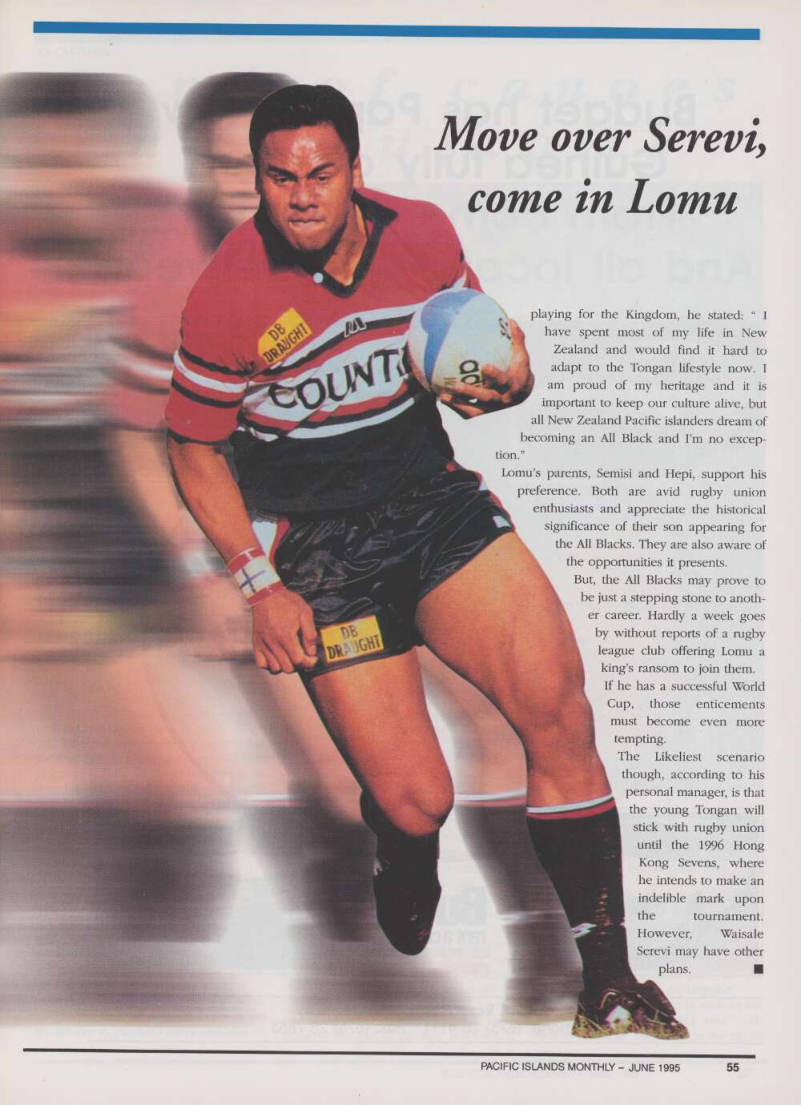
Move over Serevi, come in Lomu
r playing for the Kingdom, he stated: “ I V \ have spent most of my life in New \ Zealand and would find it hard to a<^a P t to the Tongan lifestyle now. I HHH am proud of my heritage and it is Wgfr important to keep our culture alive, but all New Zealand Pacific islanders dream of becoming an All Black and I’m no excep tion.”
Lomu’s parents, Semisi and Hepi, support his preference. Both are avid rugby union |k enthusiasts and appreciate the historical significance of their son appearing for the All Blacks. They are also aware of \ the opportunities it presents.
But, the All Blacks may prove to kbe just a stepping stone to anoth er career. Hardly a week goes 5 by without reports of a rugby league club offering Lomu a H king’s ransom to join them.
If he has a successful World A.A Cup, those enticements must become even more tempting.
The Likeliest scenario though, according to his personal manager, is that W." ** lc young Tongan will B Nick with rugby union ■ until the 1996 Hong Kong Sevens, where ' \'. T : ' ■ he intends to make an k a- indelible mark upon ■ the tournament.
Hk However > Waisale
■ Serevi may have other * ■' ‘ plans. ■