In the name of nature
pp. 22-23 · Read in the full issue
Environment
By David North
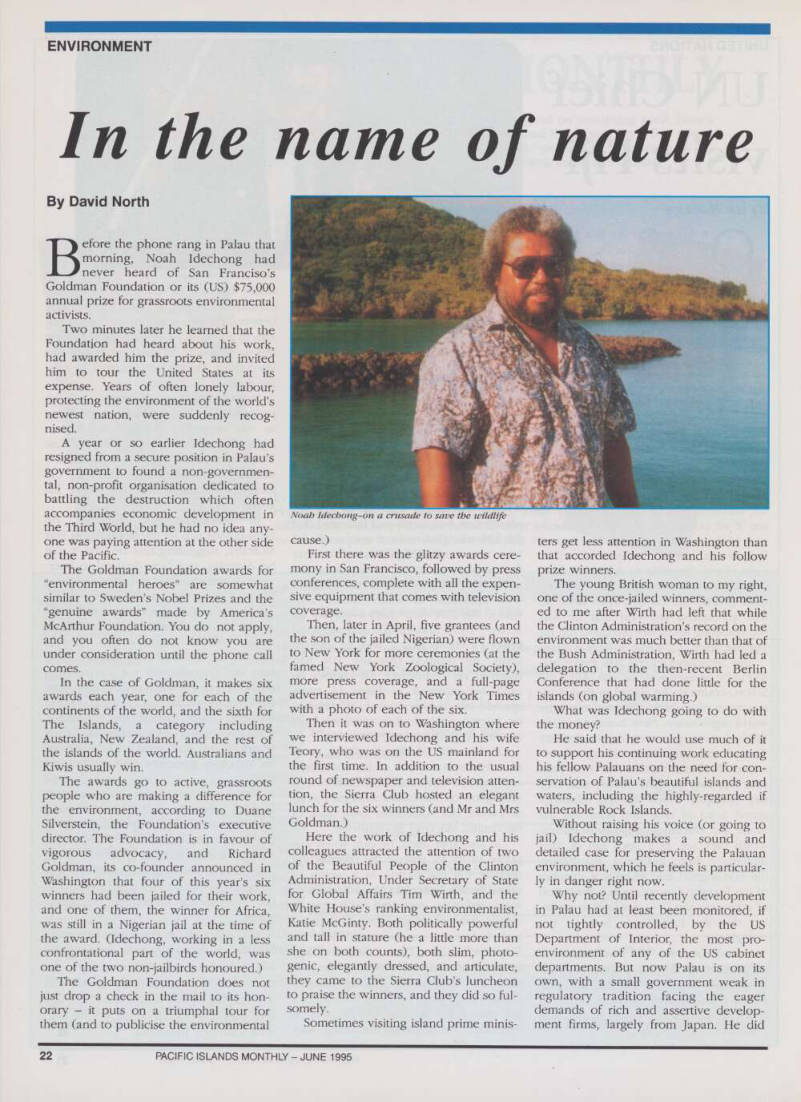
Before the phone rang in Palau that morning, Noah Idechong had never heard of San Franciso’s Goldman Foundation or its (US) $75,000 annual prize for grassroots environmental activists.
Two minutes later he learned that the Foundation had heard about his work, had awarded him the prize, and invited him to tour the United States at its expense. Years of often lonely labour, protecting the environment of the world’s newest nation, were suddenly recog nised.
A year or so earlier Idechong had resigned from a secure position in Palau’s government to found a non-governmen tal, non-profit organisation dedicated to battling the destruction which often accompanies economic development in the Third World, but he had no idea any one was paying attention at the other side of the Pacific.
The Goldman Foundation awards for “environmental heroes” are somewhat similar to Sweden’s Nobel Prizes and the “genuine awards” made by America’s McArthur Foundation. You do not apply, and you often do not know you are under consideration until the phone call comes.
In the case of Goldman, it makes six awards each year, one for each of the continents of the world, and the sixth for The Islands, a category including Australia, New Zealand, and the rest of the islands of the world. Australians and Kiwis usually win.
The awards go to active, grassroots people who are making a difference for the environment, according to Duane Silverstein, the Foundation’s executive director. The Foundation is in favour of vigorous advocacy, and Richard Goldman, its co-founder announced in Washington that four of this year’s six winners had been jailed for their work, and one of them, the winner for Africa, was still in a Nigerian jail at the time of the award. (Idechong, working in a less confrontational part of the world, was one of the two non-jailbirds honoured.) The Goldman Foundation does not just drop a check in the mail to its hon orary - it puts on a triumphal tour for them (and to publicise the environmental
cause.) First there was the glitzy awards cere mony in San Francisco, followed by press conferences, complete with all the expen sive equipment that comes with television coverage.
Then, later in April, five grantees (and the son of the jailed Nigerian) were flown to New York for more ceremonies (at the famed New York Zoological Society), more press coverage, and a full-page advertisement in the New York Times with a photo of each of the six.
Then it was on to Washington where we interviewed Idechong and his wife Teory, who was on the US mainland for the first time. In addition to the usual round of newspaper and television atten tion, the Sierra Club hosted an elegant lunch for the six winners (and Mr and Mrs Goldman.) Here the work of Idechong and his colleagues attracted the attention of two of the Beautiful People of the Clinton Administration, Under Secretary of State for Global Affairs Tim Wirth, and the White House’s ranking environmentalist, Katie McGinty. Both politically powerful and tall in stature (he a little more than she on both counts), both slim, photo genic, elegantly dressed, and articulate, they came to the Sierra Club’s luncheon to praise the winners, and they did so ful somely.
Sometimes visiting island prime minis
ters get less attention in Washington than that accorded Idechong and his follow prize winners.
The young British woman to my right, one of the once-jailed winners, comment ed to me after Wirth had left that while the Clinton Administration’s record on the environment was much better than that of the Bush Administration, Wirth had led a delegation to the then-recent Berlin Conference that had done little for the islands (on global warming.) What was Idechong going to do with the money?
He said that he would use much of it to support his continuing work educating his fellow Palauans on the need for con servation of Palau’s beautiful islands and waters, including the highly-regarded if vulnerable Rock Islands.
Without raising his voice (or going to jail) Idechong makes a sound and detailed case for preserving the Palauan environment, which he feels is particular ly in danger right now.
Why not? Until recently development in Palau had at least been monitored, if not tightly controlled, by the US Department of Interior, the most pro environment of any of the US cabinet departments. But now Palau is on its own, with a small government weak in regulatory tradition facing the eager demands of rich and assertive develop ment firms, largely from Japan. He did
Noah Idechong-on a crusade to save the wildlife
not need to spell out to me that under similar circumstances, elsewhere in the Pacific, that rain-forests disappeared, and pollution and erosion took their place.
Idechong has a particular interest and knowledge about the maritime environ ment. (While working for the Government of Palau he had, among other things, supervised the highly suc cessful giant clam seedlings project, which has spread this potential source of food and cash income to most of the island groups of the Pacific.) “You know those fish that you see swimming in tanks in fancy restaurants in Hong Kong and Taiwan?” he asked. “The customer picks out the one he wants, and then it is cooked for him.”
I said I had not noticed them, but in the States there are sometimes lobsters in restaurant tanks awaiting similar fates.
He then told me how some Indonesian fishermen spread cyanide in the water to stun the fish, so that they can be captured alive.
“Doesn’t that poison the customer in Hong Kong?” I asked.
“For the fish it is a mild dose, he is just stunned” he replied, “but the chemical kills lots of other living things.”
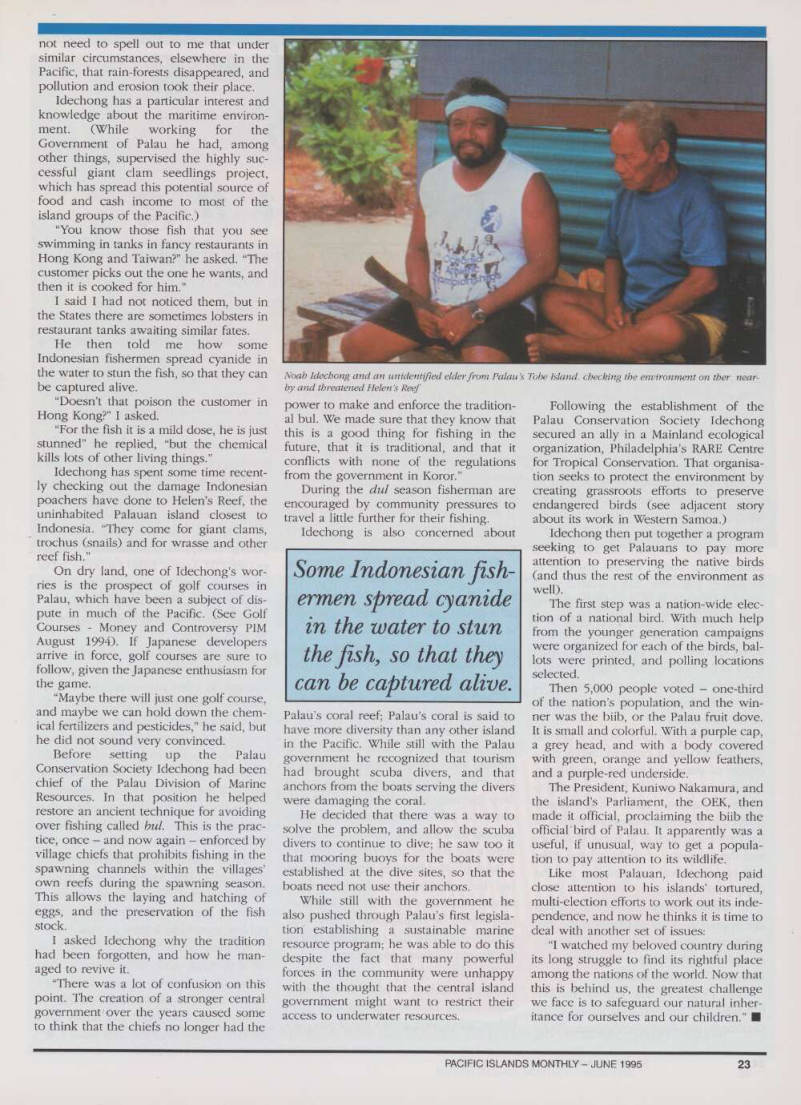
Idechong has spent some time recent ly checking out the damage Indonesian poachers have done to Helen’s Reef, the uninhabited Palauan island closest to Indonesia. “They come for giant clams, trochus (snails) and for wrasse and other reef fish.”
On dry land, one of Idechong’s wor ries is the prospect of golf courses in Palau, which have been a subject of dis pute in much of the Pacific. (See Golf Courses - Money and Controversy PIM August 1994). If Japanese developers arrive in force, golf courses are sure to follow, given the Japanese enthusiasm for the game.
“Maybe there will just one golf course, and maybe we can hold down the chem ical fertilizers and pesticides,” he said, but he did not sound very convinced.
Before setting up the Palau Conservation Society Idechong had been chief of the Palau Division of Marine Resources. In that position he helped restore an ancient technique for avoiding over fishing called bul. This is the prac tice, once - and now again - enforced by village chiefs that prohibits fishing in the spawning channels within the villages’ own reefs during the spawning season.
This allows the laying and hatching of eggs, and the preservation of the fish stock.
I asked Idechong why the tradition had been forgotten, and how he man aged to revive it.
“There was a lot of confusion on this point. The creation of a stronger central government over the years caused some to think that the chiefs no longer had the
power to make and enforce the tradition al bul. We made sure that they know that this is a good thing for fishing in the future, that it is traditional, and that it conflicts with none of the regulations from the government in Koror.”
During the dul season fisherman are encouraged by community pressures to travel a little further for their fishing.
Idechong is also concerned about
Some Indonesian fish
ermen spread cyanide
in the water to stun the fish , so that they can be captured alive.
Palau’s coral reef; Palau’s coral is said to have more diversity than any other island in the Pacific. While still with the Palau government he recognized that tourism had brought scuba divers, and that anchors from the boats serving the divers were damaging the coral.
He decided that there was a way to solve the problem, and allow the scuba divers to continue to dive; he saw too it that mooring buoys for the boats were established at the dive sites, so that the boats need not use their anchors.
While still with the government he also pushed through Palau’s first legisla tion establishing a sustainable marine resource program; he was able to do this despite the fact that many powerful forces in the community were unhappy with the thought that the central island government might want to restrict their access to underwater resources.
Following the establishment of the Palau Conservation Society Idechong secured an ally in a Mainland ecological organization, Philadelphia’s RARE Centre for Tropical Conservation. That organisa tion seeks to protect the environment by creating grassroots efforts to preserve endangered birds (see adjacent story about its work in Western Samoa.) Idechong then put together a program seeking to get Palauans to pay more attention to preserving the native birds (and thus the rest of the environment as well).
The first step was a nation-wide elec tion of a national bird. With much help from the younger generation campaigns were organized for each of the birds, bal lots were printed, and polling locations selected.
Then 5,000 people voted - one-third of the nation’s population, and the win ner was the biib, or the Palau fruit dove.
It is small and colorful. With a purple cap, a grey head, and with a body covered with green, orange and yellow feathers, and a purple-red underside.
The President, Kuniwo Nakamura, and the island’s Parliament, the OEK, then made it official, proclaiming the biib the official bird of Palau. It apparently was a useful, if unusual, way to get a popula tion to pay attention to its wildlife.
Like most Palauan, Idechong paid close attention to his islands’ tortured, multi-election efforts to work out its inde pendence, and now he thinks it is time to deal with another set of issues: “I watched my beloved country during its long struggle to find its rightful place among the nations of the world. Now that this is behind us, the greatest challenge we face is to safeguard our natural inher itance for ourselves and our children.” ■
Noah Idechong and an unidentified elder from Palau’s Tobe Island, checking the environment on ther near by and threatened Helen’s Reef