visits Fiji
p. 21 · Read in the full issue
United Nations
UN Chief visits Fiji
By Ian Williams
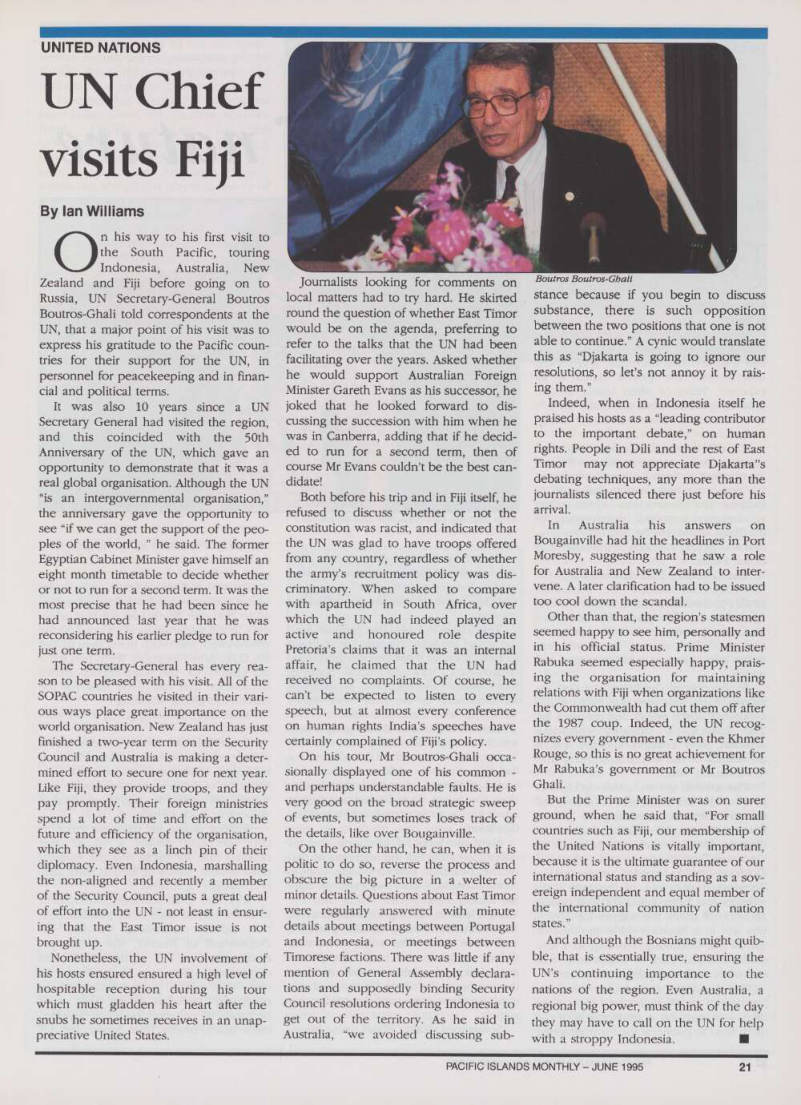
On his way to his first visit to the South Pacific, touring Indonesia, Australia, New Zealand and Fiji before going on to Russia, UN Secretary-General Boutros Boutros-Ghali told correspondents at the UN, that a major point of his visit was to express his gratitude to the Pacific coun tries for their support for the UN, in personnel for peacekeeping and in finan cial and political terms.
It was also 10 years since a UN Secretary General had visited the region, and this coincided with the 50th Anniversary of the UN, which gave an opportunity to demonstrate that it was a real global organisation. Although the UN “is an intergovernmental organisation,” the anniversary gave the opportunity to see “if we can get the support of the peo ples of the world, ” he said. The former Egyptian Cabinet Minister gave himself an eight month timetable to decide whether or not to run for a second term. It was the most precise that he had been since he had announced last year that he was reconsidering his earlier pledge to run for just one term.
The Secretary-General has every rea son to be pleased with his visit. All of the SOPAC countries he visited in their vari ous ways place great importance on the world organisation. New Zealand has just finished a two-year term on the Security Council and Australia is making a deter mined effort to secure one for next year.
Like Fiji, they provide troops, and they pay promptly. Their foreign ministries spend a lot of time and effort on the future and efficiency of the organisation, which they see as a linch pin of their
diplomacy. Even Indonesia, marshalling
the non-aligned and recently a member of the Security Council, puts a great deal of effort into the UN - not least in ensur ing that the East Timor issue is not
brought up.
Nonetheless, the UN involvement of his hosts ensured ensured a high level of hospitable reception during his tour which must gladden his heart after the snubs he sometimes receives in an unap preciative United States.
Journalists looking for comments on local matters had to try hard. He skirted round the question of whether East Timor would be on the agenda, preferring to refer to the talks that the UN had been facilitating over the years. Asked whether he would support Australian Foreign Minister Gareth Evans as his successor, he joked that he looked forward to dis cussing the succession with him when he was in Canberra, adding that if he decid ed to run for a second term, then of course Mr Evans couldn’t be the best can didate!
Both before his trip and in Fiji itself, he refused to discuss whether or not the constitution was racist, and indicated that the UN was glad to have troops offered from any country, regardless of whether the army’s recruitment policy was dis criminatory. When asked to compare with apartheid in South Africa, over which the UN had indeed played an active and honoured role despite Pretoria’s claims that it was an internal affair, he claimed that the UN had received no complaints. Of course, he can’t be expected to listen to every speech, but at almost every conference on human rights India’s speeches have certainly complained of Fiji’s policy.
On his tour, Mr Boutros-Ghali occa sionally displayed one of his common and perhaps understandable faults. He is very good on the broad strategic sweep of events, but sometimes loses track of the details, like over Bougainville.
On the other hand, he can, when it is politic to do so, reverse the process and obscure the big picture in a welter of minor details. Questions about East Timor were regularly answered with minute details about meetings between Portugal and Indonesia, or meetings between Timorese factions. There was little if any mention of General Assembly declara tions and supposedly binding Security Council resolutions ordering Indonesia to get out of the territory. As he said in Australia, “we avoided discussing sub
stance because if you begin to discuss substance, there is such opposition between the two positions that one is not able to continue.” A cynic would translate this as “Djakarta i|S going to ignore our resolutions, so let’s not annoy it by rais ing them.”
Indeed, when in Indonesia itself he praised his hosts as a “leading contributor to the important debate,” on human rights. People in Dili and the rest of East Timor may not appreciate Djakarta”s debating techniques, any more than the journalists silenced there just before his arrival.
In Australia his answers on Bougainville had hit the headlines in Port Moresby, suggesting that he saw a role for Australia and New Zealand to inter vene. A later clarification had to be issued too cool down the scandal.
Other than that, the region’s statesmen seemed happy to see him, personally and in his official status. Prime Minister Rabuka seemed especially happy, prais ing the organisation for maintaining relations with Fiji when organizations like the Commonwealth had cut them off after the 1987 coup. Indeed, the UN recog nizes every government - even the Khmer Rouge, so this is no great achievement for Mr Rabuka’s government or Mr Boutros Ghali.
But the Prime Minister was on surer ground, when he said that, “For small countries such as Fiji, our membership of the United Nations is vitally important, because it is the ultimate guarantee of our international status and standing as a sov ereign independent and equal member of the international community of nation states.”
And although the Bosnians might quib ble, that is essentially true, ensuring the UN’s continuing importance to the nations of the region. Even Australia, a regional big power, must think of the day they may have to call on the UN for help with a stroppy Indonesia. ■
Boutros Boutros-Ghali