No nukes is good nukes
pp. 17-18 · Read in the full issue
By Ian Williams
In three weeks of unprecedented intense discussions at the UN in New York, the Pacific has achieved some major concessions on clearing up nuclear test sites, enforcing the Treaty of Raratonga, and on transit of nuclear mate rials.
The occasion for these diplomatic suc cesses is the 25-year review of the Nuclear Non Proliferation Treaty. In the 1960’5, as China and France joined the nuclear club, prophets looked forward gloomily to the end of the century, antic ipating possibly dozens of countries with nuclear arsenals. It was an even more frightening prospect than the uneasy sta bility of mutually assured destruction, appropriately acronymed MAD, on which the US/Soviet arms race was based.
Hence the NPT, valid for twenty five years, which represented an unprece dented degree of cooperation between the nuclear powers. In one sense, how ever, such collaboration was hardly surprising since the NPT established a cosy club of the five nuclear powers, Britain, China, France, the USA and the USSR, which were the only countries allowed to retain nuclear weapons.
In return, they were supposed to take steps to disarm themselves, and to ensure that peaceful nuclear technology was available to all other signatories. They did not, and this mandatory 25-year review gave all the other 170-plus signatories the chance to complain about the nuclear weapons states’ lack of progress. Far from disarming during the Reagan era both the USA and Soviet Union vastly increased their arsenals. They even had an example to cite, since South Africa had voluntarily abandoned its nuclear weapons.
The weapon of choice for ihe have nets at the Review conference has been the issue of how long the treaty should be renewed for - five years, twenty five years, or indefinitely. The nuclear nations and most of the developed world wanted it extended indefinitely, and the roasting they were getting from the non-aligned nations probably reinforced their deter mination to twist arms in the corridors to secure votes. The US alone and half a dozen cruising the corridors applying pressure." complained one Pacific diplo mat, "But they didn't always know who was doing what. I was approached by several different guys in one day, And then there were the Canadians and the others!”
The American zeal for everyone to sign on for an indefinite extension did not however meet with universal approval. Washington's moral pressure on Russia not to supply nuclear reactors to Iran, a signatory of the treaty, was somewhat diminished by the absolute
refusal of the Clinton administration to exert the faintest pressure on Israel.
Protected by its strong lobby in Washington, Israel is the treaty’s biggest failure, a non-signatory with an unde clared arsenal of around two hundred nuclear devices. Hence the unhappiness of Egypt and other Arab and non-aligned states with an indefinite, unconditional renewal.
The industrialised countries were determined that the treaty would be essentially unchanged and that any con cessions that were wrested from a reluctant North would not be in it, or attached to it. Anything they agreed would not be conditions or small print, they assured, as others cast around for words to describe what the Conference Report recommendations would be.
“Sweeteners” or “Desiderata” were two semi-facetious suggestions. Despite the denials of connections, it is clear that the final vote of many states on whether to renew the treaty or not, will depend on what is agreed in the recommendations,
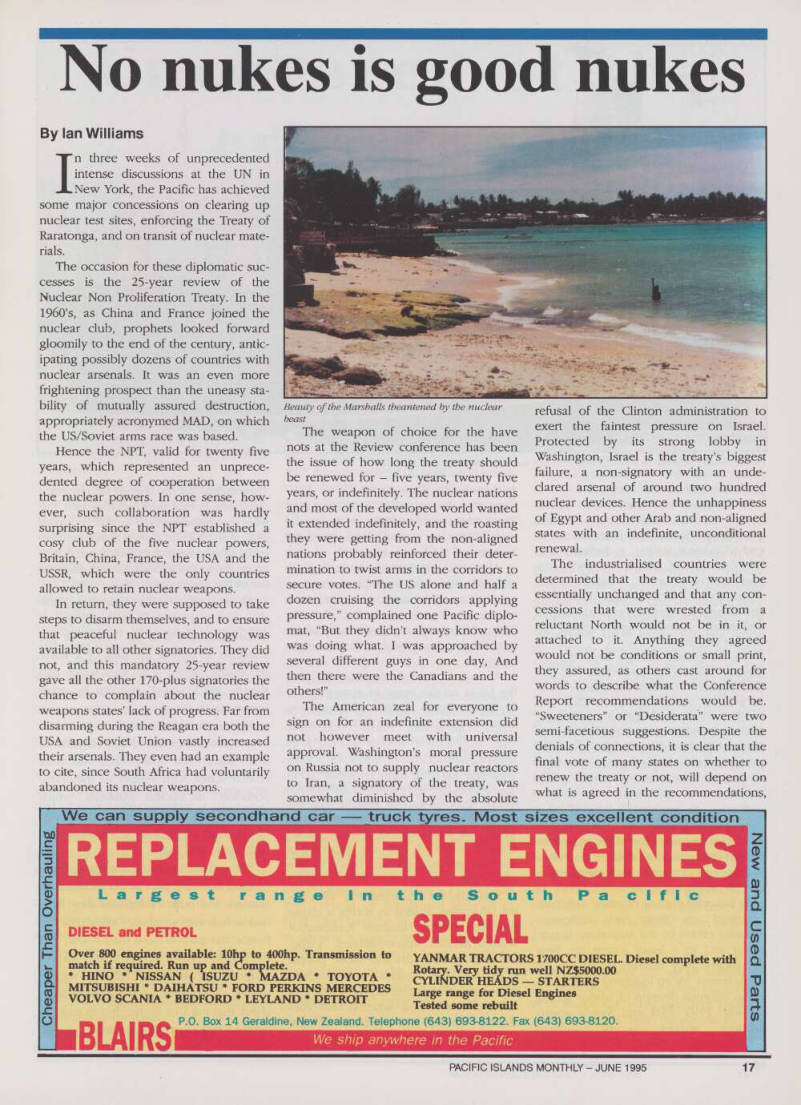
Beauty of the Marshalls theantened by the nuclear beast
just what “sweeteners” they get.
Other states want variously or collec tively, among other things, a firm commitment to nuclear disarmament, an end to nuclear testing, a declaration of “No first use” of nuclear weapons, sup port for non-nuclear weapons states when attacked, Israel to sign to the treaty and disarm, an end to the production of fissionable materials and support for nuclear free zones.
To complicate matters, until the last minute, the voting procedure had not been agreed on. Many delegations want ed a secret, rather than open vote. This would not only make all the arm-twisting in vain, it would make it counterproduc tive. Delegations at UN conferences have a long traditions of getting their own back for undue pressure in the secrecy of the ballot.
Fishing in troubled waters is what many Pacific islanders do for a living, so it is pleasant to note their diplomats proved rather good at it. Since no Pacific islands have declared the slightest inten tion of acquiring nuclear weaponry or even peaceful nuclear reactors, they con centrated on their own concerns.
Resisting efforts by the Australians in par ticular and to a lesser extent the New Zealanders, they refused to be just an amen corner for an indefinite extension.
An informal division of labour sprang up with PNG, FSM and Samoa spear heading moves against nuclear
transportation. New Zealand and PNG went after the South Pacific Nuclear Free Zone while the Marshalls, as befits the main US nuclear testing site, pursued the question of aid for the clear up.
After their initial shock, the Australians and New Zealanders joined in, enough to erase some of the resentment that many of the island delegations felt after the Berlin Global Climate conference, where they felt let down by their larger neigh bours.
As a result, Pacific delegations feel that the US is on the verge of accepting the Raratonga South Pacific Nuclear Free Zone in which case the UK will certainly follow, which increases the chances of France. That in turn would allow the Marshalls, FSM and Palau to emerge from the nuclear defence umbrella that the US forced over them, and also to sign the treaty. That likelihood was enhanced when US Secretary of Energy Hazel O’Leary indicated that she expected a compete nuclear test ban treaty by the end of the year.
Similarly, the US delegation, after ini tial reluctance, agreed to accept a clause proposed by the Marshalls Ambassador Wilfred Kendall, acknowledging “a spe cial responsibility towards those people of former United Nations Trust Territories who have been adversely affected as a result of the nuclear weapon tests con ducted during the period of the
Trusteeship.” In his speech he reminded delegates, in case they had forgotten, just what the clause referred to, that “between 1946 and 1958 the United. States detonat ed 66 atomic weapons of immense power on or above atolls located in the northern tier of the Marshall Islands.”
There is of course a domestic dimen sion to this. If aid is forthcoming, then it means that there is no need for the Marshalls to pursue the idea of a waste processing facility - an idea which had already led to much concern by other Forum states.
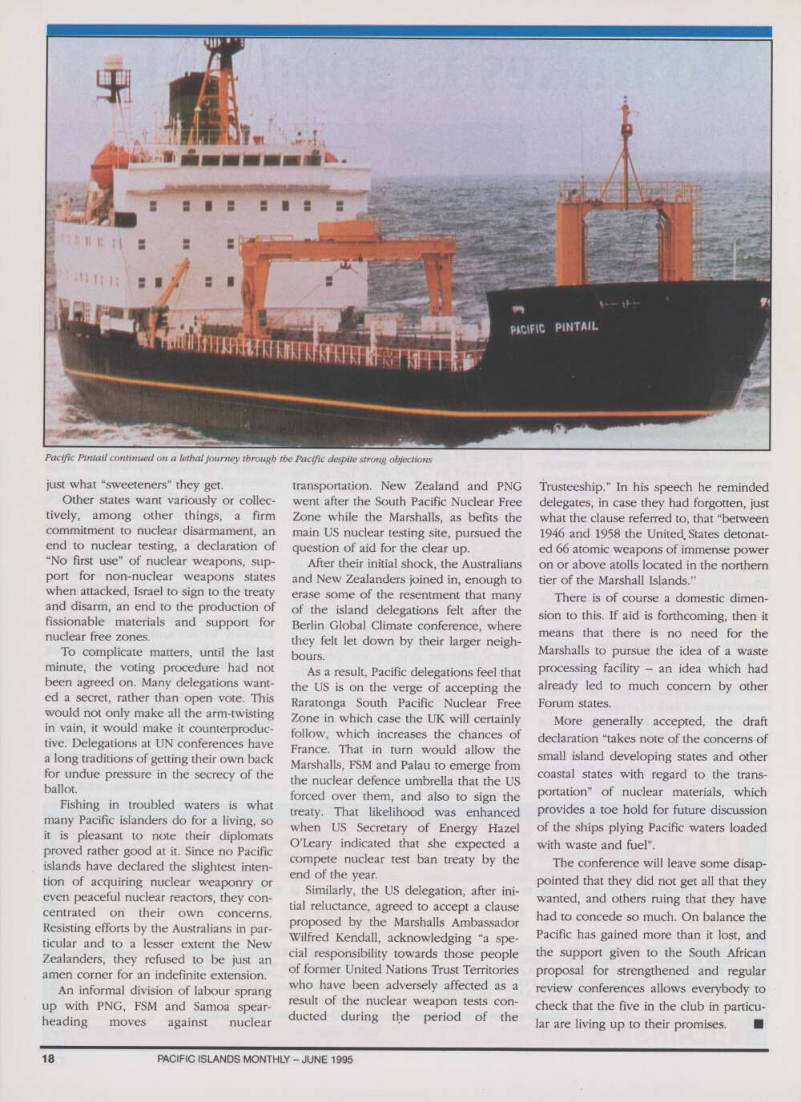
More generally accepted, the draft declaration “takes note of the concerns of small island developing states and other coastal states with regard to the trans portation” of nuclear materials, which provides a toe hold for future discussion of the ships plying Pacific waters loaded with waste and fuel”.
The conference will leave some disap pointed that they did not get all that they wanted, and others ruing that they have had to concede so much. On balance the Pacific has gained more than it lost, and the support given to the South African
proposal for strengthened and regular
review conferences allows everybody to check that the five in the club in particu lar are living up to their promises. ■
Pacific Pintail continued on a lethal journey through the Pacific despite strong objections