sheer madness
pp. 15-16 · Read in the full issue
Cover Stories
Commercial sense or sheer madness
The Marshallese government says the proposal to store nuclear waste on its contaminated islands is turning a bad situation to its advantage, Greenpeace says the proposal is flawed and lethal, YUNUS RASHID reports the pros and
cons of the proposal.
It would have been a safe bet sev eral years ago to say that nobody in the world wanted to do anything with nuclear waste - least of all people who have had first-hand experience of radiation.
Incredible as it may seem, the Marshallese government is proposing to do just that - store nuclear waste on its remote islands endangering, if not in the near future than at least 10,000 years down the lane, the entire Pacific with radioactive contamination.
The Marshall Islands are no newcom er to the “nuclear age”. Its population understands more than most the long term problems associated with radioactivity. During the 1940 s and 50s, while the Marshall Islands were adminis tered as a UN Strategic Trust Territory, the United States conducted 67 atmospheric nuclear tests there, including the Bravo test in 1954, which contaminated many of the inhabited atolls with radiation.
In 1994, releases of classified informa tion about the test programme in the Marshalls, confirmed that not only has the United States of America been lying for 40 years about the extent of the contami nation but that the US deliberately exposed the Marshallese people to radia tion as part of a medical experiment code-named “Project 4.1” (PIM April 1994).
The Marshallese government is sug gesting that the proposal allows them to make the best use of a bad situation, given the remoteness of their islands; the island’s geological stability; the already contaminated state of many islands; and the unsatisfactory attempts to clean up that contamination.
But, while the short-term economic imperative which has driven the Marshalls to consider offering itself as a nuclear waste dump may be understand
able, it makes no sense in the longer term - or in environmental and economic terms - to take such a risk.
Why the proposal does not make sense is explained in a report compiled by Greenpeace about the repercussions of such a plan.
The report says the scheme is flawed for various reasons and one of them is that it suggests: “A solution to this nuclear challenge may lie in the Republic of the Marshall Islands. The Marshallese Government has indicated a willingness for one or more of the country’s many remote, uninhabitable islands to be con sidered for long-term storage and permanent disposal of surplus nuclear materials, spent fuel and other highly radioactive substances...”
The flaw in this statement, the report says, is that to suggest that providing a single storage facility in the Marshall Islands is going to solve the global prob lem of nuclear waste defies current experience. It is clear that the only long term solution to the problem is an end to the generation of nuclear waste.
The current stockpiles of waste should be stored above ground, preferably on the site where the waste is generated and where it can be monitored and if neces sary, retrieved. While there is no international consensus on how to dis pose of waste, there should be no move to create new “sacrifice” areas.
If the nuclear industry can assume that its waste problem is solved by shifting the problem to a second country, the incen tive and responsibility to reduce the amount of nuclear waste generated will
disappear.
A related problem is that of trans portation. The report says the country’s bid in fact exacerbates many of the risks involved in current radioactive waste management, because of the much
greater handling anid transportation need ed. The risks involved in transporting such materials in economic, environmen tal and political terms have not been fully or adequately considered.
The second flaw is that the proposal states that, “These island formations, which descend 18,000 feet into the abyssal depths of the ocean, are consid ered geologically stable”.
The Greenpeace report says this notion, while true fails to consider that fact that a lot of waste considered for storage has half-lives (technical term for the rate of decay of radiactivity) beyond 10,000 years. It says that stability of any geological formation cannot be guaran teed for that long. In support of its argument, Greenpeace quoted American scientists Doctor Bowman and Doctor Venri, who have expressed strong oppo sition to geologic disposal of nuclear wastes. Their concern was based on the fact that as the containers holding the waste dissolve long before the wastes become inert, the waste can react and detonate.
Yet another concern is that while the bureaucratic words “closely monitored” will be applied to the dump site, the problem with it is that the monitoring will tell when the leak has occurred and not when the leak would occur.
Whether the Republic of Marshall Islands can use one or more of its nudear-damaged islands as a long-term storage and permanent disposal site for spent'nuclear fuel or high-level radioac tive waste raises significant legal and
policy questions. Binding obligations
under regional and broader multilateral treaties, the requirements of US legisla tion and emerging principles of international law and policy all combine to cast serious doubt on the legal accept ability of the proposal.
Greenpeace says that two internation al treaties may bear directly on any proposal for storage or disposal of nuclear waste in the Marshalls: the Convention for the Protection of the Natural Resources and Environment of the South Pacific Region, opened for sig nature on November 25, 1986, and the Basel Convention on the Control of Transboundary Movements of Hazardous Wastes and their Disposal, opened for signature on March 22, 1989. The former would seem to ban such a proposal alto gether, while the latter at least casts doubt on its viability.
The proposal to store or dispose of spent nuclear fuel and high-level radioac tive waste in the Marshall Islands is fundamentally inconsistent with four emerging consensus principles of both a global and regional nature related to the need to protect the marine environment and the environment of small island nations from pollution generated by the industrialised world. First, it is improper for industrialised countries to use devel oping countries as the garbage dump for their nuclear waste. Second, low-lying atolls such as those in the Marshall Islands are not suitable for storage or dis posal because they are an integral, ecological component of the oceans and the marine environment. Third, given the major uncertainties about the safety of
waste management generally, application
of the precautionary approach should preclude the assumption of major nuclear waste storage and disposal responsibili ties in small, developing countries.
Fourth, in the South Pacific region, in par ticular, the creation of an environment free from radiation hazards is an objective that must be respected. The Marshall Islands proposal cannot stand in light of the near universal international agree ment on these principles.
But there is more to why the Marshallese government is wrong.
The Marshall Islands was the first country in the Pacific to alert the interna tional community to the impact of climate change on low-lying islands. It is there fore ironic that the same country is now ignoring its own warnings of sea level rise and increased storm activity in pur suit of the proposal for a nuclear waste
dump.
In May 1990 the world’s climate scien tists sounded a warning about the impact of global climate change unless emissions of greenhouse gases into the atmosphere were drastically cut.
The Marshall Islands would be one of the first countries seriously affected if, as the Intergovernmental Panel on Climate Change (A UN appointed body set in 1988) predicted, sea levels will rise. The highest point on its atolls is just 10 metres above sea level. A 50 metre rise in sea level would make the Marshall Islands uninhabitable, the 1994 Barbados confer ence of Small Island States was told by the Marshall Islands government.
Given the IPCC warnings, the storage of nuclear wastes cannot be guaranteed under these climate scenarios, says Greenpeace.
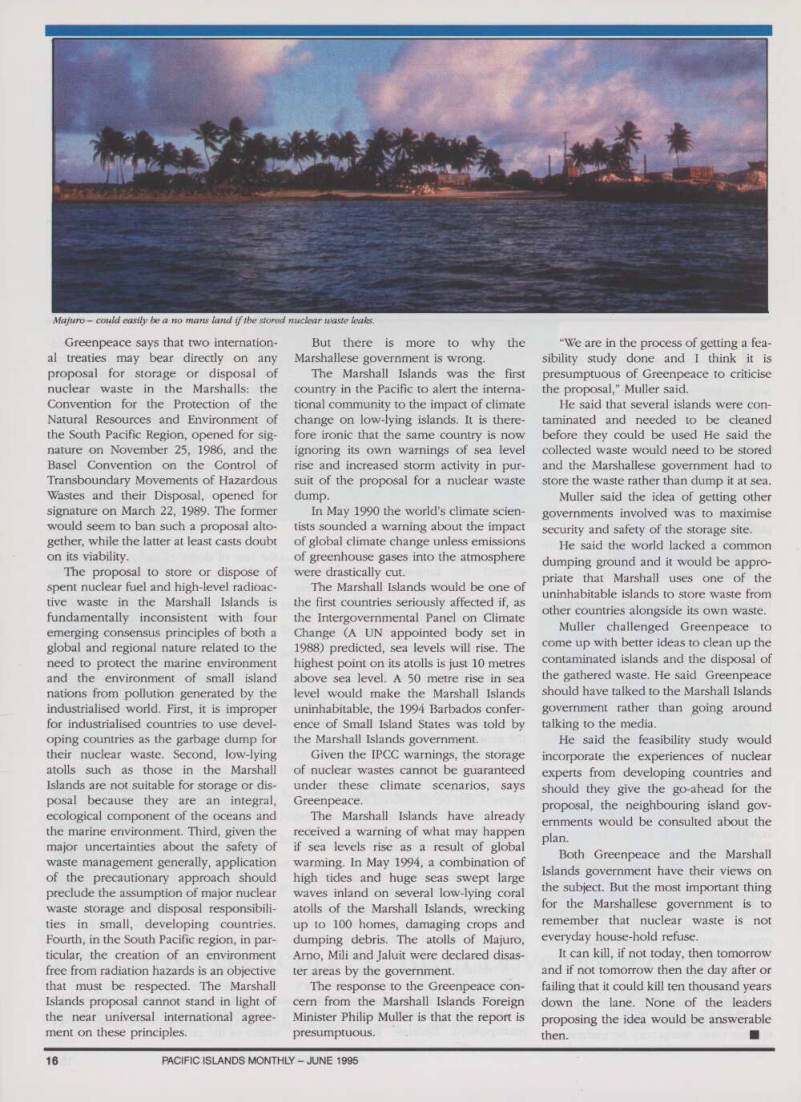
The Marshall Islands have already received a warning of what may happen if sea levels rise as a result of global warming. In May 1994, a combination of high tides and huge seas swept large waves inland on several low-lying coral atolls of the Marshall Islands, wrecking up to 100 homes, damaging crops and dumping debris. The atolls of Majuro, Arno, Mili and Jaluit were declared disas ter areas by the government.
The response to the Greenpeace con cern from the Marshall Islands Foreign Minister Philip Muller is that the report is presumptuous.
“We are in the process of getting a fea sibility study done and I think it is presumptuous of Greenpeace to criticise the proposal,” Muller said.
He said that several islands were con taminated and needed to be cleaned before they could be used He said the collected waste would need to be stored and the Marshallese government had to store the waste rather than dump it at sea.
Muller said the idea of getting other governments involved was to maximise security and safety of the storage site.
He said the world lacked a common dumping ground and it would be appro priate that Marshall uses one of the uninhabitable islands to store waste from other countries alongside its own waste.
Muller challenged Greenpeace to come up with better ideas to clean up the contaminated islands and the disposal of the gathered waste. He said Greenpeace should have talked to the Marshall Islands government rather than going around talking to the media.
He said the feasibility study would incorporate the experiences of nuclear experts from developing countries and should they give the go-ahead for the proposal, the neighbouring island gov ernments would be consulted about the plan.
Both Greenpeace and the Marshall Islands government have their views on the subject. But the most important thing for the Marshallese government is to remember that nuclear waste is not everyday house-hold refuse.
It can kill, if not today, then tomorrow and if not tomorrow then the day after or failing that it could kill ten thousand years down the lane. None of the leaders proposing the idea would be answerable then. ■
Majuro - could easily be a no mans land if the stored nuclear waste leaks.