New Fiji boat
pp. 56-57 · Read in the full issue
Shipping
New Fiji boat to create waves
By Penny Baba
Fiji’s first hydrofoil-assisted cata maran should challenge the long established inter-island ferry net work and boost tourism in Vanua Levu after services start between Vanua Levu and Viti Levu.
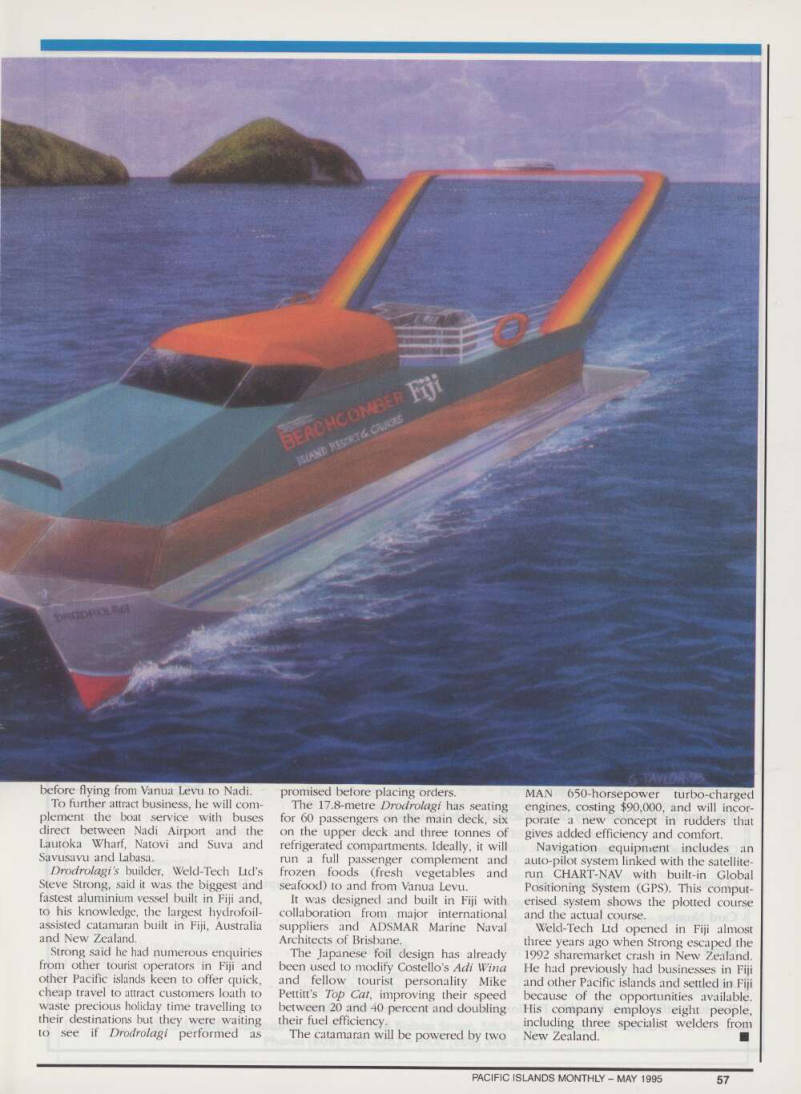
The Fsl-million, 60-seater passenger and cargo catamaran, called Drodrolagi (jainbow), was built in Lautoka for tourist industry identity and businessman, Dan Costello, known for his Beachcomber Island Resort and Cruises.
Costello will provide a daily direct ser vice from Lautoka to Savusavu - in 3-25 hours. He will directly challenge the ferry opposition by then running to Natovi, near Suva, back to Savusavu and return ing to Lautoka by 5.30 pm the same day.
The technology which will enable him to sail quickly and cheaply is the hydro foil-assisted design of Drodrolagi essentially a conventional catamaran that uses a hydrofoil to lift most of the boat 400 mm out of the water and skim over it, thus reducing sea-drag and doubling fuel
efficiency.
This fuel efficiency means Costello can offer competitive prices - $55 Lautoka/Savusavu and $34 Savusavu/Natovi, compared to the RORO’s $28.60-plus bus fares.
Nadi/Savusavu flights cost $96.
Drodrolagi will cruise at 35- 40 knots, halving travelling time between Lautoka and Savusavu, currently only serviced by the traditional leader of the inter-island ferry system, Patterson Brothers. Their Rol-On-Roll-Off service leaves Ellington
Wharf, two hours drive from Lautoka, for Nabouwalu, three hours drive from Savusavu, once a week. They also run a twice-weekly service from Savusavu to Natovi, four hours drive from Lautoka and over an hour from Suva.
Costello is expecting to enhance both tourist and local business to Vanua Levu,
the slowly developing second-largest
island of Fiji, where he has links with other tourist operators and is developing his own tourism operation with his wife’s
family.
He hopes to particularly cash in on divers, a growing percentage of Vanua Levu’s visitors, as travelling by sea gives them more time to decompress before flying out of Fiji. Otherwise, they lose precious diving time decompressing
before flying from Vanua Levu to Nadi.
To further attract business, he will complement the boat service with buses direct between Nadi Airport and the Lautoka Wharf, Natovi and Suva and Savusavu and Labasa.
Drodrolagi’s builder, Weld-Tech Ltd’s Steve Strong, said it was the biggest and fastest aluminium vessel built in Fiji and,
to his knowledge, the largest hydrofoil-
assisted catamaran built in Fiji, Australia and New Zealand.
Strong said he had numerous enquiries from other tourist operators in Fiji and other Pacific islands keen to offer quick, cheap travel to attract customers loath to waste precious holiday time travelling to their destinations but they were waiting to see if Drodrolagi performed as
promised before placing orders.
The 17.8-metre Drodrolagi has seating for 60 passengers on the main deck, six on the upper deck and three tonnes of refrigerated compartments. Ideally, it will run a full passenger complement and frozen foods (fresh vegetables and seafood) to and from Vanua Levu.
It was designed and built in Fiji with collaboration from major international suppliers and ADSMAR Marine Naval Architects of Brisbane.
The Japanese foil design has already been used to modify Costello’s Adi Wina and fellow tourist personality Mike Pettitt’s Top Cat , improving their speed between 20 and 40 percent and doubling their fuel efficiency.
The catamaran will be powered by two
MAJN 650-horsepower turbo-charged engines, costing $90,000, and will incor porate a new concept in rudders that gives added efficiency and comfort.
Navigation equipment includes an auto-pilot system linked with the satellite run CHART-NAV with built-in Global Positioning System (GPS). This comput erised system shows the plotted course and the actual course.
Weld-Tech Ltd opened in Fiji almost three years ago when Strong escaped the 1992 sharemarket crash in New Zealand.
He had previously had businesses in Fiji and other Pacific islands and settled in Fiji because of the opportunities available.
His company employs eight people, including three specialist welders from New Zealand. ■