paradise
pp. 54-55 · Read in the full issue
Yachting
Ouvea - A slice of paradise
By Sally Andrew
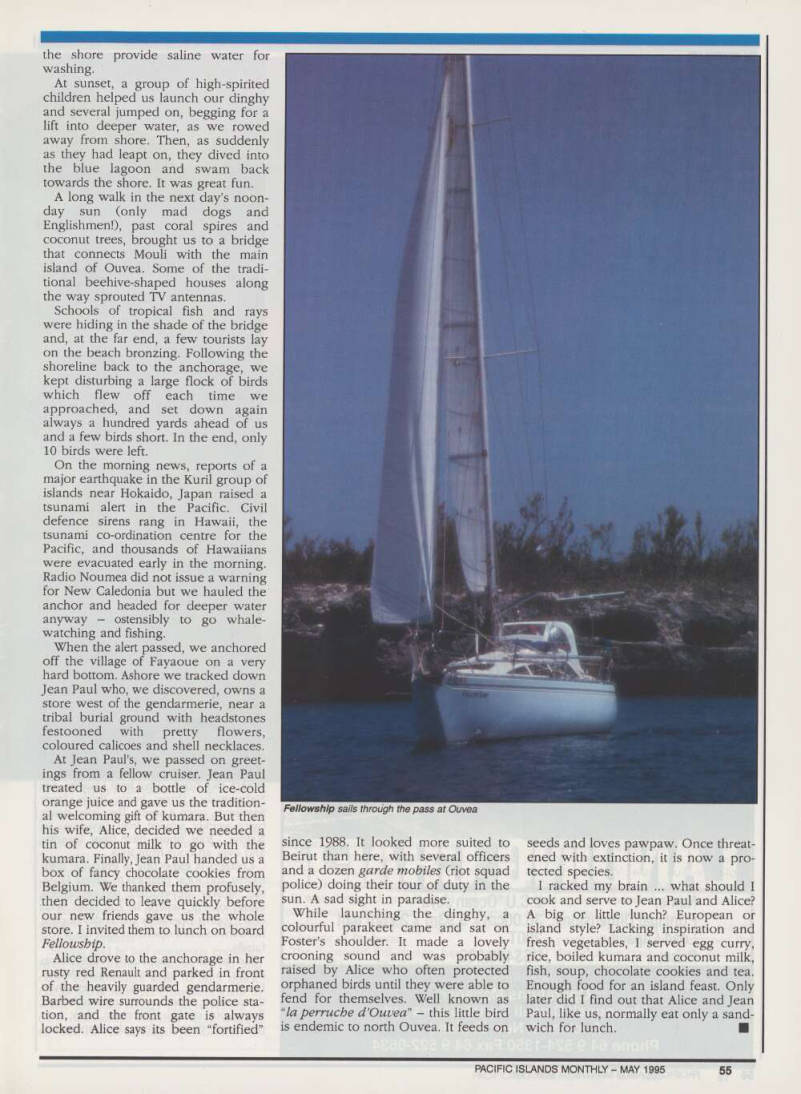
Sailing quietly through the night, we arrive at Ouvea shortly after dawn and negotiate the pass.
To starboard, uplifted limestone cliffs bear evidence of ancient marine life.
The dark water of the deep gives way to luminescent blues glimmering over
the shallow bottom.
Inside the lagoon, a wide, white beach with sand as fine as powder stretches off in the distance. The German yacht Laguna lies at anchor in front of the village church and seems suspended in calm, clear space. The view is surreal and the only sound is the laughter of the village children playing on the beach.
We row ashore and ask the local chief (le chef du village) for permis sion to visit his village. Pierre Doumi is a quiet man with grey hair and wears a black “I OWN A HARLEY” t-shirt and beige cardigan. Doumi lives in a typi cal New Caledonian cbeferie sur rounded by an imposing driftwood palisade. His homestead has an alu minium cook-house, a transitional round-thatched hut for sleeping in and a custom meeting house where tribal gatherings and discussions are held.
The village store-keeper, a large man, tried his school English on us and when he asked, I said we were from Canada. I exchanged greetings of “bonjour” with several ladies gossiping in a nearby doorstep.
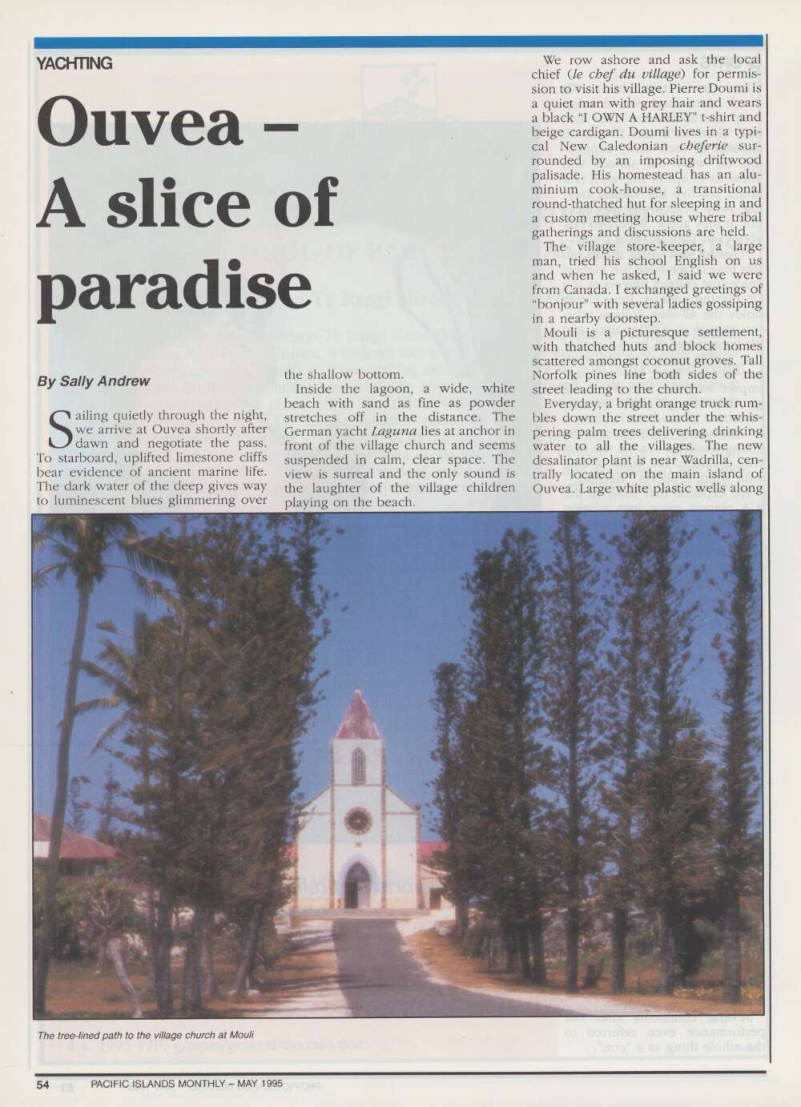
Mouli is a picturesque settlement, with thatched huts and block homes scattered amongst coconut groves. Tall Norfolk pines line both sides of the street leading to the church.
Everyday, a bright orange truck rum bles down the street under the whis pering palm trees delivering drinking water to all the villages. The new desalinator plant is near Wadrilla, cen trally located on the main island of Ouvea. Large white plastic wells along
The tree-lined path to the village church at Mouli
the shore provide saline water for
washing.
At sunset, a group of high-spirited children helped us launch our dinghy and several jumped on, begging for a lift into deeper water, as we rowed away from shore. Then, as Suddenly as they had leapt on, they dived into the blue lagoon and swam back towards the shore. It was great fun.
A long walk in the next day’s noon day sun (only mad dogs and Englishmen!), past coral spires and coconut trees, brought us to a bridge that connects Mouli with the main island of Ouvea. Some of the tradi
tional beehive-shaped houses along
the way sprouted TV antennas.
Schools of tropical fish and rays were hiding in the shade of the bridge and, at the far end, a few tourists lay on the beach bronzing. Following the shoreline back to the anchorage, we kept disturbing a large flock of birds which flew off each time we approached-, and set down again always a hundred yards ahead of us and a few birds short. In the end, only 10 birds were left.
On the morning news, reports of a major earthquake in the Kuril group of islands near Hokaido, Japan raised a tsunami alert in the Pacific. Civil defence sirens rang in Hawaii, the tsunami co-ordination centre for the Pacific, and thousands of Hawaiians were evacuated early in the morning.
Radio Noumea did not issue a warning for New Caledonia but we hauled the anchor and headed for deeper water anyway - ostensibly to go whale watching and fishing.
When the alert passed, we anchored off the village of Fayaoue on a very hard bottom. Ashore we tracked down Jean Paul who, we discovered, owns a store west of the gendarmerie, near a tribal burial ground with headstones festooned with pretty flowers, coloured calicoes and shell necklaces.
At Jean Paul’s, we passed on greet ings from a fellow cruiser. Jean Paul treated us to a bottle of ice-cold orange juice and gave us the tradition al welcoming gift of kumara. But then his wife, Alice, decided we needed a tin of coconut milk to go with the kumara. Finally, Jean Paul handed us a box of fancy chocolate cookies from Belgium. We thanked them profusely, then decided to leave quickly before our new friends gave us the whole store. I invited them to lunch on board
Fellowship.
Alice drove to the anchorage in her rusty red Renault and parked in front of the heavily guarded gendarmerie.
Barbed wire surrounds the police sta tion, and the front gate is always locked. Alice says its been “fortified”
since 1988. It looked more suited to Beirut than here, with several officers and a dozen garde mobiles (riot squad police) doing their tour of duty in the sun. A sad sight in paradise.
While launching the dinghy, a colourful parakeet came and sat on Foster’s shoulder. It made a lovely crooning sound and was probably raised by Alice who often protected orphaned birds until they were able to fend for themselves. Well known as “la perruche d’Ouvea" - this little bird is endemic to north Ouvea. It feeds on
seeds and loves pawpaw. Once threat ened with extinction, it is now a pro tected species.
I racked my brain ... what should I cook and serve to Jean Paul and Alice?
A big or little lunch? European or island style? Lacking inspiration and fresh vegetables, I served egg curry, rice, boiled kumara and coconut milk, fish, soup, chocolate cookies and tea.
Enough food for an island feast. Only later did I find out that Alice and Jean Paul, like us, normally eat only a sand wich for lunch. ■
Fellowship sails through the pass at Ouvea