Navigating the
pp. 40-41 · Read in the full issue

Politics
Navigating the treacherous waters
Sitiveni Rabuka continues his stormy voyage with no relief in sight
By Yunus Rashid
When Fiji’s Prime Minister Sitiveni Rabuka fired one of his Cabinet ministers, who was also his uncle, the message he sent to everyone else was clear: “Do or be damned!”
And of course, his uncle and former minister of Labour and Industrial Relations, Militoni Leweniqila, a veter an politician, helped Rabuka by oblig ing him with a resignation letter and moving to the back seats.
This did not mean that the boat did not rock. If it was not Leweniqila then it was Rabuka’s Tourism and Aviation Minister Harold Powell who did the rocking. He resigned over a disagree ment with Rabuka. This led Powell’s General Voters Party to reconsider its coalition with Rabuka’s Fijian party, the Soqosoqo ni Vakavulewa ni Taukei.
The axing of Leweniqila and the res ignation of Powell were a result of two problems which reached boiling point simultaneously. In the former’s case, he managed to overturn a Wage Order Act imposed by the Finance Minister when the money man went overseas.
By doing this, Leweniqila averted a possible nationwide strike. The money man on his return made his anger known to Cabinet in no uncertain terms.
It was simple: The Wage Order comes in or he goes out.
Rabuka decided that “in the national interest” the Wage Order should be re
imposed. When Rabuka announced this, Leweniqila did not want to take the flak from the unions so he told the media there would be “serious trouble” if the Wage Order was retained. Rabuka did not like what he said and asked for his resignation.
In Powell’s case, he drew up a list of people to sit on Civil Aviation Authority of Fiji’s board. His list was changed by Rabuka to include names which Powell did not agree with. So Powell resigned and his party was outraged.
Being a sailor of rough seas, Rabuka moved to prevent a capsize by imme diately appointing another GYP mem ber, Vincent Lobendahn, as assistant minister under his portfolio. When the GYP had a meeting to discuss the issue, two of its four parliamentary represen tatives opted out but two who had min isterial posts decided to stay - under standably because ministerial salaries, in excess of $40,000, are better than $16,000 for backbenchers. This affair has not been ironed out.
Knowing too well that a clique of his disgruntled backbenchers were getting more ammunition to oust him as Prime Minister, Rabuka appointed Ratu Inoke Kubuabola a minister. Ratu Inoke was one of Rabuka’s most open and vicious critics.
As anticipated, upon joining the Cabinet line-up, Ratu Inoke said he would have to go along with all Cabinet decisions as he had become one of them.
In fact, Ratu Inoke was instrumental
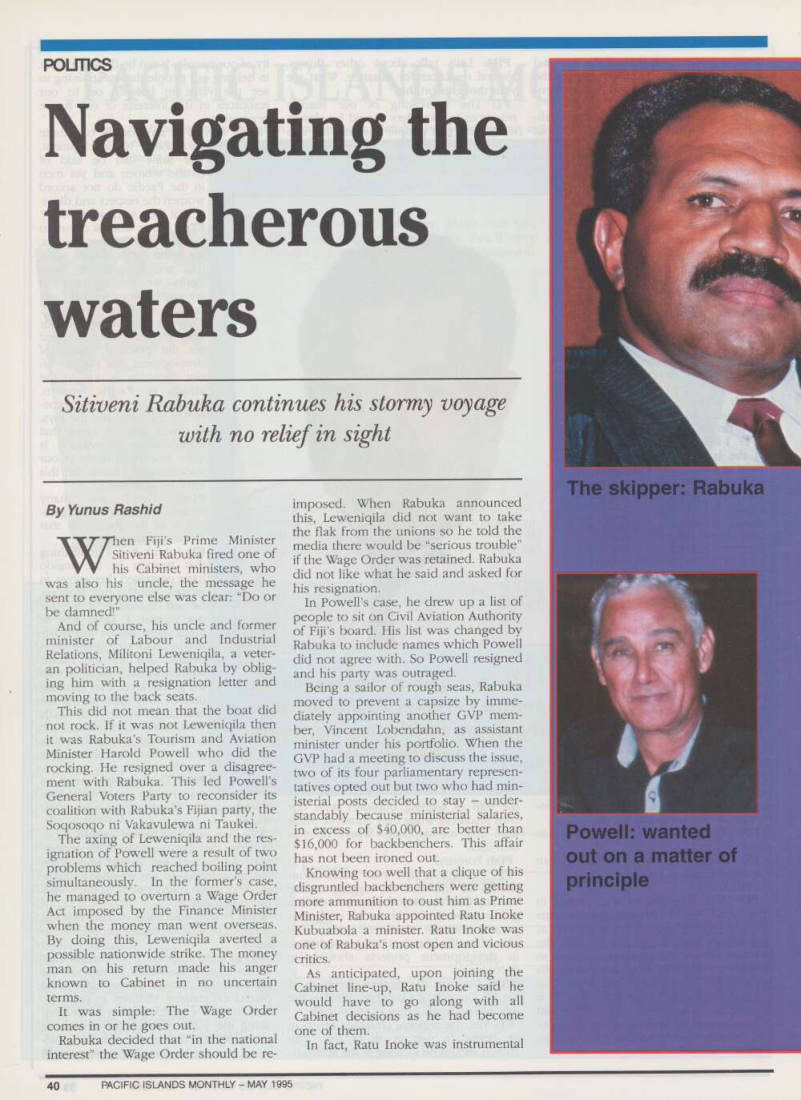
The skipper: Rabuka
Powell: wanted out on a matter of
principle
in asking Rabuka to vacate office in 1994 because of his alleged adultery and he later teamed up with several backbenchers to ask Rabuka to vacate office a second time this year.
Ratu Inoke’s reason for asking Rabuka to step down was that Rabuka had agreed to the lifting of the contro versial Sunday Observance Decree, had suggested all Fiji citizens be called Fijians and had allowed gambling into the country.
With Ratu Inoke moving to the min isterial ranks, the clique of back benchers did not gain a supporter in Leweniqila but lost a powerful force.
Rabuka is safe from any conspiracy
from the Indian Opposition parties to oust him because the leader of Opposition, Jai Ram Reddy, has said his party would not become embroiled in a power tussle which was essentially a Fijian issue. Indians cannot become prime minister as per the 1990 Constitution.
So in the meantime, while GVP mem bers decide whether they are too weak to stand against the might of Rabuka or strong enough to say enough is enough, Rabuka continues his journey through the treacherous waves of Fiji’s politics with an undisciplined crew and little support. ■
Kubuabola: gave up principles for a Cabinet post