according to
pp. 37-39 · Read in the full issue

Viewpoint
The world according to Dr Finau
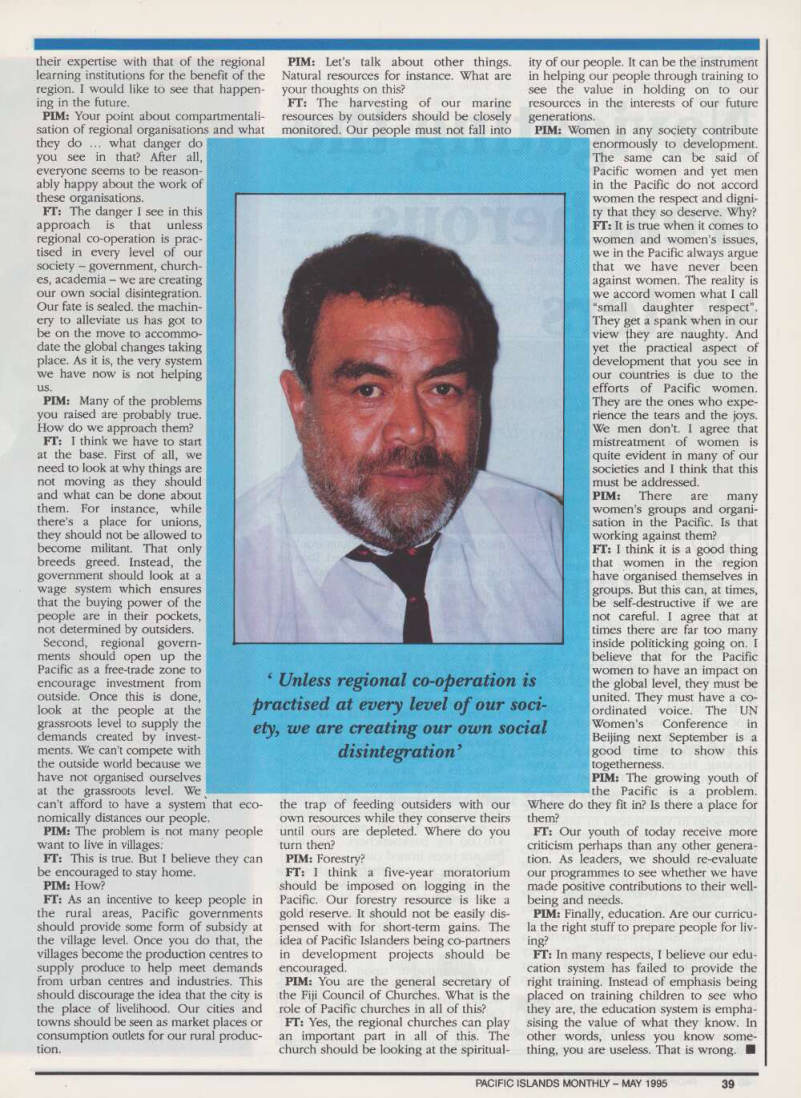
PIM talks to one of the region’s leading clergymen, the general secretary of the Fiji Council of Churches, Reverend Dr Finau Tu’uholoaki, on what Pacific island countries need to do to capitalise on the opportunities and challenges of the 21st cen tury. True the 21st century has been dubbed the Pacific Century, but as Dr Tu’uholoaki sees it, unless people of the islands band together, we will be no more than mere label bear ers for the next 100 years.
FT: The catch-phrase around the world today is simply this: eat local, think glob al. To realise this, we need to have an efficient mechanism to make this work.
PIM: But we do have this mechanism. At the regional level, we have inter-govern mental organisations such as the South Pacific Commission, the South Pacific
Forum Secretariat, the South Pacific Regional Environment Programme, the Forum Fisheries Agency, and so on.
FT: In my view these regional organisa tions are part of our problem. Because each one is a specialised agency, every one tends to keep within its given man date. We have to prepare our people bet ter, not in compartmentalised segments as is the case today. We simply do not have the resources - financial or otherwise - to work in isolation of each other. This shows in our participation at internation al conferences.
PIM: You were at the Social Summit in Copenhagen. How did we perform as a region?
FT: In fairness to everyone, we did our best. But we were unprepared. It showed. Again, this was perhaps a reflec tion that the regional organisations are
not working together closely enough as
they should. The technical support was weak because it seemed that we were not using the technical expertise available to us.
PIM: You are not talking about the use of external consultants, are you?
FT: Oh, no. I am talking about the Pacific island countries making use of the technocrats and academics we have at our regional universities such as the University of the South Pacific and the University of Papua New Guinea.
Regional organisations should combine
their expertise with that of the regional learning institutions for the benefit of the region. I would like to see that happen ing in the future.
PIM: Your point about compartmentali sation of regional organisations and what
they do ... what danger do you see in that? After all, everyone seems to be reason ably happy about the work of these organisations.
FT: The danger I see in this approach is that unless regional co-operation is prac tised in every level of our society - government, church es, academia - we are creating our own social disintegration.
Our fate is sealed, the machin ery to alleviate us has got to be on the move to accommo date the global changes taking place. As it is, the very system we have now is not helping us.
PIM; Many of the problems you raised are probably true.
How do we approach them?
FT; I think we have to start at the base. First of all, we need to look at why things are not moving as they should and what can be done about them. For instance, while there’s a place for unions, they should not be allowed to become militant. That only breeds greed. Instead, the government should look at a wage system which ensures that the buying power of the people are in their pockets, not determined by outsiders.
Second, regional govern ments should open up the Pacific as a free-trade zone to encourage investment from outside. Once this is done, look at the people at the grassroots level to supply the demands created by invest ments. We can’t compete with the outside world because we have not organised ourselves at the grassroots level. We
can’t afford to have a system that eco nomically distances our people.
PIM: The problem is not many people want to live in villages; FT: This is true. But I believe they can be encouraged to stay home.
PIM: How?
FT: As an incentive to keep people in the rural areas, Pacific governments should provide some form of subsidy at the village level. Once you do that, the villages become the production centres to
supply produce to help meet demands
from urban centres and industries. This should discourage the idea that the city is the place of livelihood. Our cities and towns should be seen as market places or consumption outlets for our rural produc tion.
PIM: Let’s talk about other things, Natural resources for instance. What are your thoughts on this?
FT: The harvesting of our marine resources by outsiders should be closely monitored. Our people must not fall into
the trap of feeding outsiders with our own resources while they conserve theirs until ours are depleted. Where do you turn then?
PIM; Forestry?
FT; I think a five-year moratorium should be imposed on logging in the Pacific. Our forestry resource is like a gold reserve. It should not be easily dis pensed with for short-term gains. The idea of Pacific Islanders being co-partners in development projects should be
encouraged.
PIM: You are the general secretary of the Fiji Council of Churches. What is the role of Pacific churches in all of this?
FT: Yes, the regional churches can play an important part in all of this. The church should be looking at the spiritual
ity of our people. It can be the instrument in helping our people through training to see the value in holding on to our resources in the interests of our future generations, PIM: Women in any society contribute
enormously to development.
The same can be said of Pacific women and yet men in the Pacific do not accord women the respect and digni ty that they so deserve. Why?
FT: It is true when it comes to women and women’s issues, we in the Pacific always argue that we have never been against women. The reality is we accord women what I call
I “small daughter respect”.
They get a spank when in our view jhey are naughty. And yet the practical aspect of development that you see in our countries is due to the efforts of Pacific women.
They are the ones who expe rience the tears and the joys.
We men don’t. I agree that mistreatment of women is quite evident in many of our societies and I think that this must be addressed.
PIM: There are many women’s groups and organi sation in the Pacific. Is that working against them?
FT: I think it is a good thing that women in the region have organised themselves in groups. But this can, at times, be self-destructive if we are not careful. I agree that at times there are far too many inside politicking going on. I believe that for the Pacific women to have an impact on the global level, they must be united. They must have a co ordinated voice. The UN Women’s Conference in Beijing next September is a good time to show this
togetherness.
PIM: The growing youth of the Pacific is a problem.
Where do they fit in? Is there a place for them?
FT: Our youth of today receive more criticism perhaps than any other genera tion. As leaders, we should re-evaluate our programmes to see whether we have made positive contributions to their well being and needs.
PIM: Finally, education. Are our curricu la the right stuff to prepare people for liv ing?
FT; In many respects, I believe our edu cation system has failed to provide the
right training. Instead of emphasis being
placed on training children to see who they are, the education system is empha sising the value of what they know. In other words, unless you know some thing, you are useless. That is wrong. ■
‘ Unless regional co-operation is practised at every level of our soci ety, we are creating our own social
disintegration