Age-old
pp. 26-28 · Read in the full issue
Focus
Age-old practice under scrutiny
Dispute mars Vanuatu s traditional practice of land diving and highlights ancient fears as a diver is seri
ously injured this season
By Patrick Decloitre
Vanuatu’s northern Pentecost island’s world famous land diving, a major tourist attrac tion, has this year become the centre of controversy for the Ministry of Culture and commercial tour opera tors. Ministry officials want to ban it this year to restore its traditional sig nificance while the tourism industry argues it has an obligation to fulfil to overseas tour wholesalers.
Earlier this year, the Vanuatu Department of Culture and Religion’s executive officer, Lazare Asal, banned land-diving, the precursor to Western style Bungee jumping, for the whole of 1995. In Pentecost, the ban was sup ported by a group, South Pentecost Tourism Development Council, headed by a local chief, Leo Bebe.
The reason for the ban, according to Asal, was to allow time to reorganise the way the land-diving ceremony, Nagol , is conducted before it resumes next year. Nagol, Asal says, has
become too commercialised and has subsequently lost its traditional signifi cance. “We are looking into the idea of forming a body that would control the ceremony and restore its traditional and customary value,” he said.
“The ceremony is not the jump alone, it involves a lot of customs and that’s what we’re trying to restore.”
But he admits that although meetings have been held for a number of years in Pentecost, “the issue of land-diving has been disputed for a number of years”.
According to custom, if a dispute exists over land-diving, then Nagol should not take place. If someone ignores this and goes ahead, then it is believed something bad will happen to him.
Asal also thinks there are too many commercial jumps each year. “This is now taking place every week-end in April and May. This has to be reduced.
Each village group sells about eight to 10 dives every year. That’s just too much,” he said.
Last October, Asal explains, another
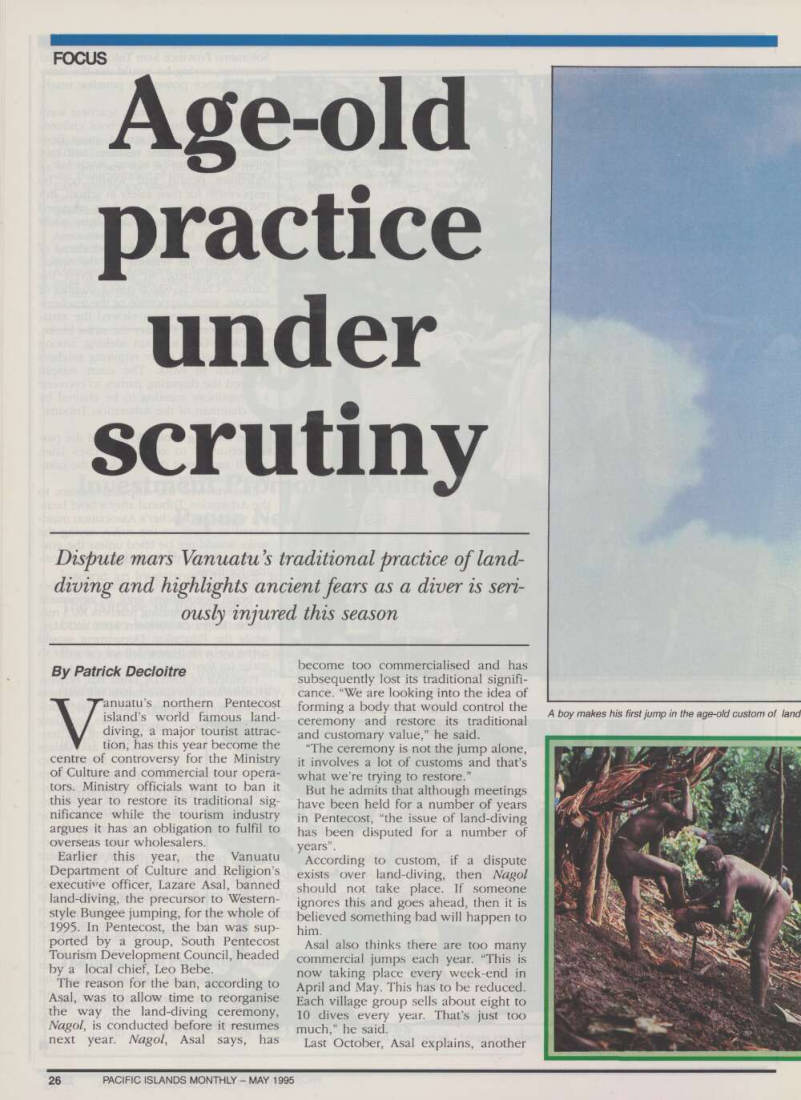
A boy makes his first jump in the age-old custom of land
There is a legend on land-diving in Pentecost. It tells the story of a woman being chased by her angry husband. She finally comes up with the idea of luring him into a trap. She climbed a banyon tree and jumped from a branch after tying vines to her ankles. The husband jumped after her but without the sup port of vines and killed himself.
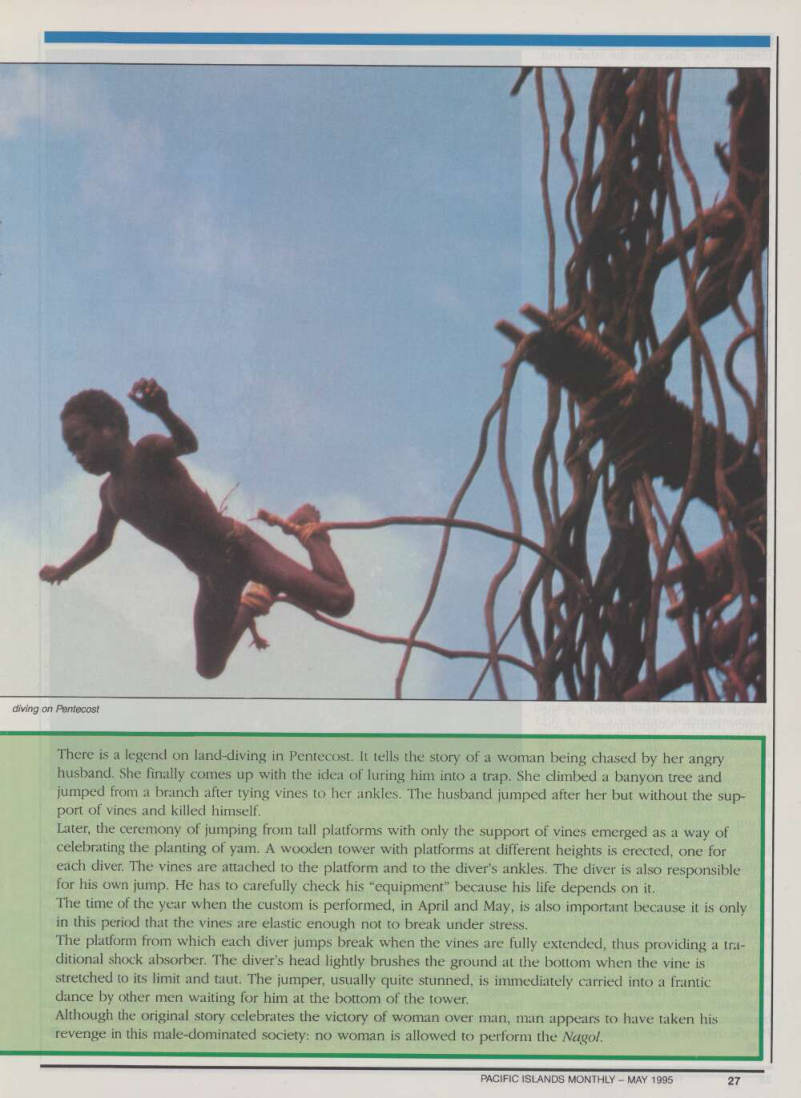
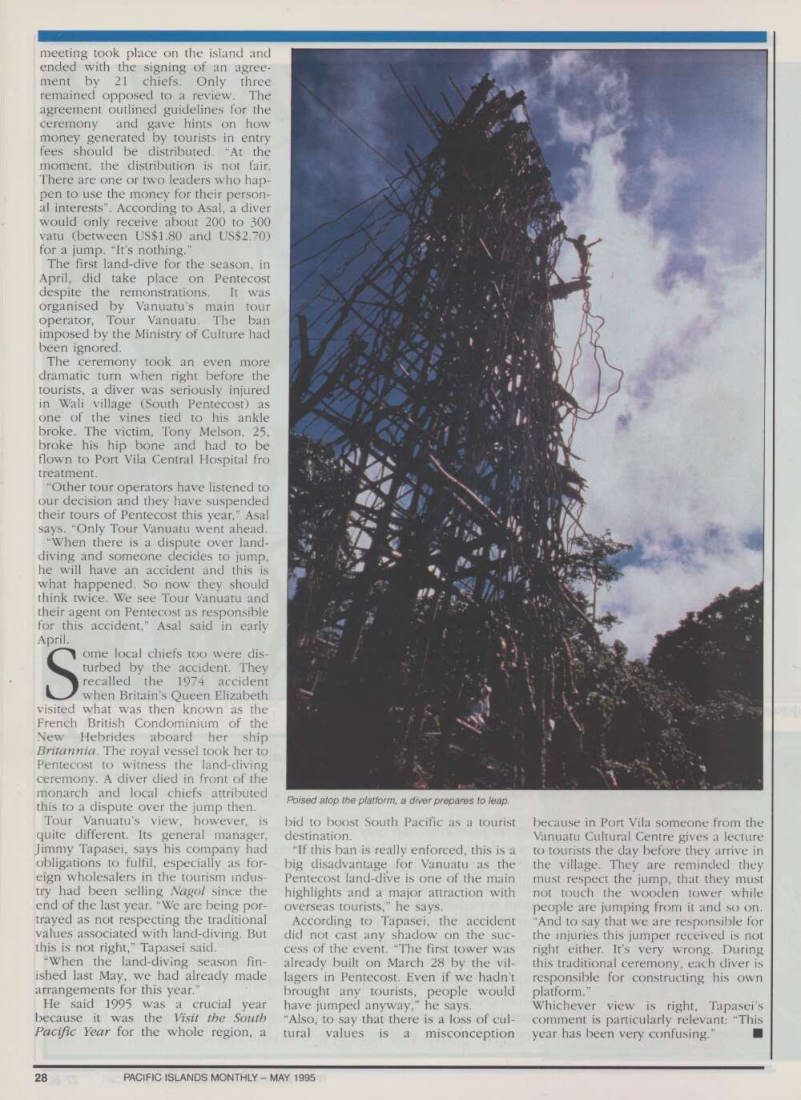
Later, the ceremony of jumping from tall platforms with only the support of vines emerged as a way of celebrating the planting of yam. A wooden tower with platforms at different heights is erected, one for each diver. The vines are attached to the platform and to the diver’s ankles. The diver is also responsible for his own jump. He has to carefully check his “equipment” because his life depends on it.
The time of the year when the custom is performed, in April and May, is also important because it is only in this period that the vines are elastic enough not to break under stress.
The platform from which each diver jumps break when the vines are fully extended, thus providing a tra ditional shock absorber. The diver’s head lightly brushes the ground at the bottom when the vine is stretched to its limit and taut. The jumper, usually quite stunned, is immediately carried into a frantic dance by other men waiting for him at the bottom of the tower.
Although the original story celebrates the victory of woman over man, man appears to have taken his revenge in this male-dominated society: no woman is allowed to perform the Nagol.
diving on Pentecost
meeting took place on the island and ended with the signing of an agree ment by 21 chiefs. Only three remained opposed to a review. The agreement outlined guidelines for the ceremony and gave hints on how money generated by tourists in entry fees should be distributed. “At the moment, the distribution is not fair.
There are one or two leaders who hap pen to use the money for their person al interests”. According to Asal, a diver would only receive about 200 to 300 vatu (between US$l.BO and US$2.7O) for a jump. “It’s nothing.”
The first land-dive for the season, in April, did take place on Pentecost despite the remonstrations. It was organised by Vanuatu's main tour operator, Tour Vanuatu. The ban imposed by the Ministry of Culture had
been ignored.
The ceremony took an even more dramatic turn when right before the tourists, a diver was seriously injured in Wali village (South Pentecost) as one of the vines tied to his ankle broke. The victim, Tony Melson, 25, broke his hip bone and had to be flown to Port Vila Central Hospital fro treatment.
“Other tour operators have listened to our decision and they have suspended their tours of Pentecost this year,” Asal says. “Only Tour Vanuatu went ahead.
“When there is a dispute over land diving and someone decides to jump, he will have an accident and this is what happened. So now they should think twice. We see Tour Vanuatu and their agent on Pentecost as responsible for this accident,” Asal said in early April.
Some local chiefs too were dis turbed by the accident. They recalled the 1974 accident when Britain’s Queen Elizabeth visited what was then known as the French British Condominium of the New Hebrides aboard her ship Britannia. The royal vessel took her to Pentecost to witness the land-diving ceremony. A diver died in front of the monarch and local chiefs attributed this to a dispute over the jump then.
Tour Vanuatu’s view, however, is quite different. Its general manager, Jimmy Tapasei, says his company had obligations to fulfil, especially as for eign wholesalers in the tourism indus try had been selling Nagol since the end of the last year. “We are being por trayed as not respecting the traditional values associated with land-diving. But this is not right,” Tapasei said.
“When the land-diving season fin ished last May, we had already made arrangements for this year.”
He said 1995 was a crucial year because it was the Visit the South Pacific Year for the whole region, a
bid to boost South Pacific as a tourist destination.
“If this ban is really enforced, this is a big disadvantage for Vanuatu as the Pentecost land-dive is one of the main highlights and a major attraction with overseas tourists,” he says.
According to Tapasei, the accident did not cast any shadow on the suc cess of the event. “The first tower was already built on March 28 by the vil lagers in Pentecost. Even if we hadn't brought any tourists, people would have jumped anyway,” he says.
“Also, to say that there is a loss of cul tural values is a misconception
because in Port Vila someone from the Vanuatu Cultural Centre gives a lecture to tourists the day before they arrive in
the village. They are reminded they
must respect the jump, that they must not touch the wooden tower while people are jumping from it and so on.
“And to say that we are responsible for the injuries this jumper received is not right either. It’s very wrong. During this traditional ceremony, each diver is responsible for constructing his own
platform.”
Whichever view is right, Tapasei’s comment is particularly relevant: “This year has been very confusing.” ■
Poised atop the platform, a diver prepares to leap.