A Faltering
pp. 22-25 · Read in the full issue
Education
Start To The
School Year
A nationwide strike by teachers rocked Papua New Guinea and forced government to enter into negotiations with the union
By Maureen Gerewa
History has shown that uprisings take place when ordinary peo ple cannot deal with economic and social pressures. This served as a les son for Papua New Guinea government last month when teachers held a nation wide strike that crippled the entire edu cation system.
The strike, the first ever well organised strike, saw 18,000 teachers from all schools and institutions stop work for eight days in protest over salaries and
working conditions.
Plans for the strike had begun earlier in the year. The government had paid little attention because previous strike threats had never materialised. But on March 21, despite warnings from the government and its agencies, the teachers carried out their threat.
The Teaching Service Act makes no provisions for such strikes. But the Papua New Guinea Teachers Association referred to provisions in the Industrial Relations Act to justify their action.
The legality of it is still being ques tioned, even after the national court did
not order them back to work as request ed by the government.
The strike was sparked off when the government failed to inform teachers of the fate of their new wage structure, as public sector wage increases were ruled out. The structure, effective from mid -1994, was the result of three years of tough battling.
The country was in economic turmoil and the new government, headed by Prime Minister Sir Julius Chan and Finance Minister Chris Haiveta, had frozen wage increases for the public sec tor for the year because it did not have the money to pay. The new wage struc ture for the teachers had, among other benefits, entitled them to a 3.3-percent annual pay rise, based on performance and productivity. It also included a five percent allowance for headmasters, retrenchment and retirement benefits and travel expenses.
The teachers were aggrieved because they saw the government as reneging on an agreement. They also felt they were the most hardworking of public servants who deserved every one those benefits.
The teachers were also asking for wage
adjustments based on the Consumer Price Index for 1994 and 1995 and the 12-per cent devaluation of the kina.
In the face of government’s failure to
provide an acceptable explanation, the
association felt a strike was the most effective weapon available.
The Teachers Association went to the polls in February and most voted in sup port of a strike.
Talks between the Teaching Service Commission, the government agency which employs the 18,000 teachers, and PNGTA were tense as the two parties refused to give in. TSC refused to enter tain the teachers demands for two rea sons: the government’s inability to pay and the Memorandum of Understanding for the new wage structure did not have a provision for negotiations seeking adjustments based on CPI.
In mid-February, a third party compris ing government officers from the Finance and Labour & Employment departments and Salaries and Conditions Monitoring Committee were engaged in the meet ings.
Three days later the government told the teachers the freeze on their salaries
and other benefits was lifted, and pay ments would begin from April 14. This was welcomed by the teachers and their union. But they still insisted on a CPI adjustment to offset the higher cost of liv ing.
The government offered a 1.5-percent CPI increase to all public servants, includ ing teachers who rejected it, saying the actual increase for 1994 was 4.8 percent and even higher for 1995.
PNGTA also wanted to insert a clause in the wage agreement providing for nego tiations for CPI-based increases.
On March 5, the two parties signed a Memorandum of Understanding which allowing CPI as part of the wage-fixation mechanism for teachers. The same day PNGTA asked TSC to begin negotiations for such an adjustment. TSC responded it would only negotiate before an Arbitration Tribunal. The teachers associ-
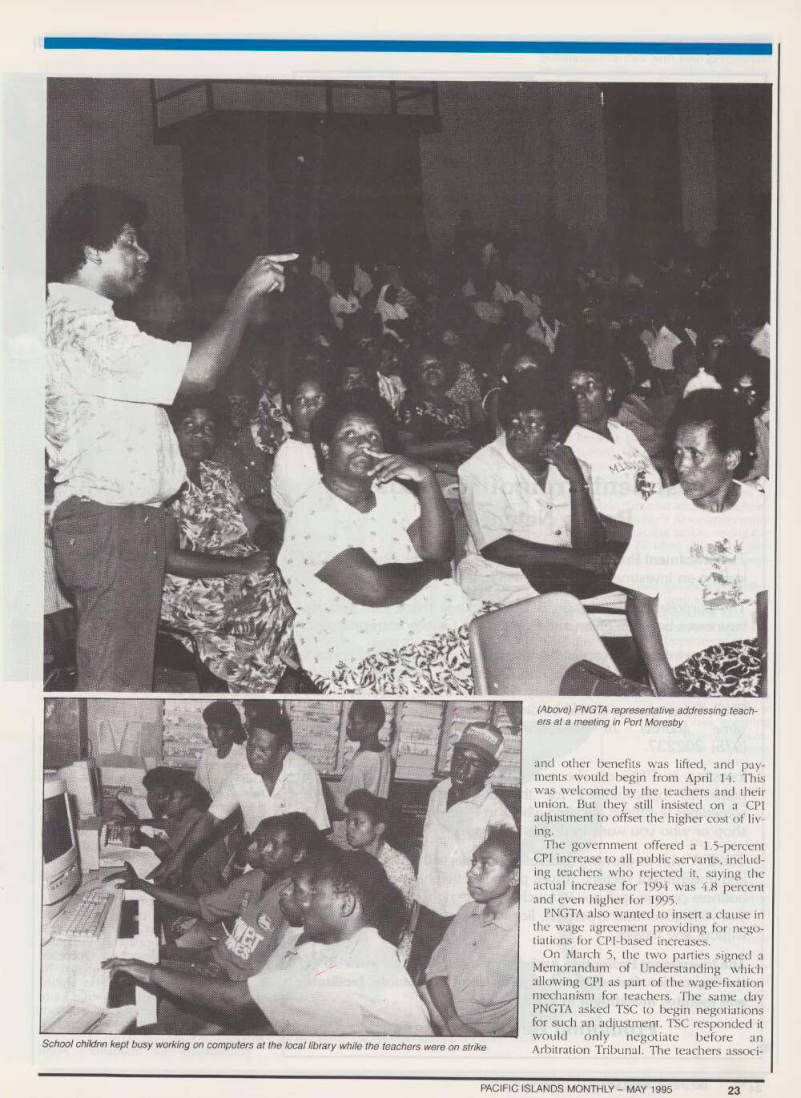
(Above) PNGTA representative addressing teach ers at a meeting in Port Moresby
School childrn kept busy working on computers at the local library while the teachers were on strike
ation refused.
Education Minister Joseph Onguglo warned a strike would be illegal and those who did go on strike would either lose their salaries, be demoted or dis missed.
“My ministry, the department and the Teaching Service Commission (TSC) wish to make it clear that any sit-in striker will be deemed to be absent from duty and would result in loss of salary. Even a teacher sitting in his or her classroom but not actually teaching subjects cannot be taken as being on duty,” he said.
At the same time, the teachers in vol cano-devastated East New Britain were warned against participating in the strike.
Rabaul’s State of Emergency Operation Unit’s deputy controller threatened he would have them arrested. He argued that children had already missed a lot of classes because of the volcanic eruptions and should not be victimised further by a strike.
Administrator for trouble-torn North
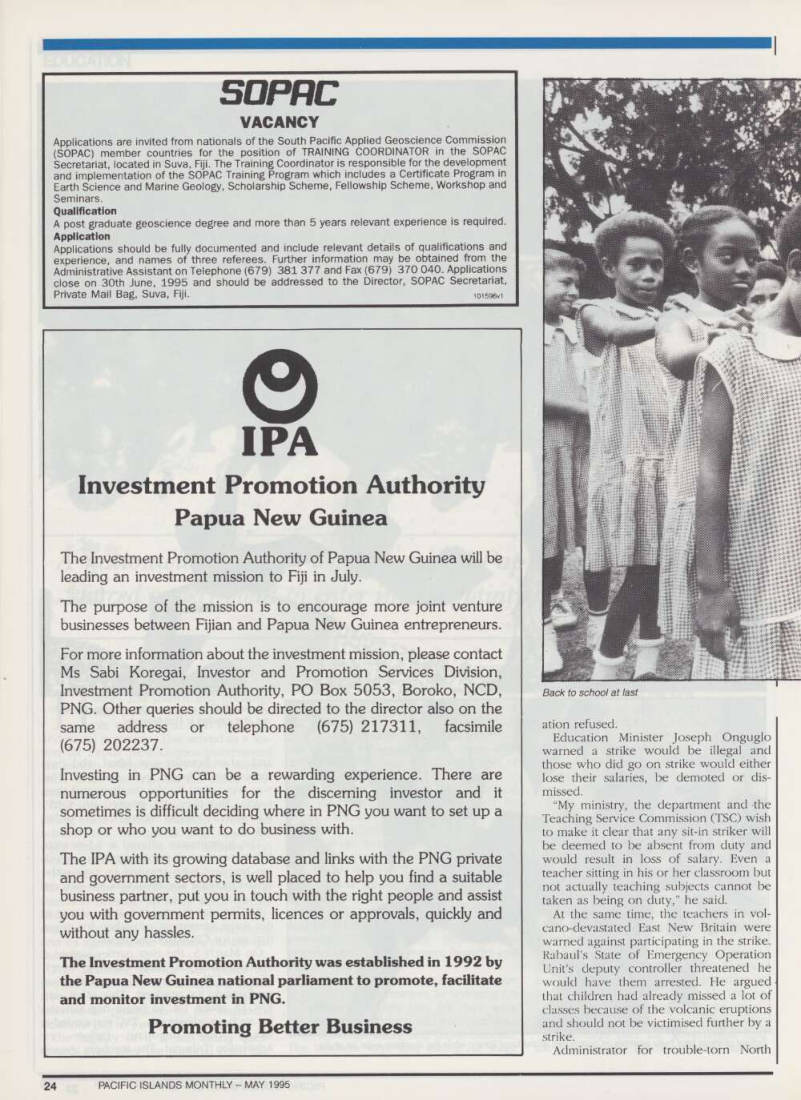
Back to school at last
Solomons Province Sam Tulo gave similar warnings, saying he would use the state of-emergency powers to penalise teach ers.
Despite these warnings, teachers went on strike on March 21. School children around the country stayed away from school because their teachers had told them they would be not teaching for an indefinite period and would not be responsible for their safety at school. But PNGTA made sure its teachers prepared lessons to keep the children busy while they were at home.
Parents, who were informed ahead of time about the reasons for the strike, were sympathetic to them. Even the Catholic Church, which runs a number of schools, were supportive of the teachers.
But the government viewed the situa tion differently. The day thd strike broke, it took PNGTA to court seeking, among other things, an order requiring teachers to return to work. The court instead ordered the disputing parties to convene a compulsory meeting to be chaired by the chairman of the Arbitration Tribunal, Margaret Elias.
The meeting broke down and the par ties returned to court four days later, which again sent them back to the com pulsory meeting.
Elias referred the disputed matters to the Arbitration Tribunal after a brief hear ing when the Teacher’s Association main tained its stand on the strike, saying the strike would not be lifted unless the gov ernment came up with something posi tive for them.
Eventually, the two parties got together to begin negotiations until an agreement was reached promising teachers K 6.5 mil lion in increases between April and May, while the Education Department would come up with a new school calendar to make up for time lost.
President of PNGTA Taina Bai, howev er, reminded the government the teachers demands were only one of the many
cases needing
urgent atten tion and unless it attended to them, there would be seri ous repercus sions for the country.
"We little peo ple down here are not blind, we have eyes to see; we little
people down
here are not deaf, we have ears to hear.
We are your
subjects and
you are our
people (lead
ers) we rely on.”
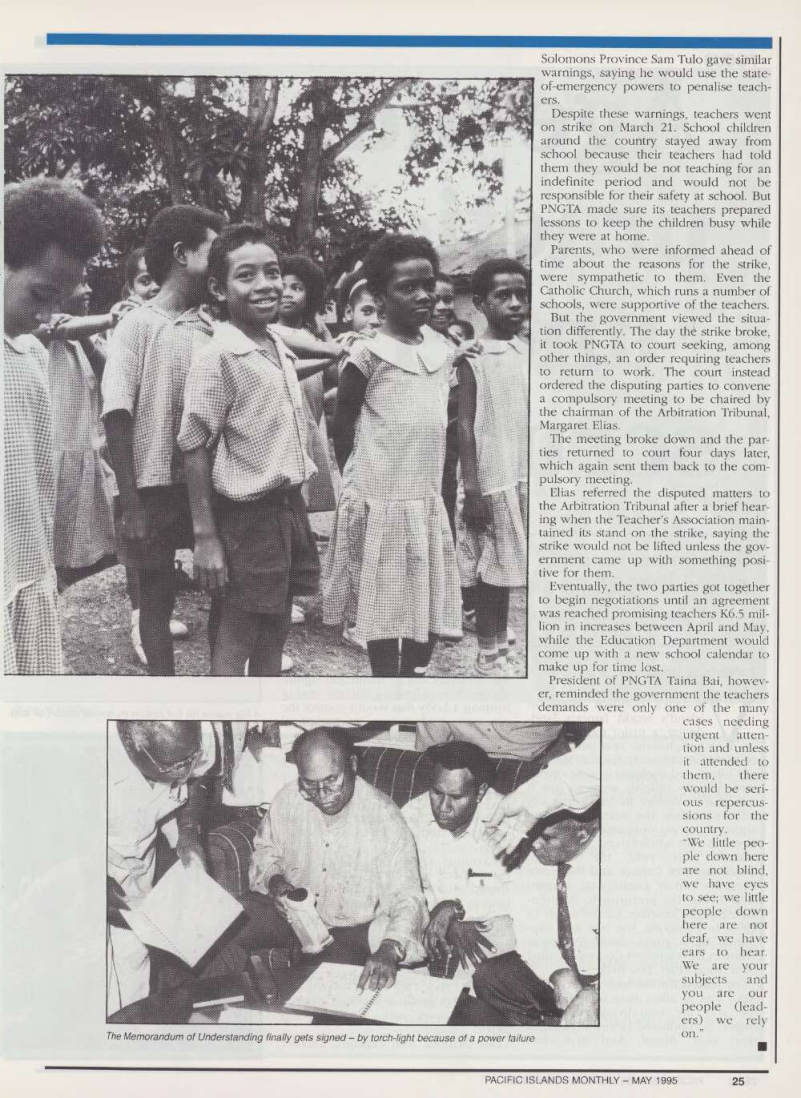
The Memorandum of Understanding finally gets signed - by torch-light because of a power failure