A major
pp. 18-19 · Read in the full issue
Economy
currency crisis
As the Cook Islands dollar teeters on the brink of collapse, no answers are forthcoming from politicians
By Yunus Rashid
Unless drastic financial policies are implemented to arrest the declining pur chasing power of the Cook Islands dol lar, people would start feeling the pinch of poverty in about a month. This was the warning given by one of the five opposition members of the Cooks parlia ment, Doctor Robert Woonton.
Dr Woonton said investment had been dwindling over the months as the small nation was hit by damaging scandals.
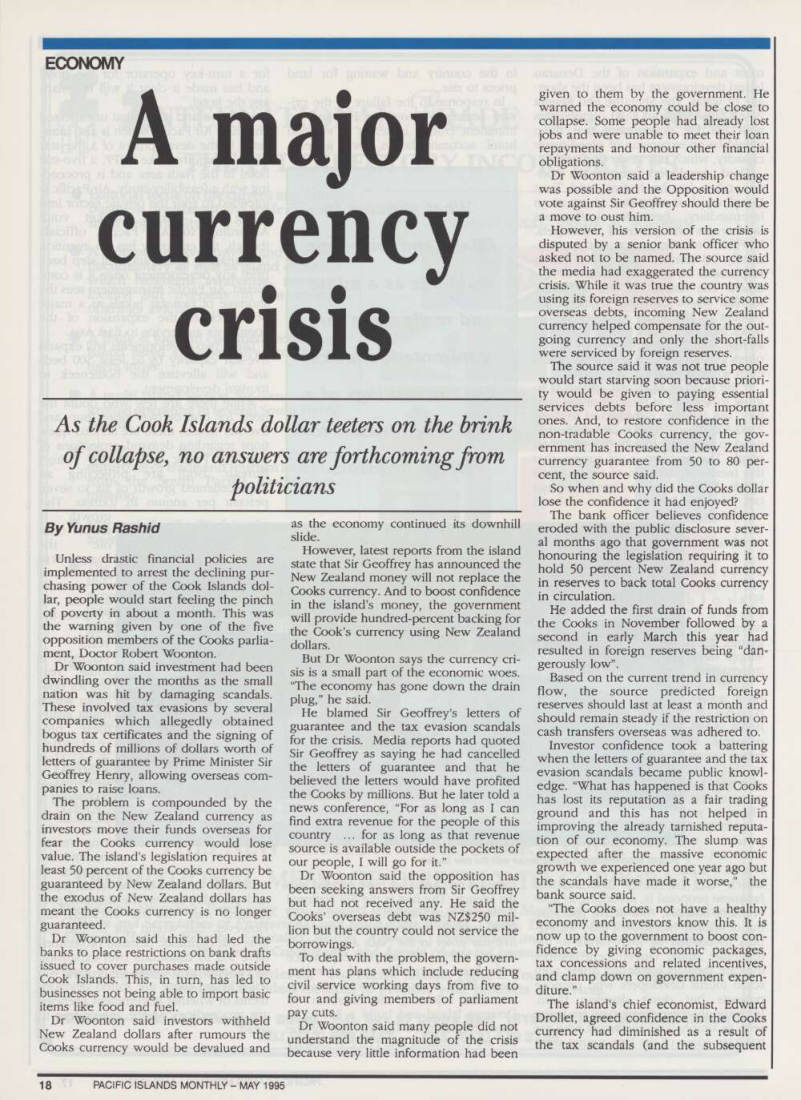
These involved tax evasions by several companies which allegedly obtained bogus tax certificates and the signing of hundreds of millions of dollars worth of letters of guarantee by Prime Minister Sir Geoffrey Henry, allowing overseas com panies to raise loans.
The problem is compounded by the drain on the New Zealand currency as investors move their funds overseas for fear the Cooks currency would lose value. The island’s legislation requires at least 50 percent of the Cooks currency be guaranteed by New Zealand dollars. But the exodus of New Zealand dollars has meant the Cooks currency is no longer guaranteed.
Dr Woonton said this had led the banks to place restrictions on bank drafts issued to cover purchases made outside Cook Islands. This, in turn, has led to businesses not being able to import basic items like food and fuel.
Dr Woonton said investors withheld New Zealand dollars after rumours the Cooks currency would be devalued and
as the economy continued its downhill slide.
However, latest reports from the island state that Sir Geoffrey has announced the New Zealand money will not replace the Cooks currency. And to boost confidence in the island’s money, the government will provide hundred-percent backing for the Cook’s currency using New Zealand dollars.
But Dr Woonton says the currency cri sis is a small part of the economic woes.
“The economy has gone down the drain plug,” he said.
He blamed Sir Geoffrey’s letters of guarantee and the tax evasion scandals for the crisis. Media reports had quoted Sir Geoffrey as saying he had cancelled the letters of guarantee and that he believed the letters would have profited the Cooks by millions. But he later told a news conference, “For as long as I can find extra revenue for the people of this country ... for as long as that revenue source is available outside the pockets of our people, I will go for it.”
Dr Woonton said the opposition has been seeking answers from Sir Geoffrey but had not received any. He said the Cooks’ overseas debt was NZ$25O mil lion but the country could not service the
borrowings.
To deal with the problem, the govern ment has plans which include reducing civil service working days from five to four and giving members of parliament pay cuts.
Dr Woonton said many people did not understand the magnitude of the crisis because very little information had been
given to them by the government. He warned the economy could be close to
collapse. Some people had already lost
jobs and were unable to meet their loan repayments and honour other financial
obligations.
Dr Woonton said a leadership change was possible and the Opposition would vote against Sir Geoffrey should there be a move to oust him.
However, his version of the crisis is disputed by a senior bank officer who asked not to be named. The source said the media had exaggerated the currency crisis. While it was true the country was using its foreign reserves to service some overseas debts, incoming New Zealand currency helped compensate for the out going currency and only the short-falls were serviced by foreign reserves.
The source said it was not true people would start starving soon because priori ty would be given to paying essential services debts before less important ones. And, to restore confidence in the non-tradable Cooks currency, the gov ernment has increased the New Zealand currency guarantee from 50 to 80 per cent, the source said.
So when and why did the Cooks dollar lose the confidence it had enjoyed?
The bank officer believes confidence eroded with the public disclosure sever al months ago that government was not honouring the legislation requiring it to hold 50 percent New Zealand currency in reserves to back total Cooks currency in circulation.
He added the first drain of funds from the Cooks in November followed by a second in early March this year had resulted in foreign reserves being “dan
gerously low”.
Based on the current trend in currency flow, the source predicted foreign reserves should last at least a month and should remain steady if the restriction on cash transfers overseas was adhered to.
Investor confidence took a battering when the letters of guarantee and the tax evasion scandals became public knowl edge. “What has happened is that Cooks has lost its reputation as a fair trading ground and this has not helped in improving the already tarnished reputa tion of our economy. The slump was expected after the massive economic growth we experienced one year ago but the scandals have made it worse,” the bank source said.
“The Cooks does not have a healthy economy and investors know this. It is now up to the government to boost con fidence by giving economic packages, tax concessions and related incentives, and clamp down on government expen diture.”
The island’s chief economist, Edward Drollet, agreed confidence in the Cooks currency had diminished as a result of the tax scandals (and the subsequent
enquiry into it), the size of the nation’s debts and rumours.
Drollet said that to prevent the country from losing all its money, banks had imposed exchange controls against the repatriation of funds. And to prevent liq uidity problems, the Reserve Bank ruled that cheques written in the Cooks would not be honoured in New Zealand. This means all transfers have to be done elec tronically, allowing the government to keep a tab on the money that goes out.
Remittance can be made only for essen tial services.
Drollet said the rumours of food and other supplies running out were false. He explained that food flow into the country had slowed down because payments were made on the baqis of money com ing into the country. The banks, in an effort to control their overseas reserves, were operating on a day-to-day basis. He added the government had not stepped in to help the banks control cash sur pluses because this had not been neces sary.
Meanwhile, Cook Islands News report ed the Public Service Commission would retire 156 workers between May and December with a payout amounting to about U 55650,000. The newspaper said these workers were long overdue for retirement - some are in their seventies.
Under the new public service policy, the oldest workers would be retired first, then those who have turned 60 or have completed 46 years of service.
The newspaper quoted Public Service commissioner Pae Puna as saying those affected already had income from three sources: old-age pension, superannua tion and their salaries.
Puna said when the 156 retirements were completed, the commission would begin enforcing the 60-year age and 40year service retirement regulation. And the remaining civil servants face shorter working hours.
The Opposition Alliance Party has crit
icised this plan, saying it would adversely affect the lowly paid civil servants. They have in turn come up with a plan which they say would be better than slashing working hours.
The plan includes: • Reducing all ministerial and MP salaries by 25 percent. • Stopping all overseas travel and junkets on first and busi ness classes. • Stopping tax-free allowances for the elite public servants. • Taking no more dance teams on travel junkets. • Switching to the New Zealand currency immediately. • Stopping the Cook Islands national constitution festival for 1995 and other “money-wast ing” festivals. • Reducing the size of Cabinet from nine to five or three mem bers. ■
Sir Geoffrey Henry: blamed for the economic crisis
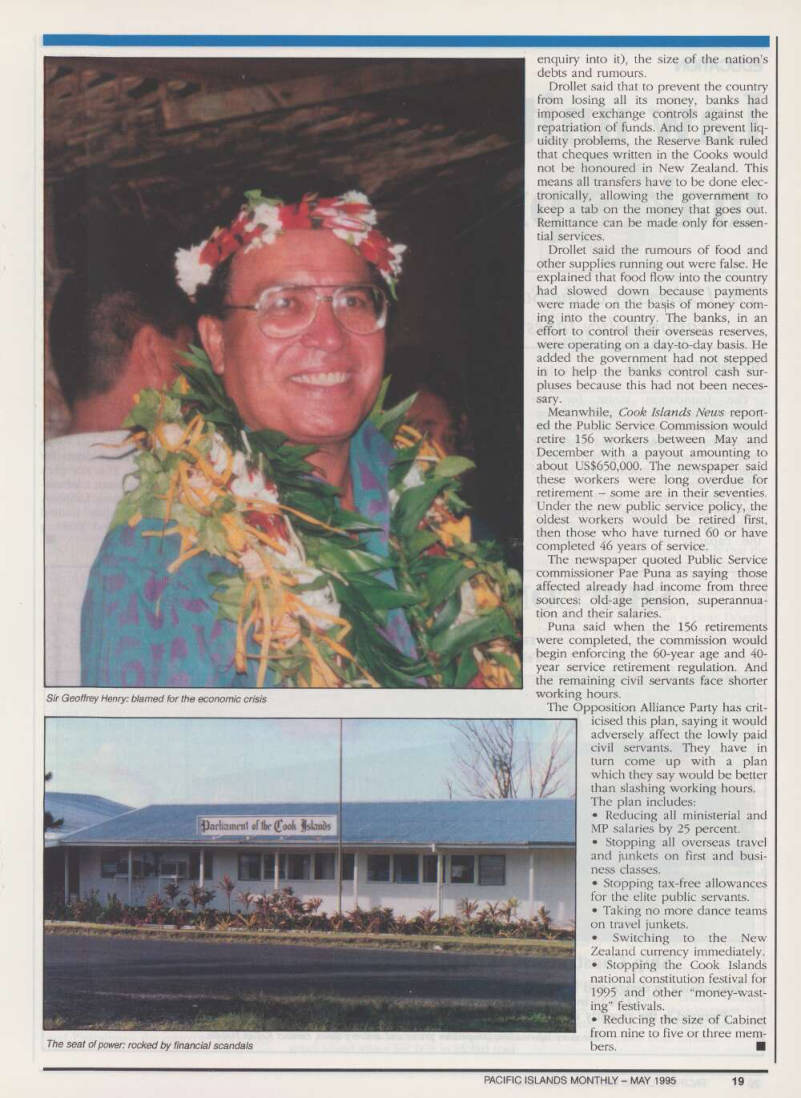
The seat of power: rocked by financial scandals