the investors?
pp. 15-17 · Read in the full issue

Tourism
But where are the investors?
For an industry that is shoxving increases in demand and profits, there is a surprising lack
of interest from the private sector
By Roman Grynberg
It would be difficult to ask for more if you were running the Fiji tourism sector. From the outside the sector seems to be moving ahead quite nicely. Tourism arrivals are grow ing at what the Fiji Visitors Bureau pro jects will be a rate of six percent at the end of the century. In 1994, Fiji had 318,000 tourist arrivals, up from 278,000 in 1993. Total earnings from tourism were $419-6 million in 1994. If the FVB is to be believed then we shall
foreign exchange earnings of tourism leaking out for imported products for the same sector, the remainder is suffi ciently large.
But while the arrival statistics are booming, they mask a fundamental cri sis of confidence in the industry’s future. The loss of confidence is all the more surprising given the changes in the industry - from relying on the old low-income, Australian and New Zealand visitors to a new high-income, high-profit tourism from East Asia and North America.
the words of government tourism offi cials, exhibited high occupancy and increasing yields as five-star hotels such as the Sheraton and Regent raise prices.
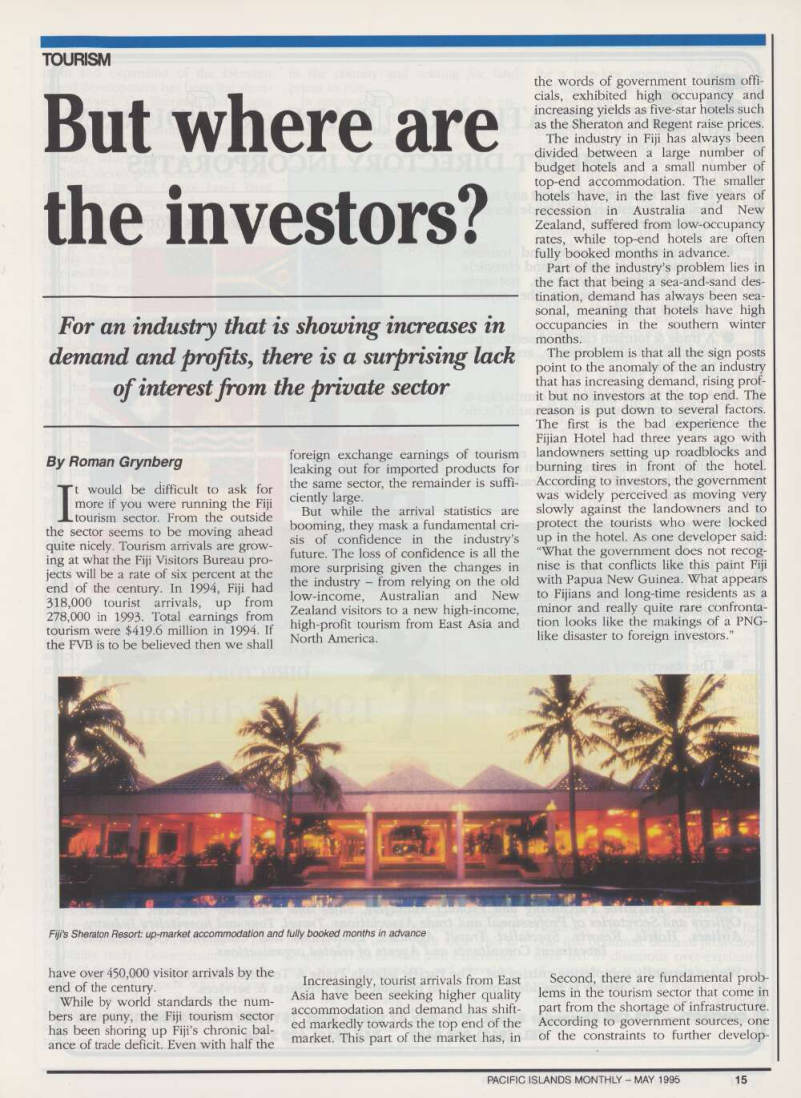
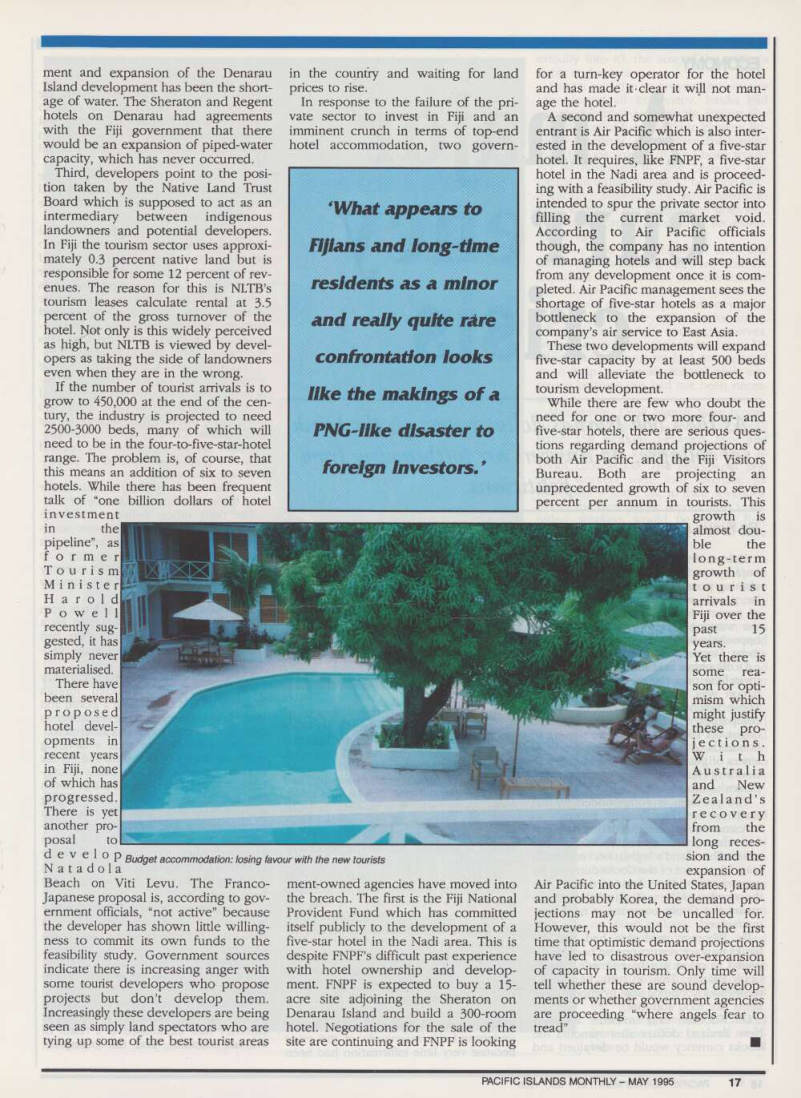
The industry in Fiji has always been divided between a large number of budget hotels and a small number of top-end accommodation. The smaller hotels have, in the last five years of recession in Australia and New Zealand, suffered from low-occupancy rates, while top-end hotels are often fully booked months in advance.
Part of the industry’s problem lies in the fact that being a sea-and-sand des tination, demand has always been sea sonal, meaning that hotels have high occupancies in the southern winter months.
The problem is that all the sign posts point to the anomaly of the an industry that has increasing demand, rising prof it but no investors at the top end. The reason is put down to several factors.
The first is the bad experience the Fijian FFotel had three years ago with landowners setting up roadblocks and burning tires in front of the hotel.
According to investors, the government was widely perceived as moving very slowly against the landowners and to protect the tourists who were locked up in the hotel. As one developer said: “What the government does not recog nise is that conflicts like this paint Fiji with Papua New Guinea. What appears to Fijians and long-time residents as a minor and really quite rare confronta tion looks like the makings of a PNG like disaster to foreign investors.”
have over 450,000 visitor arrivals by the end of the century.
While by world standards the num bers are puny, the Fiji tourism sector has been shoring up Fiji’s chronic bal ance of trade deficit. Even with half the
Increasingly, tourist arrivals from East
Asia have been seeking higher quality
accommodation and demand has shift ed markedly towards the top end of the market. This part of the market has, in
Second, there are fundamental prob lems in the tourism sector that come in part from the shortage of infrastructure.
According to government sources, one of the constraints to further develop
Fiji’s Sheraton Resort: up-market accommodation and fully booked months in advance
ment and expansion of the Denarau Island development has been the short age of water. The Sheraton and Regent hotels on Denarau had agreements with the Fiji government that there would be an expansion of piped-water capacity, which has never occurred.
Third, developers point to the posi tion taken by the Native Land Trust Board which is supposed to act as an intermediary between indigenous landowners and potential developers.
In Fiji the tourism sector uses approxi mately 0.3 percent native land but is responsible for some 12 percent of rev enues. The reason for this is NLTB’s tourism leases calculate rental at 3.5 percent of the gross turnover of the hotel. Not only is this widely perceived as high, but NLTB is viewed by devel opers as taking the side of landowners even when they are in the wrong.
If the number of tourist arrivals is to grow to 450,000 at the end of the cen tury, the industry is projected to need 2500-3000 beds, many of which will need to be in the four-to-five-star-hotel range. The problem is, of course, that this means an addition of six to seven hotels. While there has been frequent talk of “one billion dollars of hotel investment
in the I pipeline”, as former Tourism Minister Harold Powell recently sug gested, it has simply never materialised.
There have been several proposed hotel devel opments in recent years in Fiji, none of which has progressed.
There is yet another pro posal to
develop
Nata d o 1 a
Beach on Viti Levu. The Franco- Japanese proposal is, according to goveminent officials, “not active” because the developer has shown little willingness to commit its own funds to the feasibility study. Government sources indicate there is increasing anger with some tourist developers who propose projects but don’t develop them, Increasingly these developers are being seen as simply land spectators who are tying up some of the best tourist areas
in the country and waiting for land prices to rise.
In response to the failure of the private sector to invest in Fiji and an imminent crunch in terms of top-end hotel accommodation, two govern-
' What appears to
Fijians and long-time
residents as a minor and really quite rare confrontation looks like the makings of a PNG-like disaster to
foreign Investors
ment-owned agencies have moved into the breach. The first is the Fiji National Provident Fund which has committed itself publicly to the development of a five-star hotel in the Nadi area. This is despite FNPF’s difficult past experience with hotel ownership and develop ment. FNPF is expected to buy a 15acre site adjoining the Sheraton on Denarau Island and build a 300-room hotel. Negotiations for the sale of the site are continuing and FNPF is looking
for a turn-key operator for the hotel and has made it clear it will not man age the hotel.
A second and somewhat unexpected entrant is Air Pacific which is also inter ested in the development of a five-star hotel. It requires, like FNPF, a five-star hotel in the Nadi area and is proceed ing with a feasibility study. Air Pacific is intended to spur the private sector into filling the current market void.
According to Air Pacific officials though, the company has no intention of managing hotels and will step back from any development once it is com pleted. Air Pacific management sees the shortage of five-star hotels as a major bottleneck to the expansion of the company’s air service to East Asia.
These two developments will expand five-star capacity by at least 500 beds and will alleviate the bottleneck to tourism development.
While there are few who doubt the need for one or two more four- and five-star hotels, there are serious ques tions regarding demand projections of both Air Pacific and the Fiji Visitors Bureau. Both are projecting an unprecedented growth of six to seven percent per annum in tourists. This
growth is I almost dou- I ble the
I long-term
I growth of tourist I arrivals in I Fiji over the I past 15
i years.
Yet there is some rea son for opti- I mism which I might justify these pro jections.
With I Australia and New Zealand’s recovery from the long reces sion and the expansion of
Air Pacific into the United States, Japan and probably Korea, the demand pro jections may not be uncalled for.
However, this would not be the first time that optimistic demand projections have led to disastrous over-expansion of capacity in tourism. Only time will tell whether these are sound develop ments or whether government agencies are proceeding “where angels fear to tread”
Budget accommodation: losing favour with the new tourists