a leader
pp. 12-13 · Read in the full issue
Obituary
A nation mourns a leader
Vanuatu pays homage to former President Fred Timakata
By Patrick Decloitre
Vanuatu’s second President and a founding father of the island state, Fred Timakata, died at his Port Vila home, aged 59, on March 21. The nation’s politicians paid homage to him at a cere mony which was the biggest ever for a statesmen. Vanuatu’s dignitaries, tradi tional chiefs, ministers, members of Opposition and numerous ordinary folk recognised Timakata’s contribution to the
island’s history.
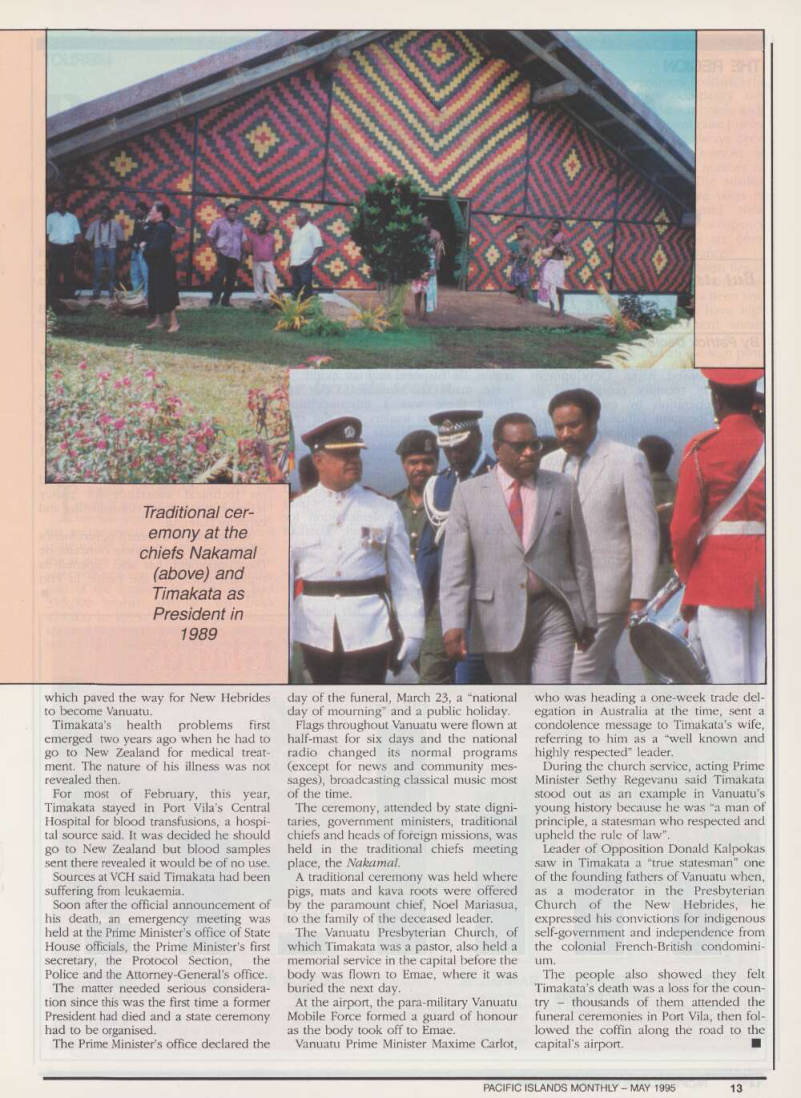
Timakata was one of the early leaders of the Vanuaaku Pati. He was Vanuatu’s president from 1989 to 1994.
A former Presbyterian pastor and tradi tional chief, Timakata (who comes from Emae Island in Vanuatu) had earlier been a deputy Prime Minister and Minister of Home Affairs in Vanuatu’s first govern ment after independence, from 1980 to 1983.
He had also held the positions of
Speaker of Parliament from 1983 to 1987 and Minister of Health from 1987 to 1989.
He was Chancellor of the University of the South Pacific from 1992 to 1993.
His term as head of state was marked by his strong stand to uphold the consti tution and his insistence on maintaining a code of conduct among leaders.
Timakata was not only a religious and political leader, he was also one of the highest traditional chiefs of Vanuatu. He received his customary name, Timakata, in 1975 on Emae Island. The same year, the Council of Chiefs, the Shepherds, elected him to become their voice in the pre-independence Representative Assembly. Two years later, the assembly was dissolved and he became a member of the constitution drafting committee,
which paved the way for New Hebrides to become Vanuatu.
Timakata’s health problems first emerged two years ago when he had to go to New Zealand for medical treat ment. The nature of his illness was not revealed then.
For most of February, this year, Timakata stayed in Port Vila’s Central Hospital for blood transfusions, a hospi tal source said. It was decided he should go to New Zealand but blood samples sent there revealed it would be of no use.
Sources at VCH said Timakata had been suffering from leukaemia.
Soon after the official announcement of his death, an emergency meeting was held at the Prime Minister’s office of State House officials, the Prime Minister’s first secretary, the Protocol Section, the Police and the Attorney-General’s office.
The matter needed serious considera tion since this was the first time a former President had died and a state ceremony had to be organised.
The Prime Minister’s office declared the
day of the funeral, March 23, a “national day of mourning” and a public holiday.
Flags throughout Vanuatu were flown at half-mast for six days and the national radio changed its normal programs (except for news and community mes sages), broadcasting classical music most of the time.
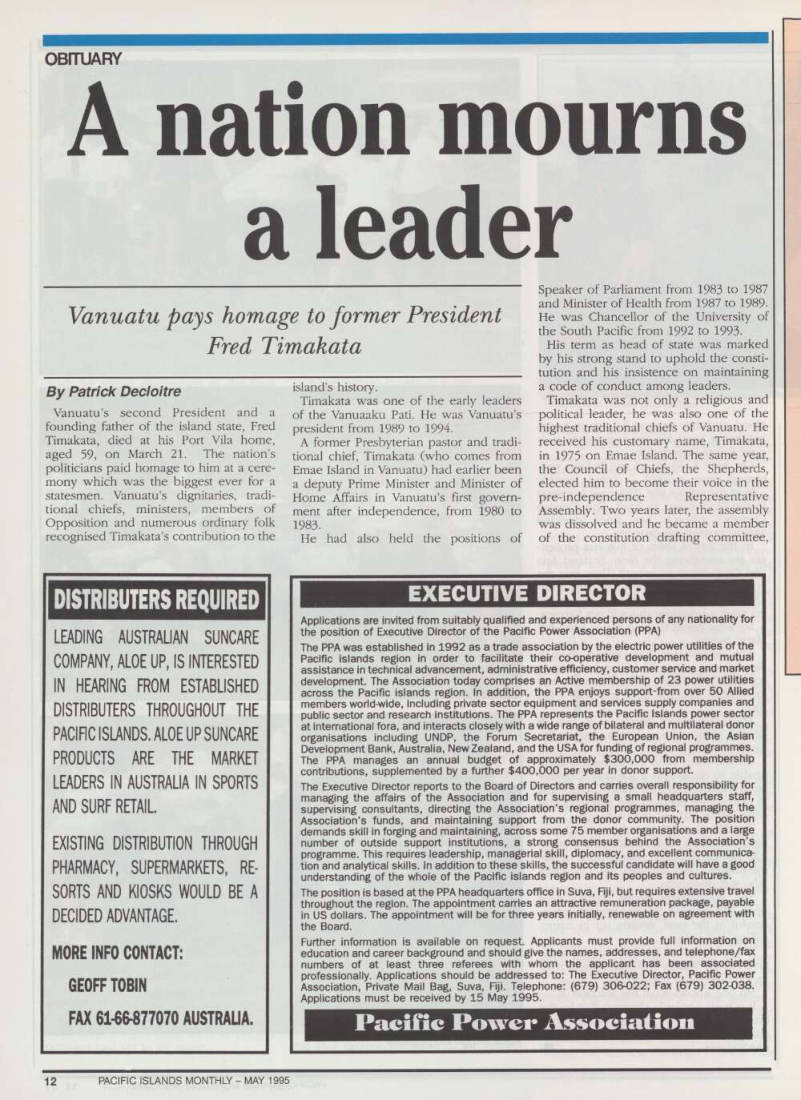
The ceremony, attended by state digni taries, government ministers, traditional chiefs and heads of foreign missions, was held in the traditional chiefs meeting place, the Nakamal.
A traditional ceremony was held where pigs, mats and kava roots were offered by the paramount chief, Noel Mariasua, to the family of the deceased leader.
The Vanuatu Presbyterian Church, of which Timakata was a pastor, also held a memorial service in the capital before the body was flown to Emae, where it was buried the next day.
At the airport, the para-military Vanuatu Mobile Force formed a guard of honour as the body took off to Emae.
Vanuatu Prime Minister Maxime Carlot,
who was heading a one-week trade del egation in Australia at the time, sent a condolence message to Timakata’s wife, referring to him as a “well known and highly respected” leader.
During the church service, acting Prime Minister Sethy Regevanu said Timakata stood out as an example in Vanuatu’s young history because he was “a man of principle, a statesman who respected and upheld the rule of law”.
Leader of Opposition Donald Kalpokas saw in Timakata a “true statesman” one of the founding fathers of Vanuatu when, as a moderator in the Presbyterian Church of the New Hebrides, he expressed his convictions for indigenous
self-government and independence from
the colonial French-British condomini um.
The people also showed they felt Timakata’s death was a loss for the coun try - thousands of them attended the funeral ceremonies in Port Vila, then fol lowed the coffin along the road to the capital’s airport. ■
Traditional cer emony at the chiefs Nakamal (above) and Timakata as President in 1989