The Kiwi
pp. 10-11 · Read in the full issue
New Zealand
The Kiwi dilemma
As the Maori openly defy the law, the authorities appear powerless to do anything
By Martin Tiffany
A Pakeha man is kicked off an Auckland park for illegal occupation of the land.
This seemingly small incident magnifies a sore point in the Maori land enigma (some may say madness) currently facing the New Zealand government - a puzzle that has epidemic qualities which those in power seem at a loss to control.
Alistair Goodwin, a 37-year-old surf reporter and landscaper, pitched his tent in Albert Park in inner city Auckland on March 26 to protest Maori occupation of Wanganui’s Motua Gardens. On March 27 police evicted him after he ignored a tres pass notice from the Auckland City Council. His eviction only added weight to the point he was making: “You can’t have different laws for different races”.
At the Wanganui gardens hundreds of Maori ignored an eviction notice from the local council and around 1500 Maori par tied as the spm deadline passed on March 30.
Maori have occupied the gardens, which they have renamed Pakaitore Marae, since February 28. They say they are reclaiming land which is rightfully theirs.
Protest leader Ken Mair said the reclaiming of the gardens should encour age other Kiwi (Maori tribal groups) to do the same in their areas.
Despite other land disputes in recent months before the Motua Gardens occu pation, the Wanganui stand-off seems to mark a new and improved resurgence of Maori activists and protesters. As veteran protester Eva Rickard said, the stand in Wanganui was “the beginning of the Maori nation”.
Many people are angry at the decision not to forcibly remove the garden occu piers .
The Wanganui local council looked to the government for guidance. The gov ernment basically said, “It’s your problem you sort it out”.
In April the council went to the High Court seeking a decision on the land ownership. As this issue went to press a decision had yet to be made.
If a decision is made that is not favourable to the garden occupiers, no doubt Mair will repeat his famous we
don’t-recognise-Pakeha-law line.
It is ironic that the Wanganui protesters threatened to go to the Police Complaints
Authority with police brutality and harass
ment claims - even though they do not recognise Pakeha law.
There were a few angry scenes in Wanganui and police reinforcements were called to the city. Maori set up a roadblock and smashed windows of two cars which tried to drive through the blockade. There were a few minor skir mishes, some disorderly behaviour and a number of fierce haka (Maori war dance). A handful of men were charged with disorderly conduct.
A lid was able to be kept on the situa tion, one that had the potential to boil over into nasty racial violence.
However, the fact that the Maori ignored the law and stayed on the land remains a sore point. The government seems perplexed as it tries to tackle a del icate situation which, if not handled cor rectly, could turn into the worst conflict between Maori and Pakeha in recent times - one that would make Bastion Point look like a school-yard scuffle.
In 1978 Maori activists were kicked off land at Bastion Point after a 506-day cam paign. They were forced off by 600 police and servicemen; 222 protesters were arrested and many were convicted of wil ful trespass.
Nine years later the Waitagi Tribunal ruled that Bastion Point be returned to the Ngati Whatua - the tribe evicted from their huts on the site in the 1950 s - who had watched as their homes were torched.
The tribunal ruled the area remain a public park. The government paid $3 mil lion in reparation “to inaugurate pro grammes necessary for the tribe’s rehabil itation”.
The Waitagi Tribunal is a body of 17 members, currently 60 percent Pakeha and 40 percent Maori, set up to rule on land claims. However, the tribunal is act ing as a catalyst for some of the current
unrest and land claims.
Some Maori say they have given the tri bunal 10 years but it has failed to pro duce the desired results.
The tribunal is under tremendous pres sure. It has over 400 land claim cases pending and few resources. A single case can take years to complete and may require substantial specialist research - all of which cost money. The tribunal is con tinually asking for more funds from the government to help it operate effectively.
Also stirring up the Maori is a younger, more radical, better educated (in Maori history) element which is taking control and playing on the emotions of the younger Maori. The elders seem to be losing power.
The Maori, who make up 12 to 13 percent of the population, have an unemployment rate three times the national aver age - one in four are unemployment.
They also have lower education than the national average and 75 percent earn less
than NZ$2O,OOO.
Out of this, the unrest, the protests and the petty violence come easily. They are a race who feel they have legitimate grievances.
One only has to look at the history of land in Auckland to understand these grievances. Thousands of acres of prime land were bought by Pakeha for a pit tance - blankets, tobacco and a few hun dred pounds - and sold for big profits.
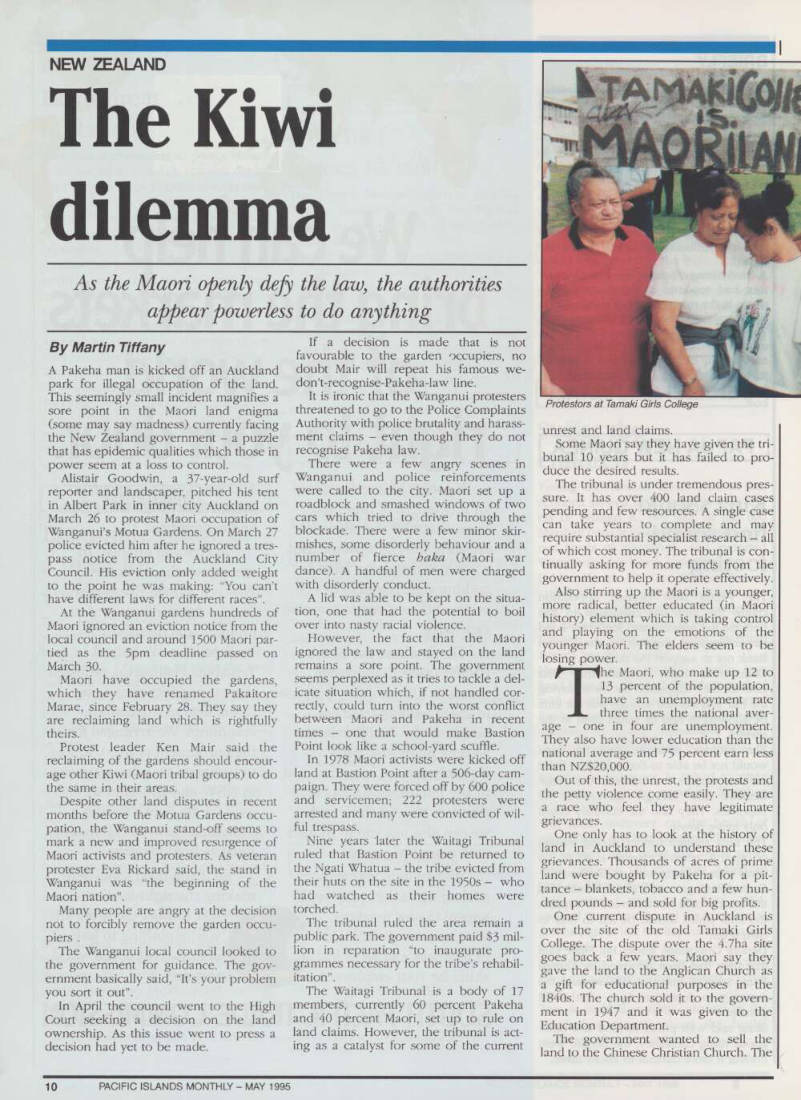
One current dispute in Auckland is over the site of the old Tamaki Girls College. The dispute over the 4.7 ha site goes back a few years. Maori say they gave the land to the Anglican Church as a gift for educational purposes in the 1840 s. The church sold it to the govern ment in 1947 and it was given to the Education Department.
The government wanted to sell the land to the Chinese Christian Church. The
Protestors at Tamaki Girls College
Maori said they wanted it back as it was not being used for the community pur pose it was intended for.
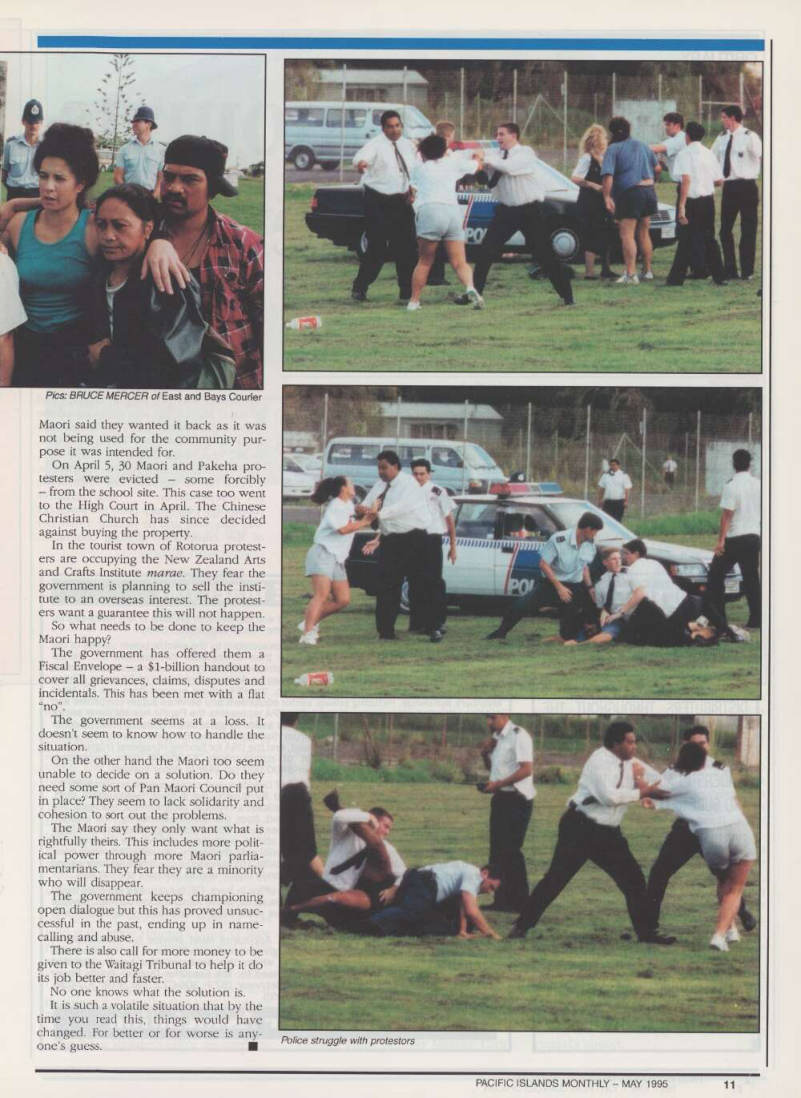
On April 5, 30 Maori and Pakeha pro testers were evicted - some forcibly - from the school site. This case too went to the High Court in April. The Chinese Christian Church has since decided against buying the property.
In the tourist town of Rotorua protest ers are occupying the New Zealand Arts and Crafts Institute marae. They fear the government is planning to sell the insti tute to an overseas interest. The protest ers want a guarantee this will not happen.
So what needs to be done to keep the
Maori happy?
The government has offered them a Fiscal Envelope - a $ 1-billion handout to cover all grievances, claims, disputes and incidentals. This has been met with a flat “no”.
The government seems at a loss. It doesn’t seem to know how to handle the situation.
On the other hand the Maori too seem unable to decide on a solution. Do they need some sort of Pan Maori Council put in place? They seem to lack solidarity and cohesion to sort out the problems.
The Maori say they only want what is rightfully theirs. This includes more polit ical power through more Maori parlia mentarians. They fear they are a minority who will disappear.
The government keeps championing
open dialogue but this has proved unsuc cessful in the past, ending up in name calling and abuse.
There is also call for more money to be given to the Waitagi Tribunal to help it do its job better and faster.
No one knows what the solution is.
It is such a volatile situation that by the time you read this, things would have changed. For better or for worse is any one’s guess. ■
Pics: BRUCE MERCER of East and Bays Courier
Police struggle with protestors