Politics
pp. 26-28 · Read in the full issue

By Yunus Rashid
pressure from a minority group.
The church had waged an intense cam paign against the lifting of the ban, but this did not dampen the enthusiasm with which government defended its decision, even when attacked by some of its own backbenchers.
The Opposition parties, especially the Indian parties, did not enter into debate over what they considered a “natural” deci sion for the good of the country. When Parliament endorsed the decision, the Methodists branded Rabuka a “Judas” and “traitor of the church”.
The Bill went to Senate where it found many sympathisers and the general feeling was the Bill would get through. But an extra ordinary sequence of events happened when it was time to vote. The Bill was passed by voice but Bole, who was put in Senate by Rabuka, called for division or voice count. The Bill was lost by one vote,
Fiji’s political pundits were left gaping when Prime Minister Sitiveni Rabuka ably dribbled the lifting of the con troversial Sunday Observance Decree Bill through parliament only to have it kicked out of goal by his own man, Senator Filipe Bole.
What was to have been a positive turning point in Rabuka’s leadership became a vic tory for the Methodist Church.
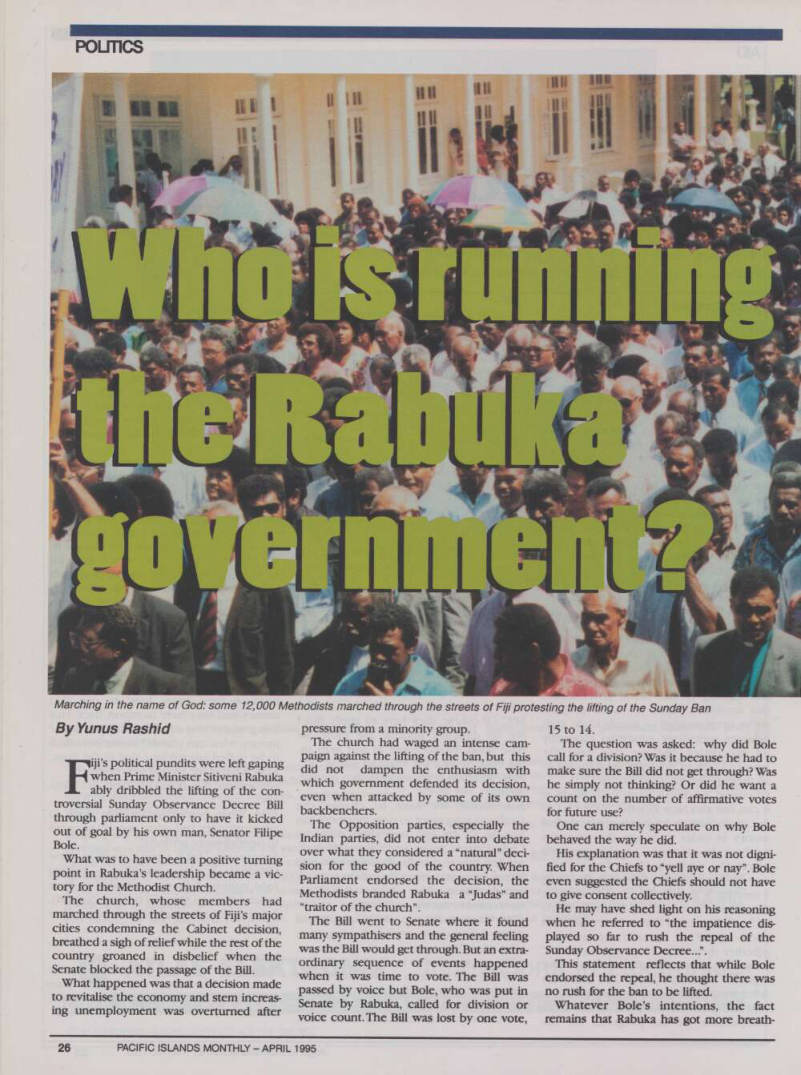
The church, whose members had marched through the streets of Fiji’s major cities condemning the Cabinet decision, breathed a sigh of relief while the rest of the country groaned in disbelief when the Senate blocked the passage of the Bill.
What happened was that a decision made to revitalise the economy and stem increas ing unemployment was overturned after
15 to 14.
The question was asked: why did Bole call for a division? Was it because he had to make sure the Bill did not get through? Was he simply not thinking? Or did he want a count on the number of affirmative votes for future use?
One can merely speculate on why Bole behaved the way he did.
His explanation was that it was not digni fied for the Chiefs to “yell aye or nay”. Bole even suggested the Chiefs should not have to give consent collectively.
He may have shed light on his reasoning when he referred to “the impatience dis played so far to rush the repeal of the Sunday Observance Decree...”.
This statement reflects that while Bole endorsed the repeal, he thought there was no rush for the ban to be lifted.
Whatever Bole’s intentions, the fact remains that Rabuka has got more breath
Marching in the name of God: some 12,000 Methodists marched through the streets of Fiji protesting the lifting of the Sunday Ban
ing space and the Methodists are happy.
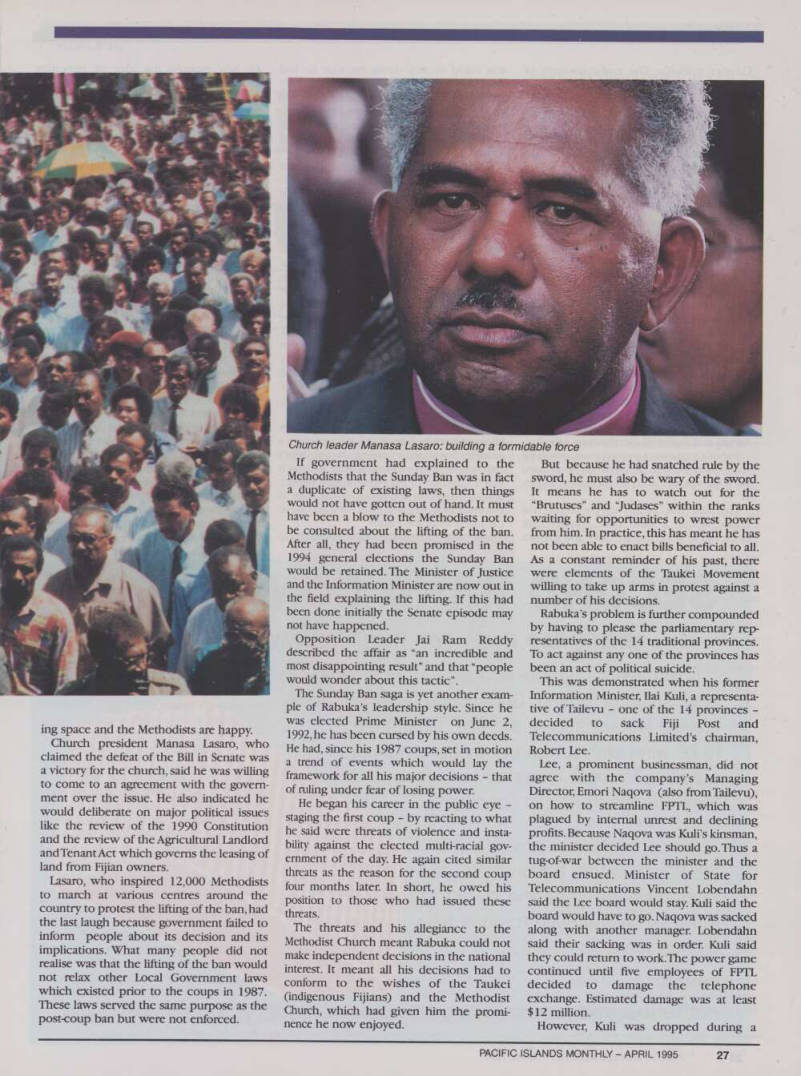
Church president Manasa Lasaro, who claimed the defeat of the Bill in Senate was a victory for the church, said he was willing to come to an agreement with the govern ment over the issue. He also indicated he would deliberate on major political issues like the review of the 1990 Constitution and the review of the Agricultural Landlord and Tenant Act which governs the leasing of land from Fijian owners.
Lasaro, who inspired 12,000 Methodists to march at various centres around the country to protest the lifting of the ban, had the last laugh because government failed to inform people about its decision and its implications. What many people did not realise was that the lifting of the ban would not relax other Local Government laws which existed prior to the coups in 1987.
These laws served the same purpose as the post-coup ban but were not enforced.
If government had explained to the Methodists that the Sunday Ban was in fact a duplicate of existing laws, then things would not have gotten out of hand. It must have been a blow to the Methodists not to be consulted about the lifting of the ban.
After all, they had been promised in the 1994 general elections the Sunday Ban would be retained. The Minister of Justice and the Information Minister are now out in the field explaining the lifting. If this had been done initially the Senate episode may not have happened.
Opposition Leader Jai Ram Reddy described the affair as “an incredible and most disappointing result” and that “people would wonder about this tactic”.
The Sunday Ban saga is yet another exam ple of Rabuka’s leadership style. Since he was elected Prime Minister on June 2, 1992, he has been cursed by his own deeds.
He had, since his 1987 coups, set in motion a trend of events which would lay the framework for all his major decisions - that of ruling under fear of losing power.
He began his career in the public eye staging the first coup - by reacting to what he said were threats of violence and insta bility against the elected multi-racial gov ernment of the day. He again cited similar threats as the reason for the second coup four months later. In short, he owed his position to those who had issued these threats.
The threats and his allegiance to the Methodist Church meant Rabuka could not make independent decisions in the national interest. It meant all his decisions had to conform to the wishes of the Taukei (indigenous Fijians) and the Methodist Church, which had given him the promi nence he now enjoyed.
But because he had snatched rule by the sword, he must also be wary of the sword.
It means he has to watch out for the “Brutuses” and “Judases” within the ranks waiting for opportunities to wrest power from him. In practice, this has meant he has not been able to enact bills beneficial to all.
As a constant reminder of his past, there were elements of the Taukei Movement willing to take up arms in protest against a number of his decisions.
Rabuka’s problem is further compounded by having to please the parliamentary rep resentatives of the 14 traditional provinces.
To act against any one of the provinces has been an act of political suicide.
This was demonstrated when his former Information Minister, Ilai Kuli, a representa tive ofTailevu - one of the 14 provinces decided to sack Fiji Post and Telecommunications Limited’s chairman, Robert Lee.
Lee, a prominent businessman, did not agree with the company’s Managing Director, Emori Naqova (also fromTailevu), on how to streamline FPTL, which was plagued by internal unrest and declining profits. Because Naqova was Kuli’s kinsman, the minister decided Lee should go. Thus a tug-of-war between the minister and the board ensued. Minister of State for Telecommunications Vincent Lobendahn said the Lee board would stay. Kuli said the board would have to go. Naqova was sacked along with another manager. Lobendahn said their sacking was in order. Kuli said they could return to work. The power game continued until five employees of FPTL decided to damage the telephone exchange. Estimated damage was at least $l2 million.
However, Kuli was dropped during a
Church leader Manasa Lasaro: building a formidable force
Cabinet reshuffle. The embarrassment of the FPTL saga followed by the drop from the Cabinet line-up made Kuli a bitter foe.
Being a tyro in politics, Rabuka’s prob lems began almost as soon as he took office. The biggest scandal, which flared at the same time as the FF*TL saga, was the out of-court settlement reached between gov ernment and Suva businessman Anthony Stephens. Stephens had sued government for $3O million for wrongful detention in 1987. Government agreed to pay Stephens a total of $lO million in cash and property in return for the withdrawal of the writ.
When documents relating to the payout were leaked to the media, Rabuka’s Attorney-General Apaitia Seru resigned and Parliament resolved to have a Commission of Inquiry investigate the deal. The findings of the inquiry became the basis of a police investigation and Seru and Stephens were charged with forgery.
These incidents indirectly led to the fall of the Rabuka government 18 months later.
Kuli and several other backbenchers voted against the 1993 Budget in the hope of a leadership change. Parliament was dis solved and a general election was called.
Rabuka’s charisma proved more powerful than many pundits believed, as he cruised back into power with an increased majori ty- This did not mean his problems had ended. Within a short time, another split occurred in government ranks and Rabuka
was asked to step down because he had called for a Government of National Unity and there were allegations that he had com mitted adultery. Rabuka offered to resign if the parliamentary SVT caucus wanted him to. The caucus decided in favour of Rabuka staying.
To Rabuka’s credit, despite being a novice to the cut-throat game of politics, he was able to pick his way through the onslaught of problems. The Opposition pushed him for a review of the Constitution and ALTA, investors asked for better economic poli cies, school leavers demanded jobs, the Fijians wanted more positive discrimina tion, he had to be wary of some of his back benchers, some of his ministers acted inde pendently bringing greater disrepute to the government and then there was the Methodist church talking about bloodshed.
The threat came when government refused to implement the recommenda tions of a Job Evaluation Exercise and refused to go to arbitration. But the strike threat forced government to arbitration, which is continuing.
Then there was Rabuka’s Information Minister, Ratu Jo Dimuri, trying to secure a majority local shareholding in the News Ltd-owned Fiji Times newspaper. He said it was a question of Fiji’s sovereignty. Rabuka quickly moved in and dispelled the fears of investors that their interests were second to the interests of the Fijians.
Just prior to that, the Trade Minister, Jim
Ah Koy, mooted the idea of importing American chickens - only by Fijians. What the Minister had hoped would gain him popularity turned out to be his and the gov ernment’s embarrassment. Fijian sharehold ers in the local chicken industry criticised the idea saying it was aimed at putting them out of business. The idea was shelved.
The latest scheme to attract widespread bad press was the proposed Hong Kong Chinese immigration plan. (Story PIM March 1995). Two ministers decided this was a way to energise Fiji’s ailing economy without any proper research. And because they could not explain the impact of such a move on Fiji’s political, social and econom ic structures - let alone identify the pro posers of the deal - the plan was left to die a natural death.
These are but a few examples of how Rabuka’s government has been running the show. It is unfortunate that when Rabuka was ready to act as the leader of the coun try and make a decision in the national interest, he gave in to a minority.
A poll conducted by the Fiji Times recent ly revealed for the first time since polling began in August 1993, that Rabuka’s popu larity rating had plunged dramatically, and that he was losing support amongst all sec tions of the community.
At this rate, if his government continues down the path of indecision, mismanage ment and pressure-group politics, Rabuka could find himself out of a job. ■