War on VAGST
pp. 22-23 · Read in the full issue
Economy
Western Samoa's controversial Value added Goods and Services Tax comes under fire once again and the government retaliates by charger two key organisers with sedition
By Alan Ah Mu
In February, a protest march against the Value Added Goods and Services Tax was postponed when two of its leading organisers were charged with sedition.
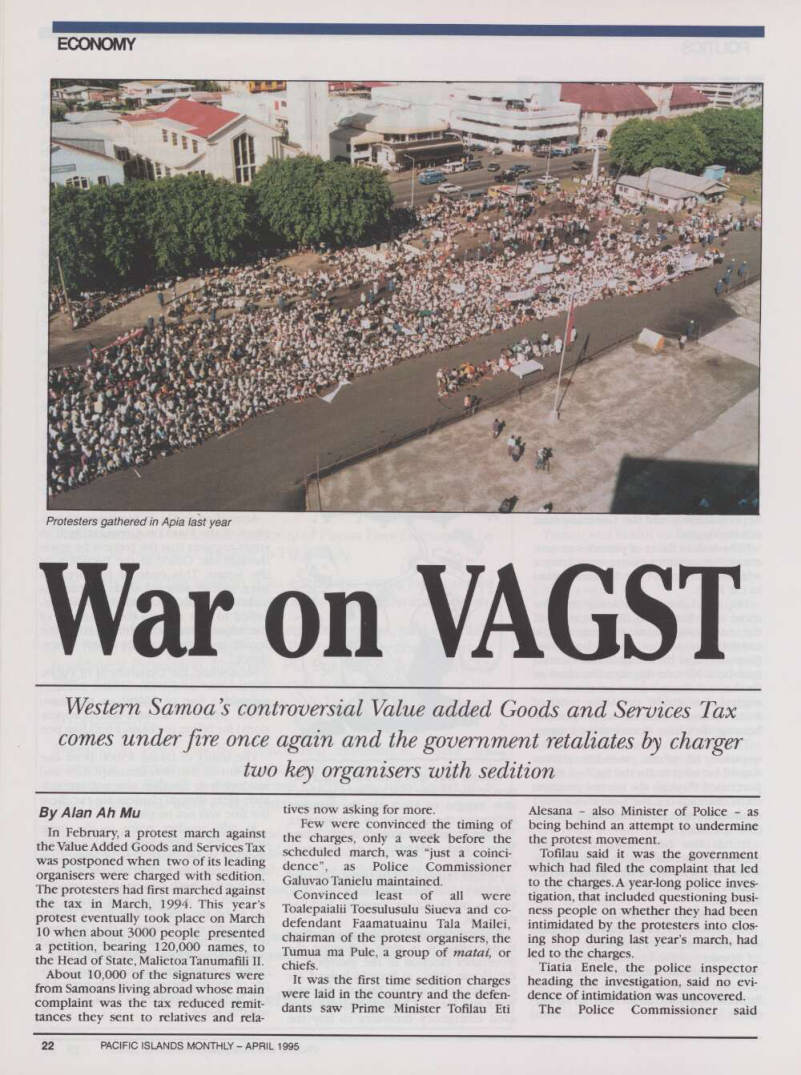
The protesters had first marched against the tax in March, 1994. This year’s protest eventually took place on March 10 when about 3000 people presented a petition, bearing 120,000 names, to the Head of State, MalietoaTanumafili 11.
About 10,000 of the signatures were from Samoans living abroad whose main complaint was the tax reduced remit tances they sent to relatives and rela
tives now asking for more.
Few were convinced the timing of the charges, only a week before the scheduled march, was “just a coinci dence”, as Police Commissioner Galuvao Tanielu maintained.
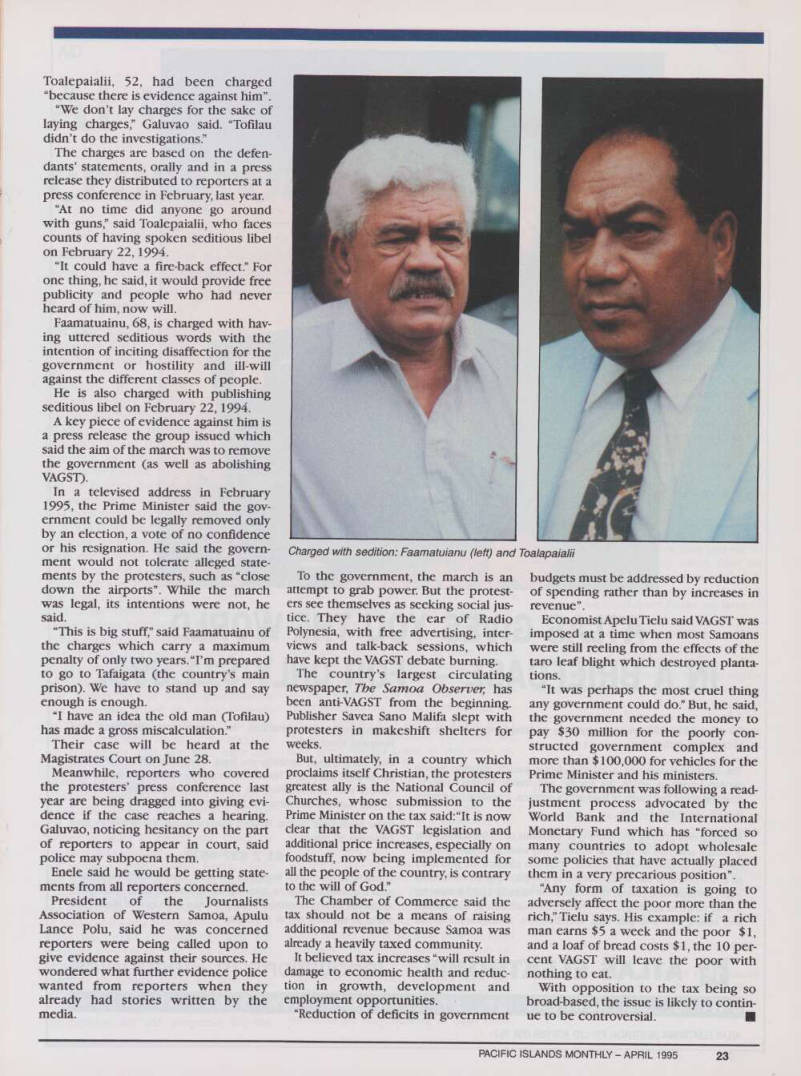
Convinced least of all were Toalepaialii Toesulusulu Siueva and co defendant Faamatuainu Tala Mailei, chairman of the protest organisers, the Tumua ma Pule, a group of matai, or chiefs.
It was the first time sedition charges were laid in the country and the defen dants saw Prime Minister Tofilau Eti
Alesana - also Minister of Police - as being behind an attempt to undermine the protest movement.
Tofilau said it was the government which had filed the complaint that led to the charges. A year-long police inves tigation, that included questioning busi ness people on whether they had been intimidated by the protesters into clos ing shop during last year’s march, had led to the charges.
Tiatia Enele, the police inspector heading the investigation, said no evi dence of intimidation was uncovered.
The Police Commissioner said
Protesters gathered in Apia last year
Toalepaialii, 52, had been charged “because there is evidence against him”.
“We don’t lay charges for the sake of laying charges,” Galuvao said. “Tofilau didn’t do the investigations.”
The charges are based on the defen dants’ statements, orally and in a press release they distributed to reporters at a press conference in February, last year.
“At no time did anyone go around with guns,” said Toalepaialii, who faces counts of having spoken seditious libel on February 22,1994.
“It could have a fire-back effect.” For one thing, he said, it would provide free publicity and people who had never heard of him, now will.
Faamatuainu, 68, is charged with hav ing uttered seditious words with the intention of inciting disaffection for the government or hostility and ill-will against the different classes of people.
He is also charged with publishing seditious libel on February 22,1994.
A key piece of evidence against him is a press release the group issued which said the aim of the march was to remove the government (as well as abolishing
Vagst).
In a televised address in February 1995, the Prime Minister said the gov ernment could be legally removed only by an election, a vote of no confidence or his resignation. He said the govern ment would not tolerate alleged state ments by the protesters, such as “close down the airports”. While the march was legal, its intentions were not, he said.
“This is big stuff,” said Faamatuainu of the charges which carry a maximum penalty of only two years. “I’m prepared to go to Tafaigata (the country’s main prison). We have to stand up and say enough is enough.
“I have an idea the old man (Tofilau) has made a gross miscalculation.”
Their case will be heard at the Magistrates Court on June 28.
Meanwhile, reporters who covered the protesters’ press conference last year are being dragged into giving evi dence if the case reaches a hearing.
Galuvao, noticing hesitancy on the part of reporters to appear in court, said police may subpoena them.
Enele said he would be getting state ments from all reporters concerned.
President of the Journalists Association of Western Samoa, Apulu Lance Polu, said he was concerned reporters were being called upon to give evidence against their sources. He wondered what further evidence police wanted from reporters when they already had stories written by the media.
To the government, the march is an attempt to grab power. But the protesters see themselves as seeking social justice. They have the ear of Radio Polynesia, with free advertising, interviews and talk-back sessions, which have kept the VAGST debate burning.
The country’s largest circulating newspaper, The Samoa Observer, has been anti-VAGST from the beginning, Publisher Savea Sano Malifa slept with protesters in makeshift shelters for weeks.
But, ultimately, in a country which proclaims itself Christian, the protesters greatest ally is the National Council of Churches, whose submission to the Prime Minister on the tax said:“lt is now clear that the VAGST legislation and additional price increases, especially on foodstuff, now being implemented for all the people of the country, is contrary to the will of God.”
The Chamber of Commerce said the tax should not be a means of raising additional revenue because Samoa was already a heavily taxed community. il believed tax increases “will result in damage to economic health and reduction in growth, development and
employment opportunities.
“Reduction of deficits in government
budgets must be addressed by reduction of spending rather than by increases in revenue”.
Economist ApeluTielu said VAGST was imposed at a time when most Samoans were still reeling from the effects of the taro leaf blight which destroyed planta tions.
“It was perhaps the most cruel thing any government could do.” But, he said, the government needed the money to pay $3O million for the poorly con structed government complex and more than $lOO,OOO for vehicles for the Prime Minister and his ministers, The government was following a read justment process advocated by the World Bank and the International Monetary Fund which has “forced so many countries to adopt wholesale some policies that have actually placed them in a very precarious position”, “Any form of taxation is going to adversely affect the poor more than the rich,” Tielu says. His example; if a rich man earns $5 a week and the poor $l, and a loaf of bread costs $ 1, the 10 per cent VAGST will leave the poor with nothing to eat.
With opposition to the tax being so broad-based, the issue is likely to contin ue to be controversial. ■
Charged with sedition: Faamatuianu (left) and Toalapaialii