Building
p. 34 · Read in the full issue
Papua New Guinea
The First
Block
F
rom little seeds grow large trees.
That’s very much the story of Boral Gas Pacific (BGP) whose first seed
was planted nearly 30 years ago in Papua New Guinea. In those three decades the PNG operations have grown to be one of the company’s largest in the Pacific.
From PNG the company’s ‘little seeds’ floated out into the Pacific to become the sizeable regional operations that they are today.
BGP is a major force in PNG en ergy. It has five terminals—at Port Moresby, Lae, Rabaul, Wewak and Mt Hagen —to service the needs of the nation’s growing economy.
LPG is used extensively throughout in dustry, in mining and in government serv ices such as the armed forces. As the most populous nation in the Pacific, PNG also has the largest potential domestic market.
The company is seeking to target this through the development of new facili ties —a major 200-tonne terminal is planned for Madang and a 20-tonne de pot is to be built at Kimbe.
The company was in partnership, un der a variety of names, with the famous Pacific trading company of W.R. Carpen ter for many years. From its earliest days the company employed PNG nationals, under a cadetship scheme aimed at de veloping local employees.
The company now says proudly that its PNG operations have been localised for 21 years ... and the personnel training pro gram continues to develop skilled employ ees who will play a role in its develop ment.
The capital investment required by the company to keep pace with regional growth over the years has been large.
PNG’s market growth has resulted in sub stantial increases in its terminal tankage.
Tankage in Port Moresby now amounts to 630 tonnes while the Lae terminal has a storage capacity of 410 tonnes.
One of BGP’s recent developments in volved the purchase of a major interna tional petroleum company’s LPG opera tions in PNG.
This was followed by the opening in November 1993 of a new, state-of-the-art depot in Rabaul to replace a facility which
was more than a quarter of a century old.
Even though it is situated on the seafront, the terminal was not badly damaged by eruptions of the Tavurvur and Vulcan vol canoes in 1994.
At no time was the facility shut down and Boral Gas was able to play a major part in the disaster relief operations.
BGP is part of the New Britain com munity which is determined to see Rabaul resurrected from beneath the ashes and lava. The company's PNG manager, Mr Grahame Kell, says: “The terminal is functioning almost nor mally. We are now taking part in the re-building of RabauL “We have had to set up a distribution network in outlying areas to make gas available to those people who have moved to areas surrounding the town.
“Even though the disaster has reduced business activity in Rabaul, a fair propor tion of our business has involved distrib uting gas to customers on nearby islands.
To ensure that they have secure sources of supply we now export to many cus tomers through Lae.”
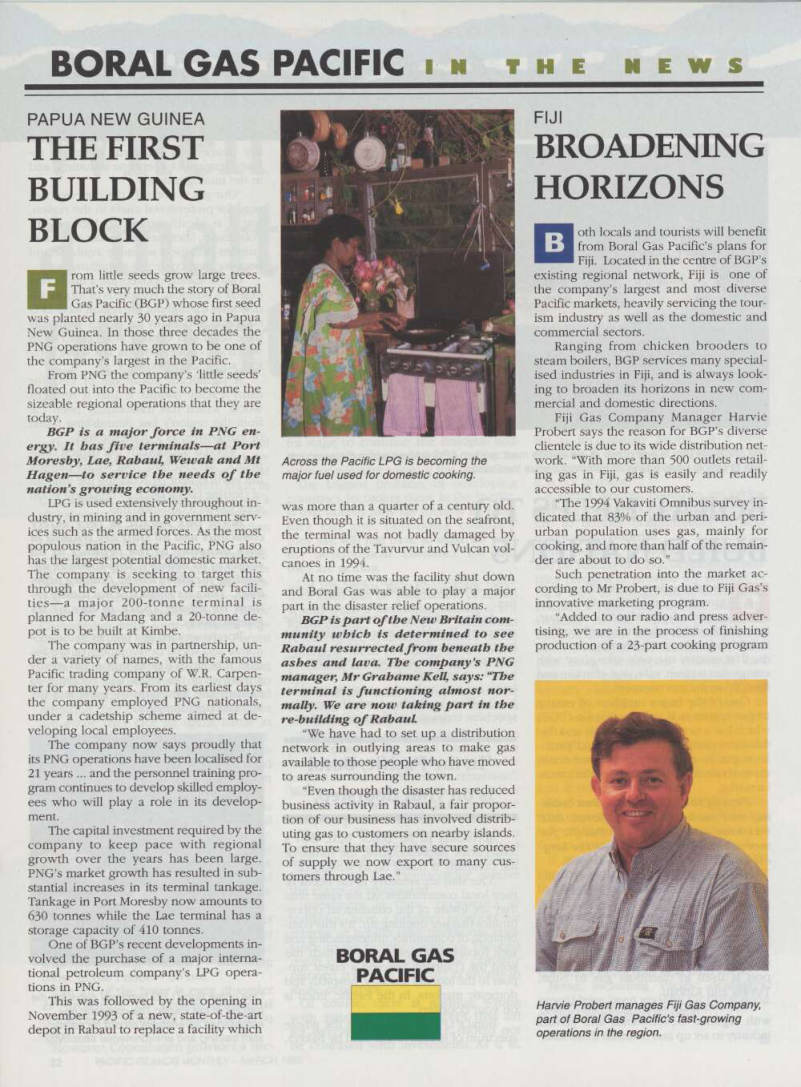
Across the Pacific LPG is becoming the major fuel used for domestic cooking.