Boral Gas Pacific
p. 33 · Read in the full issue
In The News
Boral Helps To
Build Nations
o
ne of the keys to Pacific region growth is energy. From PNG in the west to Cook Islands in the east,
from Marshall Islands in the north to Nor folk Island in the south, development into the 21st century can only take place with energy that is clean, safe, cost-effective and friendly to the environment.
One of the major suppliers of energy to the region is Boral Gas Pacific (BGP) which has a network of terminals and dis tribution centres providing liquid petro leum gas for everything from home cook ers to tourism jet boats and noodle manu
facturing.
Part of the giant Australian build ing and materials group Boral, BGP has been operating in the Pacific for more than 30years. It is now the larg est supplier of LPG in the region.
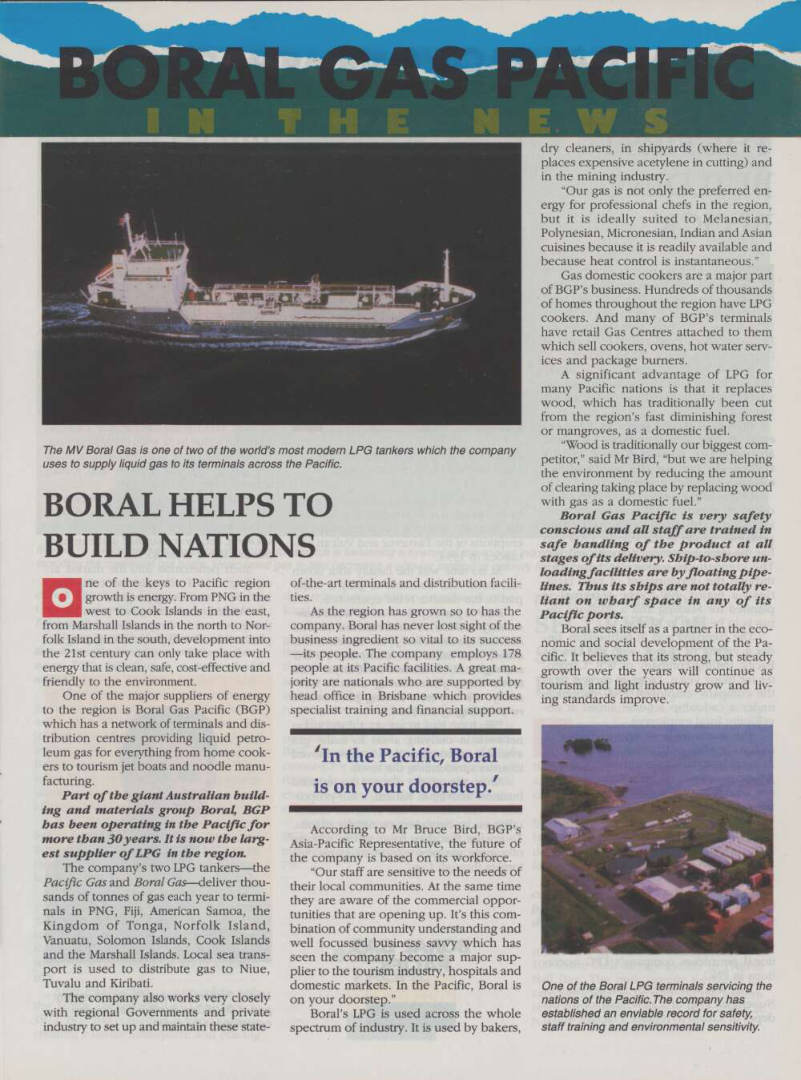
The company’s two LPG tankers—the Pacific Gas and Boral Gas —deliver thou sands of tonnes of gas each year to termi nals in PNG, Fiji, American Samoa, the Kingdom of Tonga, Norfolk Island, Vanuatu, Solomon Islands, Cook Islands and the Marshall Islands. Local sea trans port is used to distribute gas to Niue, Tuvalu and Kiribati.
The company also works very closely with regional Governments and private industry to set up and maintain these state
of-the-art terminals and distribution facili ties.
As the region has grown so to has the company. Boral has never lost sight of the business ingredient so vital to its success —its people. The company employs 178 people at its Pacific facilities. A great ma jority are nationals who are supported by head office in Brisbane which provides specialist training and financial support.
'in the Pacific, Boral is on your doorstep/
According to Mr Bruce Bird, BGP’s Asia-Pacific Representative, the future of the company is based on its workforce.
“Our staff are sensitive to the needs of their local communities. At the same time they are aware of the commercial oppor tunities that are opening up. It’s this com bination of community understanding and well focussed business savvy which has seen the company become a major sup plier to the tourism industry, hospitals and domestic markets. In the Pacific, Boral is on your doorstep.”
Boral’s LPG is used across the whole spectrum of industry. It is used by bakers,
dry cleaners, in shipyards (where it re places expensive acetylene in cutting) and in the mining industry.
“Our gas is not only the preferred en ergy for professional chefs in the region, but it is ideally suited to Melanesian, Polynesian, Micronesian, Indian and Asian cuisines because it is readily available and because heat control is instantaneous.”
Gas domestic cookers are a major part of BGP’s business. Hundreds of thousands of homes throughout the region have LPG cookers. And many of BGP’s terminals have retail Gas Centres attached to them which sell cookers, ovens, hot water serv ices and package burners.
A significant advantage of LPG for many Pacific nations is that it replaces wood, which has traditionally been cut from the region’s fast diminishing forest or mangroves, as a domestic fuel.
“Wood is traditionally our biggest com petitor,” said Mr Bird, “but we are helping the environment by reducing the amount of clearing taking place by replacing wood with gas as a domestic fuel.”
Boral Gas Pacific is very safety conscious and all staff are trained in safe handling of the product at all stages of its delivery. Ship-to-shore un loading facilities are by floating pipe lines. Thus its ships are not totally re liant on wharf space in any of its Pacific ports.
Boral sees itself as a partner in the eco nomic and social development of the Pa cific. It believes that its strong, but steady growth over the years will continue as tourism and light industry grow and liv ing standards improve.
The MV Boral Gas is one of two of the world's most modern LPG tankers which the company uses to supply liquid gas to its terminals across the Pacific.
One of the Boral LPG terminals servicing the nations of the Pacific. The company has established an enviable record for safety, staff training and environmental sensitivity.