Fiji’s
pp. 54-55 · Read in the full issue
Sports
Fiji’s lone surfer
By Shailendra Singh
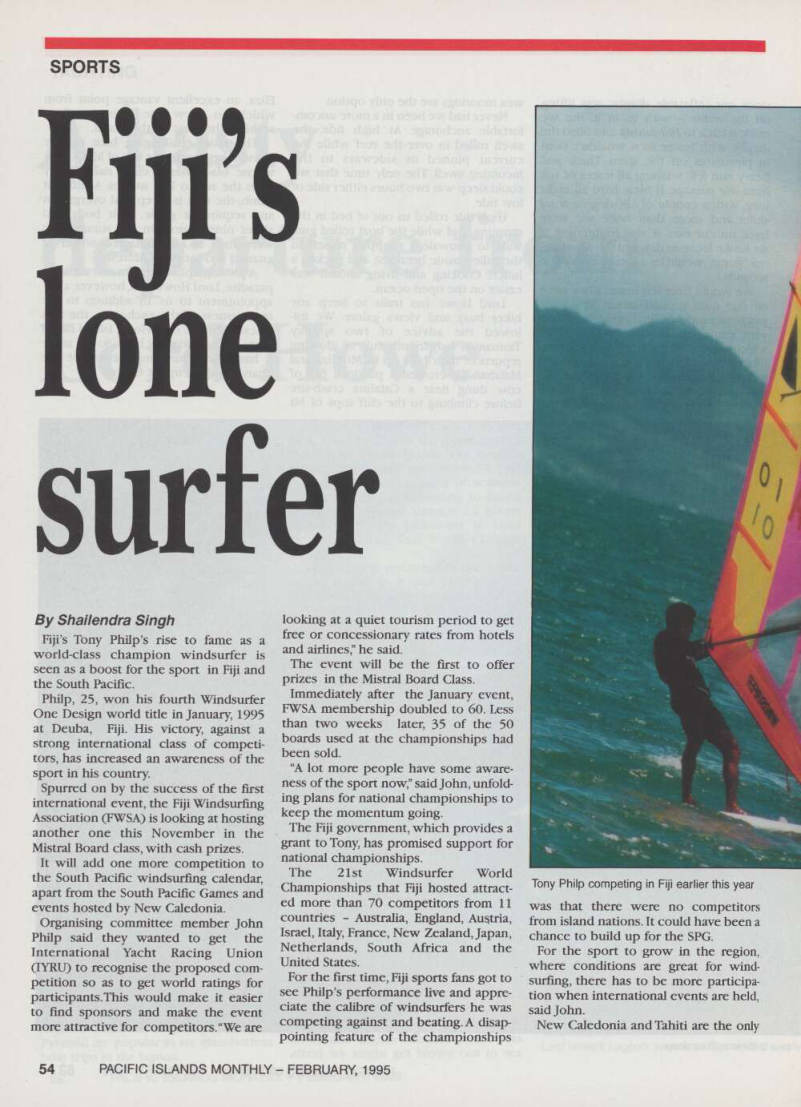
Fiji’s Tony Philp’s rise to fame as a world-class champion windsurfer is seen as a boost for the sport in Fiji and the South Pacific Philp, 23, won his fourth Windsurfer One Design world title in January, 1995 at Deuba, Fiji. His victory, against a strong international class of competi tors, has increased an awareness of the sport in his country Spurred on by the success of the first international event, the Fiji Windsurfing Association (FWSA) is looking at hosting another one this November in the Mistral Board class, with cash prizes.
It will add one more competition to the South Pacific windsurfing calendar, apart from the South Pacific Games and events hosted by New Caledonia.
Organising committee member John Philp said they wanted to get the International Yacht Racing Union (IYRU) to recognise the proposed com petition so as to get world ratings for participants. This would make it easier to find sponsors and make the event more attractive for competitors.“We are
looking at a quiet tourism period to get free or concessionary rates from hotels and airlines,” he said.
The event will be the first to offer prizes in the Mistral Board Class.
Immediately after the January event, FWSA membership doubled to 60. Less than two weeks later, 35 of the 30 boards used at the championships had been sold.
“A lot more people have some aware ness of the sport now,” said John, unfold ing plans for national championships to keep the momentum going.
The Fiji government, which provides a grant to Tony, has promised support for
national championships.
The 21st Windsurfer World Championships that Fiji hosted attract ed more than 70 competitors from 11 countries - Australia, England, Austria, Israel, Italy, France, New Zealand, Japan, Netherlands, South Africa and the United States.
For the first time, Fiji sports fans got to see Philp’s performance live and appre ciate the calibre of windsurfers he was competing against and beating. A disap pointing feature of the championships
was that there were no competitors from island nations. It could have been a chance to build up for the SPG.
For the sport to grow in the region, where conditions are great for wind surfing, there has to be more participa tion when international events are held, said John.
New Caledonia and Tahiti are the only
Tony Philp competing in Fiji earlier this year
other island countries which see regular competition and play host to some big events.
John said they did not come to Fiji because they used Olympic Class boards. Competitors from both coun tries, and Papua New Guinea, Guam and the Cook Islands, are expected for the
November championships.
The progress of the sport in the South Pacific pleases Tony Philp. He dreams of more islands holding regular interna tional competitions. While conditions for windsurfing are perfect in the South Pacific, its isolation is a setback.
“It’s hard for people to get proper competition or keep pursuing the sport,’’Tony said. “We have to hold more competitions and get top windsurfers to compete here. It’ll just snowball from there.”
For Tony the struggle to become world champion was especially hard.
Initially he had to do without the kind of government support and corporate sponsorship that comes easily to wind surfers from more developed countries.
It has been a lonely ride, admits Tony, who has been Fiji’s only competitor at many of the championships.
An unyielding love for the sport and sheer determination to achieve his goals saw him through. Having captured four windsurfer world titles, Tony feels the sacrifices have been worth it.
He’s happier now that his country is waking up to his achievements. Tony first won the windsurfer world title in Adelaide,Australia, in 1991 and repeated the feat the following year.
When the news reached home, few people knew much about him or his sport. 1993 was again Tony’s year in South Africa but he lost to Australian Beau Moulson at Illawara, Australia last year.
By the time Fiji got to host the cham pionships in January, Tony was a well known sporting figure to local fans. At the end of the week-long event, he emerged a national hero.
“I was really happy with the way it went,” he said. “Just incredible. Local support was great and winning, on top of that, was the icing on the cake.”
It was Tony who proposed to the IYRU that Fiji should host the championships.
“I always knew Fiji had the potential to hold such a big event, given the loca tion, the facilities and the weather,” he said.
There was tremendous expectation and he said he felt the pressure. The media scrutiny on him was intense throughout the championships.
Australian Lars Kleppich, who won a bronze medal at the 1992 Olympics, was Tony’s biggest threat. Kleppich was hav ing a great race in the lightweight divi sion, beating Moulson cleanly in two dis
ciplines, but his performance tapered
off on the final day.
Tony surged through, winning the freestyle brilliantly, to add to his first place in the course racing and the slalom in his middleweight class.
“The freestyle comes naturally to me,” he said. “I was doing it as soon as I could windsurf.” Tony is the first windsurfer to equal American Matt Schweitzer’s four world titles.
“It’s a great honour,” he said.Apart from his performance, Tony was delighted with the organisation.
“The overseas windsurfers had a good time in Fiji.The organisers did a fantastic job,” he said. The opening of the cham pionships was an elaborate affair, steeped in culture and tradition. A drua (double-hulled Fijian canoe) was sailed to the venue with Moulson, Kiwi wind surfer Aaron McIntosh and Philp on board.
Escorted by traditionally dressed Fijian warriors, the party presented a tabua (whale’s tooth) to the traditional owner of Deuba, Ratu Isei Saketa, asking his permission to land and for the use of the sea and surrounding areas.
This followed the ceremony of Vakasobo and qaloqalovi, which is equivalent to being granted permission to land.
The competitors were then invited to participate in a yaqona ceremony, known as sevusevu, prepared by the hosts.
On a sour note, however, Australian windsurfers Adam Quinn and girlfriend Susan Calvert became victims of Fiji’s burgeoning crime rate when thieves broke into their villa and stole personal belongings valued at $1000. Police caught the culprits and some of the items were recovered.
There were some complaints about “outdated” equipment after a few boards broke. But Philp said that was to be expected, given the demands placed on the boards by some very strong and agile windsurfers. “It happens when you have a lot of good windsurfers around.”
Philp is now eying the SPG in August where a clash looms between him and New Caledonian star Micel Quitin.
Quitin, who is on the French national team, was the Olympic Class champion for three consecutive years. He always participates in the SPG.
“He beat me in 1987 and 1991 so, nat urally, I’d like to turn the tables on him,”
Philp said. His ultimate aim is a medal at next year’s Olympic Games. He finished 10th at the 1992 Olympics. ■