Guarding
pp. 24-27 · Read in the full issue
Fisheries
our last renewable resource
The fisheries industries the world over are in trouble. When will the South Pacific nations take heed and move to safe
guard their supplies
By Roman Grynberg
The history of resource use in the South Pacific whether it was under colonial rule or in the post-indepen dence era has never been a happy one.
For over a century, the Pacific islands’ role in international trade in natural resources has been as a peripheral sup plier of some very insignificant raw materials. And even then the Pacific islands have only been suppliers of choice when supplies from sources closer to the main European and Asian markets were not available.
Whether it was sandalwood or beche
de mere or trochus shell, the relation ship deve , oped in the , 9th centu . between Pacific island suppliers and European and Asian buyers was almost invariably one of naked exploitation, Those who exploited the sandalwood and trochus of the islands had no idea of susta inable forestry or marine man
agement. They could not have possibly
known how much sandalwood and troc hus could be harvested without a ff ec ting the long term supply, gut judging from their behaviour and that G f som e of their descendants even if t h e y did know, it is doubtful they wou id have allowed their short-term
financial interests to stop them from
exploiting and eventually destroying
the resource.
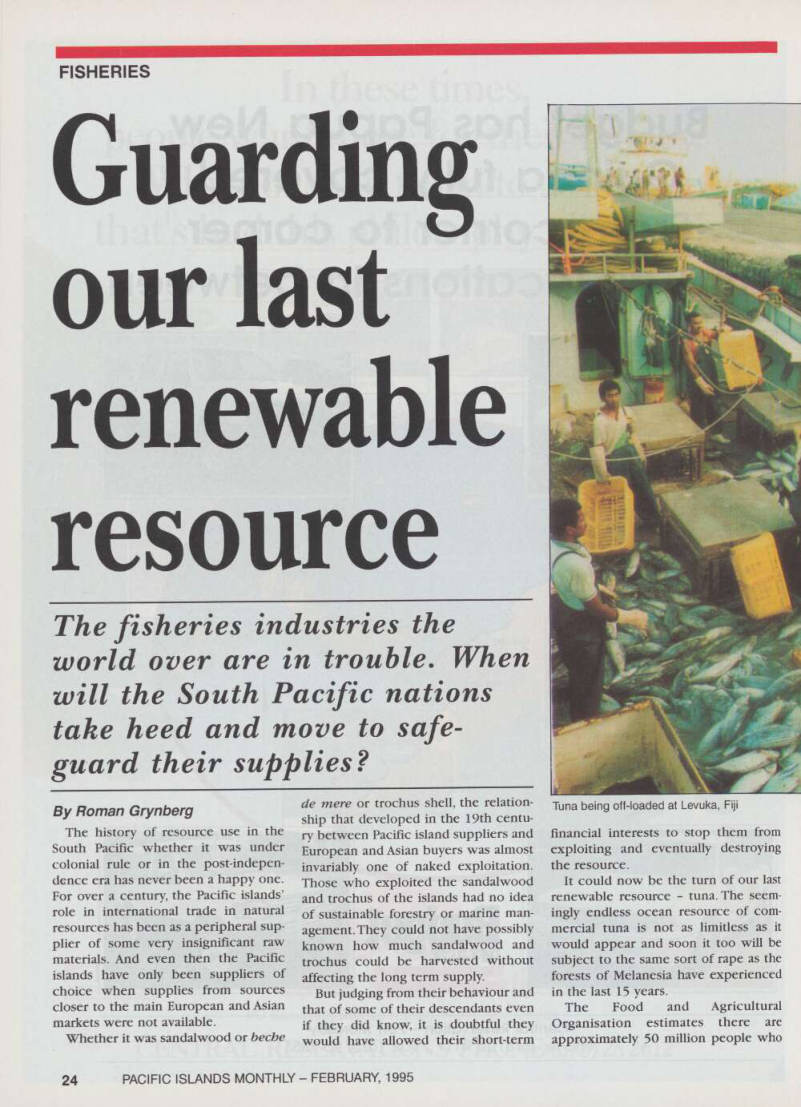
It could now be the turn of our last renewable resource - tuna. The seem ingly endless ocean resource of com mercial tuna is not as limitless as it would appear and soon it too will be subject to the same sort of rape as the forests of Melanesia have experienced in the last 13 years.
The Food and Agricultural Organisation estimates there are approximately 50 million people who
Tuna being off-loaded at Levuka, Fiji
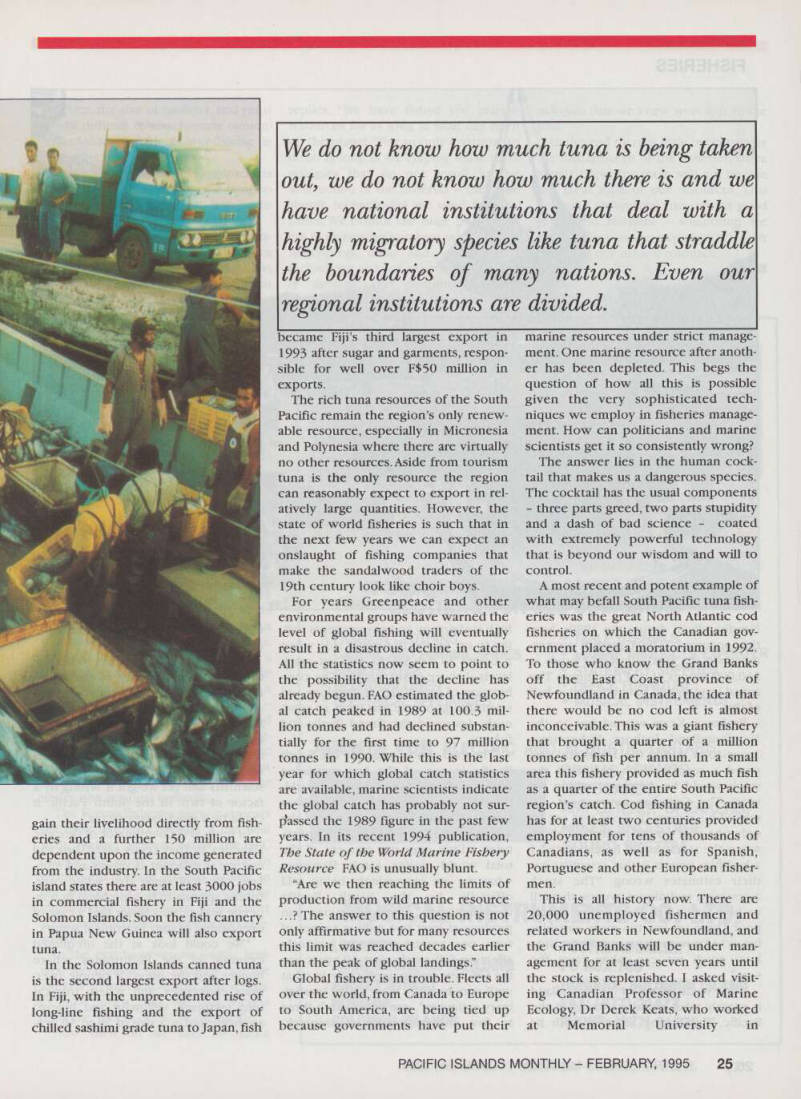
gain their livelihood directly from fish eries and a further 150 million are dependent upon the income generated from the industry. In the South Pacific island states there are at least 3000 jobs in commercial fishery in Fiji and the Solomon Islands. Soon the fish cannery in Papua New Guinea will also export tuna.
In the Solomon Islands canned tuna is the second largest export after logs.
In Fiji, with the unprecedented rise of long-line fishing and the export of chilled sashimi grade tuna to Japan, fish
We do not know how much tuna is being taken out, we do not know how much there is and we have national institutions that deal with a highly migratory species like tuna that straddle the boundaries of many nations. Even our regional institutions are divided.
became Fiji’s third largest export in 1993 after sugar and garments, respon sible for well over Fsso million in exports.
The rich tuna resources of the South Pacific remain the region’s only renew able resource, especially in Micronesia and Polynesia where there are virtually no other resources. Aside from tourism tuna is the only resource the region can reasonably expect to export in rel atively large quantities. However, the state of world fisheries is such that in the next few years we can expect an onslaught of fishing companies that make the sandalwood traders of the 19th century look like choir boys.
For years Greenpeace and other environmental groups have warned the level of global fishing will eventually result in a disastrous decline in catch.
All the statistics now seem to point to the possibility that the decline has already begun. FAO estimated the glob al catch peaked in 1989 at 100.3 mil lion tonnes and had declined substan tially for the first time to 97 million tonnes in 1990. While this is the last year for which global catch statistics are available, marine scientists indicate the global catch has probably not sur p*assed the 1989 figure in the past few years. In its recent 1994 publication, The State of the World Marine Fishery Resource FAO is unusually blunt.
“Are we then reaching the limits of production from wild marine resource ...?The answer to this question is not only affirmative but for many resources this limit was reached decades earlier than the peak of global landings.”
Global fishery is in trouble. Fleets all over the world, from Canada to Europe to South America, are being tied up because governments have put their
marine resources under strict manage ment. One marine resource after anoth er has been depleted. This begs the question of how all this is possible given the very sophisticated tech niques we employ in fisheries manage ment. How can politicians and marine scientists get it so consistently wrong?
The answer lies in the human cock tail that makes us a dangerous species.
The cocktail has the usual components - three parts greed, two parts stupidity and a dash of bad science - coated
with extremely powerful technology
that is beyond our wisdom and will to control.
A most recent and potent example of what may befall South Pacific tuna fish eries was the great North Atlantic cod fisheries on which the Canadian gov ernment placed a moratorium in 1992.
To those who know the Grand Banks off the East Coast province of Newfoundland in Canada, the idea that there would be no cod left is almost inconceivable. This was a giant fishery that brought a quarter of a million tonnes of fish per annum. In a small area this fishery provided as much fish as a quarter of the entire South Pacific region’s catch. Cod fishing in Canada has for at least two centuries provided employment for tens of thousands of Canadians, as well as for Spanish, Portuguese and other European fisher men.
This is all history now. There are 20,000 unemployed fishermen and related workers in Newfoundland, and the Grand Banks will be under man agement for at least seven years until the stock is replenished. I asked visit ing Canadian Professor of Marine Ecology, Dr Derek Keats, who worked at Memorial University in
Newfoundland during the 1980 s, how this occurred. “The Canadian govern ment set the total allowable catch at 260,000 tonnes of cod per annum. The actual level should have been set at half of this.”
Professor Keats was adviser to the Newfoundland Inshore Fisherman’s Association during the 1980 s and pre pared a report which predicted the stock would be destroyed within six years. The Canadian government dis missed his report. Dr Keats was out by only one year on his prediction about when the stock would be exhausted. I asked him how it is that scientists get their estimates wrong. “The stock assessment techniques we use that tell us how much fish there is are simply poor. There are just too many variables for us to know with any great precision how much we can taken from the seas.”
What went wrong in Newfoundland is exactly what could go wrong in the Pacific. The fishing industry with its
high technology and governments will ing to err on the optimistic side when it comes to fish stocks will set catch levels that are unsustainable. The com bination of greed, high technology and scientific ignorance are what so obvi ously destroyed the Grand Banks cod
fishery.
The FAO report suggests the South Pacific is one of the last remaining under exploited fisheries in the world.
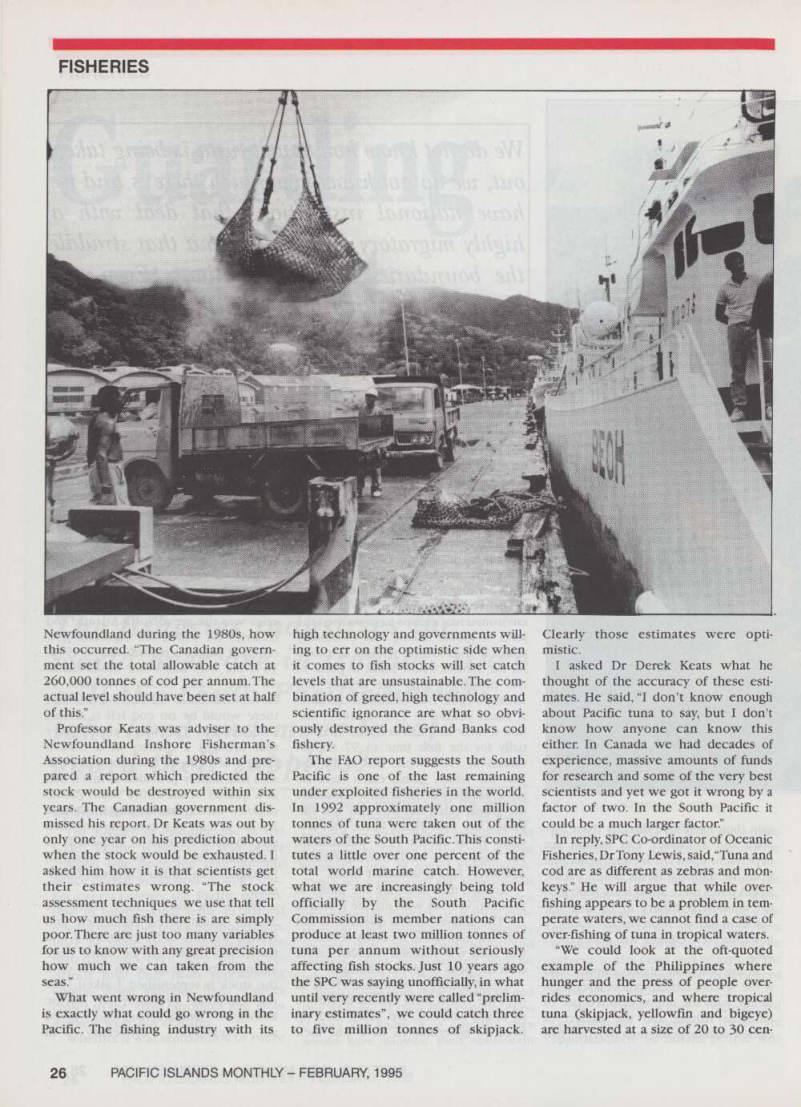
In 1992 approximately one million tonnes of tuna were taken out of the waters of the South Pacific. This consti tutes a little over one percent of the total world marine catch. However, what we are increasingly being told officially by the South Pacific Commission is member nations can produce at least two million tonnes of tuna per annum without seriously affecting fish stocks. Just 10 years ago the SPC was saying unofficially, in what until very recently were called “prelim inary estimates”, we could catch three to five million tonnes of skipjack.
Clearly those estimates were opti mistic.
I asked Dr Derek Keats what he thought of the accuracy of these esti mates. He said, “I don’t know enough about Pacific tuna to say, but I don’t know how anyone can know this either. In Canada we had decades of experience, massive amounts of funds for research and some of the very best scientists and yet we got it wrong by a factor of two. In the South Pacific it could be a much larger factor.”
In reply, SPC Co-ordinator of Oceanic Fisheries, Dr Tony Lewis, said,“Tuna and cod are as different as zebras and mon keys.” He will argue that while over fishing appears to be a problem in tem perate waters, we cannot find a case of over-fishing of tuna in tropical waters.
“We could look at the oft-quoted example of the Philippines where hunger and the press of people over rides economics, and where tropical
tuna (skipjack, yellowfin and bigeye)
are harvested at a size of 20 to 30 cen
timetres, the size of sardines, and yet it is still difficult to conclusively demon strate that biological over-fishing is occurring.”
The up-shot of the SPC argument is clear - over-fishing happens in temper ate waters but is unlikely to happen to us.
In the South Pacific we have a situa tion where the existing tuna fisheries are clearly out of control. The SPC has no idea where fish are being caught in the waters of the South Pacific because the Taiwanese and Korean tuna boats massively under-report their catch. The SPC thinks they know the total quanti ty because they can get landing figures in Thailand, Korea, etc. However, these are also under-reported for commercial reasons.
It is also readily admitted the level of scientific research is inadequate to know with certainty how much tuna can be safely caught in any year. The distant water fishing nations pay us a pittance for our tuna. Korea, Taiwan and Japan pay between four to five per cent of what they declare, the US purse-seiners pay nine percent and some nations are paying 11 percent to Australia.
There is clearly a need to protect our tuna resources from over-fishing. We do not know how much is being taken out, how much there is and we have national institutions that deal with a highly migratory species that straddle the boundaries of many nations. Even our regional institutions are divided the SPC deals with scientific issues and the Forum Fisheries Agency with polit ical, legal and increasingly economic issues. It would seem only logical that fisheries management be brought under one regional umbrella.
The Forum Fisheries Agency appears the right umbrella because it can deal with highly political issues the SPC cannot. We must also soon come to terms with foreign nations fishing in our waters. They must either sign fair multilateral agreements and report accurately on their catches or fish else where.
In the end however, no matter how well we manage our fisheries, we are unlikely to ever know with any accura cy how much tuna we can harvest from the waters of the South Pacific.
How then do we fish? Dr Keats
replies, “We have fished the marine resources for as long as man has been on the planet. We can only continue to do so as long as we employ those tech nologies that do not result in the destruction of the fisheries - the same simple technologies we used for cen turies. We cannot use huge purse-sein ers in increasing numbers with spotter helicopters, radar and sophisticated technology and not expect to ultimate ly destroy the commercial tuna resource. We must replicate the tech
nologies that we knew were safe in the past.”
In the end there is little optimism for the management of the fisheries, there is only hope that there will not be one last great rape of our resources. This will take an unusual measure of good sense and restraint - something we have almost never experienced as it relates to our natural resource. ■