pineapple
pp. 19-21 · Read in the full issue
Phasing out the pineapple
Tourist resorts are
replacing Hawaii’s
pineapple plantations
as Dole turns its atten tion to the tourism market.
Uncle Sol Kaupuiki stretches his arm in front of the expanse of dry brush and orange clay.
“All of this used to be pineapple,” he says, a proud smile on his brown crinkled face.
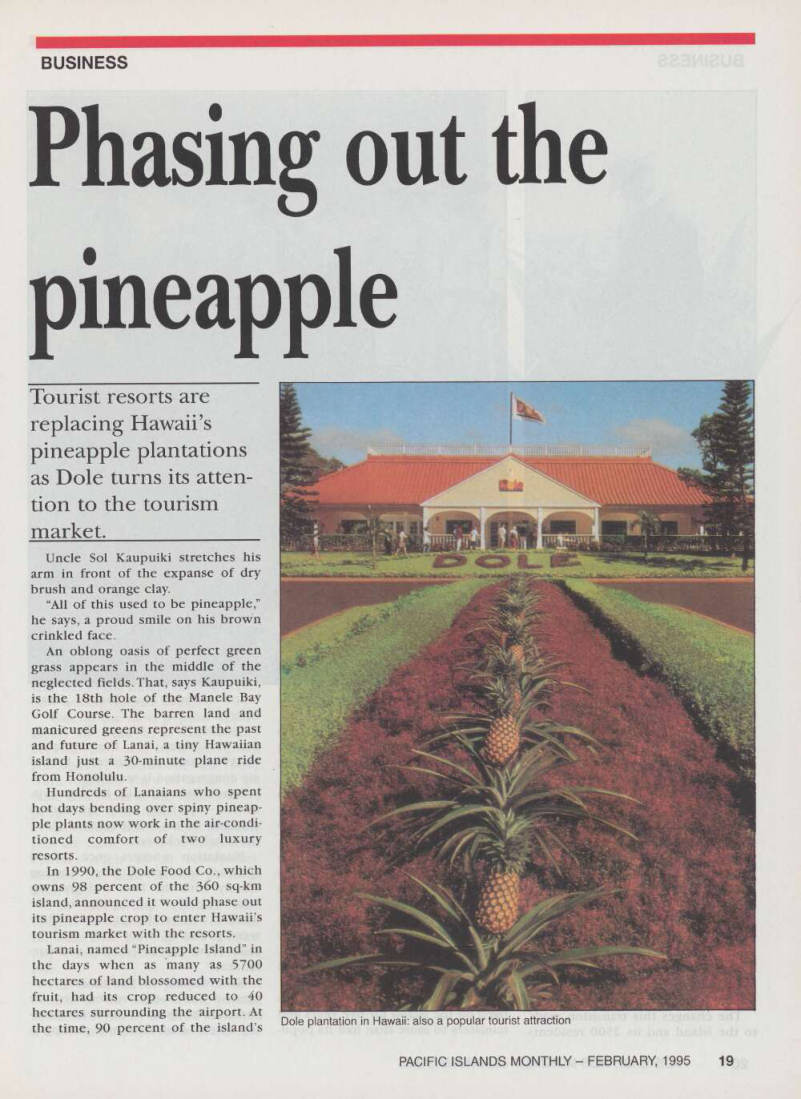
An oblong oasis of perfect green grass appears in the middle of the neglected fields. That, says Kaupuiki, is the 18th hole of the Manele Bay Golf Course. The barren land and manicured greens represent the past and future of Lanai, a tiny Hawaiian island just a 30-minute plane ride from Honolulu.
Hundreds of Lanaians who spent hot days bending over spiny pineap ple plants now work in the air-condi tioned comfort of two luxury resorts.
In 1990, the Dole Food Co., which owns 98 percent of the 360 sq-km island, announced it would phase out its pineapple crop to enter Hawaii’s tourism market with the resorts.
Lanai, named “Pineapple Island” in the days when as many as 3700 hectares of land blossomed with the fruit, had its crop reduced to 40 hectares surrounding the airport. At the time, 90 percent of the island’s
Dole plantation in Hawaii: also a popular tourist attraction
jobs were linked to pineapple. Tn April 1990, the elegantly rustic The Lodge at Koele opened amid the whistling pines of Lanai’s cool high lands. A few months later, the slick Manele Bay Resort opened on the coast, overlooking one of Hawaii’s most beautiful beaches. Both were accompanied by championship golf courses.
For the first time, residents had to share their roads with rental cars, their beaches with tourists and their jobs with outsiders.
The company said all pineapple workers, mostly first - and second generation Filipinos brought to Hawaii to work in the fields, would be considered for jobs without los ing their pensions and health bene fits. But the workers, some with Dole for 20 years and more, would have no seniority in the hotels which are
managed mostly by newcomers to
the close-knit community.
The changes this transition made to the island and its 2500 residents
are seen in various faces and places around Lanai.
Butch Gima points to the cars passing as he stops at one of the community’s few stop signs. Traffic lights are nonexistent.
“I had to wait for six or seven cars the other day! Before the hotels, you never had to wait for more than two or three,” he said.
But Gima said he wishes such minor inconveniences were the only problems he had to deal with as Lanai’s lone social worker.
The new industry, he said, has ush ered in new social problems, such as increases in divorce, family violence, depression, crime and alcohol and illegal drug use.
Father Bob Schwarzhaupt has lived on the island for five years and ministers to more than half its popu
lation through his Sacred Heart Church.
“Sunday is no longer the family day at Church. It’s the day they work,” he said. “At Christmas, half of my congregation is working.”
Schwarzhaupt said he has wit nessed spiritual and emotional changes in his Congregation since the hotels took over.
Plantation workers once gained spiritual satisfaction from working closely with the land and growing “the sweetest pineapple in the
world,” Schwarzhaupt said. “They
were proud of what they did,” he said. “Now, they’re janitors and bar tenders.”
Kurt Matsumoto, the general man ager of The Lodge, remembers the summers he spent in the fields grow ing up on Lanai. Pineapple-picking is
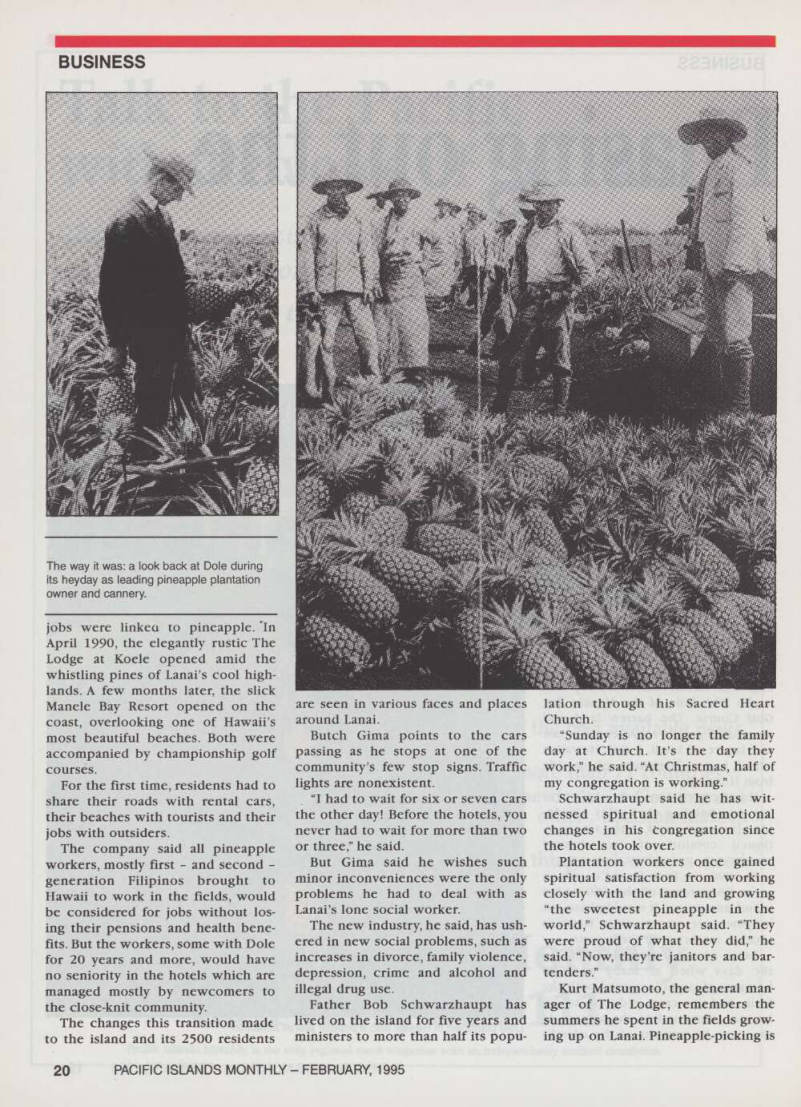
The way it was: a look back at Dole during
its heyday as leading pineapple plantation
owner and cannery.
performed in gangs of 13 or 16 work ers who stay together for years in a kind of second family, Matsumoto said. But in the hotels, these workers now usually operate alone.
“One of the most popular depart ments to work in is the laundry because they still have that group
atmosphere,” Matsumoto said. “They
work together. They all break at the same time, start at the same time, so people like it in there.”
Matsumoto said the least favourite jobs are those with a lot of personal contact such as in restaurants, despite the high earning potential from tips.
The face-to-face contact with tourists is uncomfortable for some Lanaians who grew up in a commu nity where everyone knew everyone else.
The new mix of people is most evident on the roads, where passing someone formerly meant a smile and a wave, said Kaupuiki, an island resi
dent for most of his 73 years.
Today, he sees few waves and has almost been run off narrow roads by visitors unfamiliar with the custom of pulling aside to let a car pass.
Still, Kaupuiki said he knows the situation could be worse, since other pineapple and sugar plantation clo sures have stranded thousands of people around the state. “People on this island are proud,” he said. “They want the jobs.”
Matsumoto acknowledged the transition has not been totally smooth, but he too sees the brighter side now that the hotels are in place.
“At least we’re talking about a future,” he said.“At least we’re talking about something we can work toward.
“Despite some of the difficulties, I think we are fortunate to have what we’ll have. The alternative picture is pretty bleak.” ■