Focusing
p. 11 · Read in the full issue
Opinion
closer to home
Why did New Zealand send 250 troops - the biggest military contingent to leave this country since the Vietnam War - to Bosnia on the other side of the world?
The official answer, of course, is to hon our its obligations to the United Nations and the contribution to the UN peace keeping force can certainly be justified in those terms. Those obligations also saw New Zealand military personnel serving in the Middle East, Africa, South East Asia and Central America at the end of last year.
But there was another reason, according to John Henderson, head of political sci ence at the University of Canterbury: to gain favours with major allied powers.
And why is New Zealand doing that when it is a Pacific country and the end of the Cold War should have left it free to concentrate defence and foreign policy on its own regional interests?
Foreign policy is not a major topic of debate in New Zealand, involvement in the Vietnam War and the country’s anti nuclear stance being the only issues in that area to have stirred public conscience in recent times.
So Henderson’s provocative comments, in a December speech to an international relations conference in Wellington, did not get a lot of publicity. It was not the stuff on which prime time television ratings are built.
But it raised an issue that is worthy of debate and one that may well be fired in the new political environment of propor tional representation that is bound to pro duce coalition governments and the need for consensus politics in the future. For outside of the ruling National Party there is little enthusiasm for foreign affairs - the focus of all the opposition parties is very much closer to home.
Henderson’s theme is simple: the Pacific island region is the one part of the world where what New Zealand does or does not do actually makes a difference. “In no other region is New Zealand’s action or
inaction likely to significantly affect the outcome of events,” he said.
With the Cold War over, New Zealand need no longer feel in jeopardy because of its isolation and should be taking advan tage of the freedom to pursue a more inde pendent and regional foreign policy.
Henderson, it should be pointed out, is biased. He was head of Prime Minister David Lange’s department when the anti nuclear policy was produced in the mid 1980s. And he later chaired the South Pacific Review Group which made a per suasive case for a regional foreign policy in its 1990 report, Towards a Pacific Island Community.
But that does not make his ideas any less worthy of consideration. He rejects the claims of critics that a regionally focused foreign policy reflects the views of “little New Zealanders”, saying it would provide a firm base on which to pursue wider interests and points out that con centrating on the security of a region cov ering nearly 20 percent of the globe is hardly isolationist.
In his speech, Henderson argued it was important to New Zealand’s national iden tity to recognise the geographic reality that it is a Pacific island nation. It is also increasingly a Polynesian country and it retains constitutional links with the Cook Islands, Niue and Tokelau.
These three points, he said, gave New Zealand a distinct relationship with the Pacific island region not shared by Australia, which has priority security pre occupations with South East Asia and the Indian Ocean.
New Zealand’s more relaxed relation ship with Asian countries, especially Indonesia, enabled it to serve as a bridge between the island states and Asia. “This would be in accord with the growing ten dency of the Pacific island countries to look north to Asia, rather than their tradi tional southern friends of Australia and New Zealand.”
While the region faced no direct exter nal threat, potential threats to peace and security were internal, Henderson said.
He welcomed the Pacific island peace keeping force that was established on Bougainville - short-lived as it was - as an example of what co-operation among the island states, together with New Zealand and Australia, can achieve.
But he noted it took considerable time to get the peace force together and said there was a need for contingency planning with the island governments earmarking and training sections of their forces for regional development.
A bigger New Zealand commitment to Bougainville - like the size of the force sent to Bosnia - might, he said, have helped promote a different outcome.
That is a questionable thesis given the New Zealand and Australian governments’ anxiety for the peace-keeping force to be seen as a Pacific island body, not dominat ed by two white powers.
Henderson noted the dilemma New Zealand and Australia could face if, for instance, the Tongan government request ed military assistance following a pro democracy riot. Not to respond would appear to be letting down a friendly gov ernment - responding would appear to be suppressing the evolution of democratic government.
Similar no-win situations could arise in New Caledonia, East Timor and Irian Jaya or from further military coups in the region.
New Zealand and Australia should be guided by the Forum states in any action in the region, he said. Meanwhile, it was important the island nations develop and maintain the capability and will to resolve their own problems. “Not to do so is to invite other larger outside powers to inter vene.”
And that is food for thought for all of us. ■
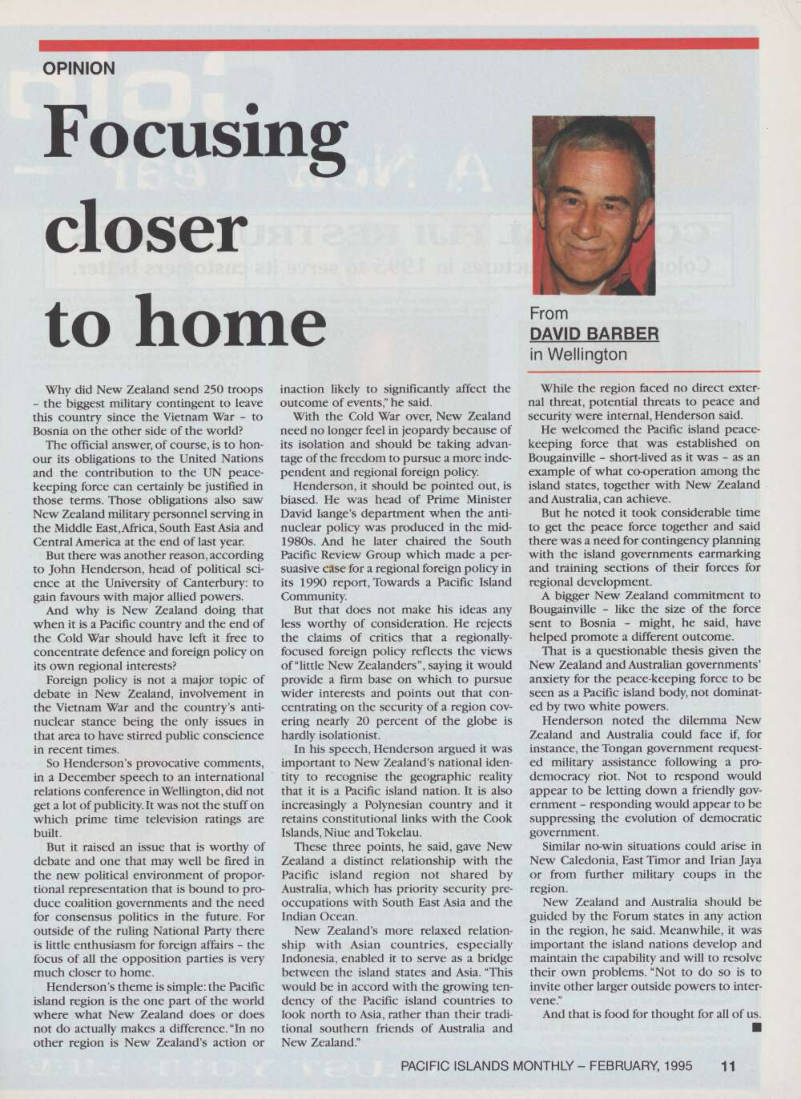
From
David Barber
in Wellington