Saving the dolphins
pp. 8-9 · Read in the full issue
Rescue
By Patrick Decloitre
Thirty-six dolphins were trapped
in Port Vila’s Erakor Lagoon between December 19 and January 3, before most of them were finally rescued by an emergency Australian-supervised operation. And worldwide news coverage of the event gave Vanuatu more publicity than it could ever have expected.
It all began like a well timed Christmas tale: in the early hours of
December 19, a pod of dolphins was suddenly found at the entrance of Port Vila’s calm lagoon. Soon the presence of the friendly mammals became a major attraction for the people of the island
state’s capital.
The dolphins seemed to have settled between tiny Erakor Island (where a resort is located) and the main island, Efate (where Port Vila is located).
Authorities first believed the dol phins had chosen the place to get shel ter and to breed. Erakor Island resort
manager Lynn Cowper said newborn dolphins were noticed among the group since Thursday, December 22.
Locals and Erakor villagers soon undertook to feeding the mammals with fish and bread and numerous locals and tourists began crossing over to the small island to enjoy the sight.
“Everyone’s respecting them. We were told they might stay for a while and that they’ll go when they’re ready. I hope they stay. It’s a beautiful sight to see them at night when the moon
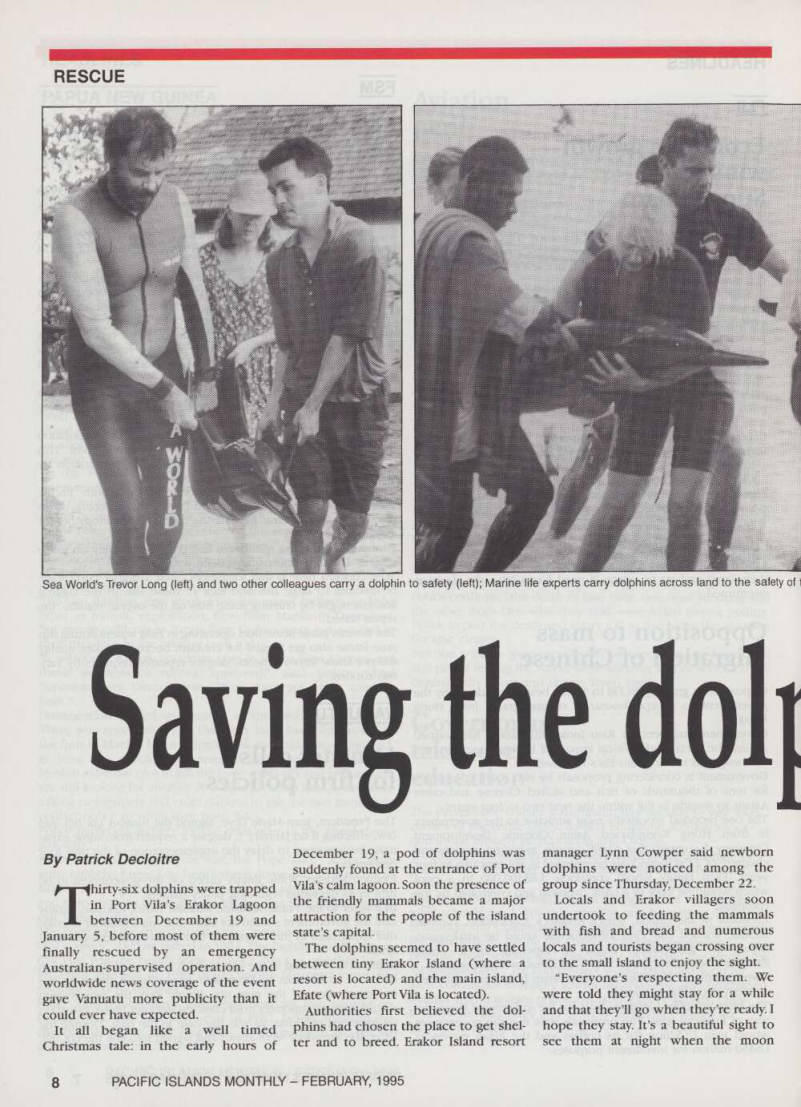
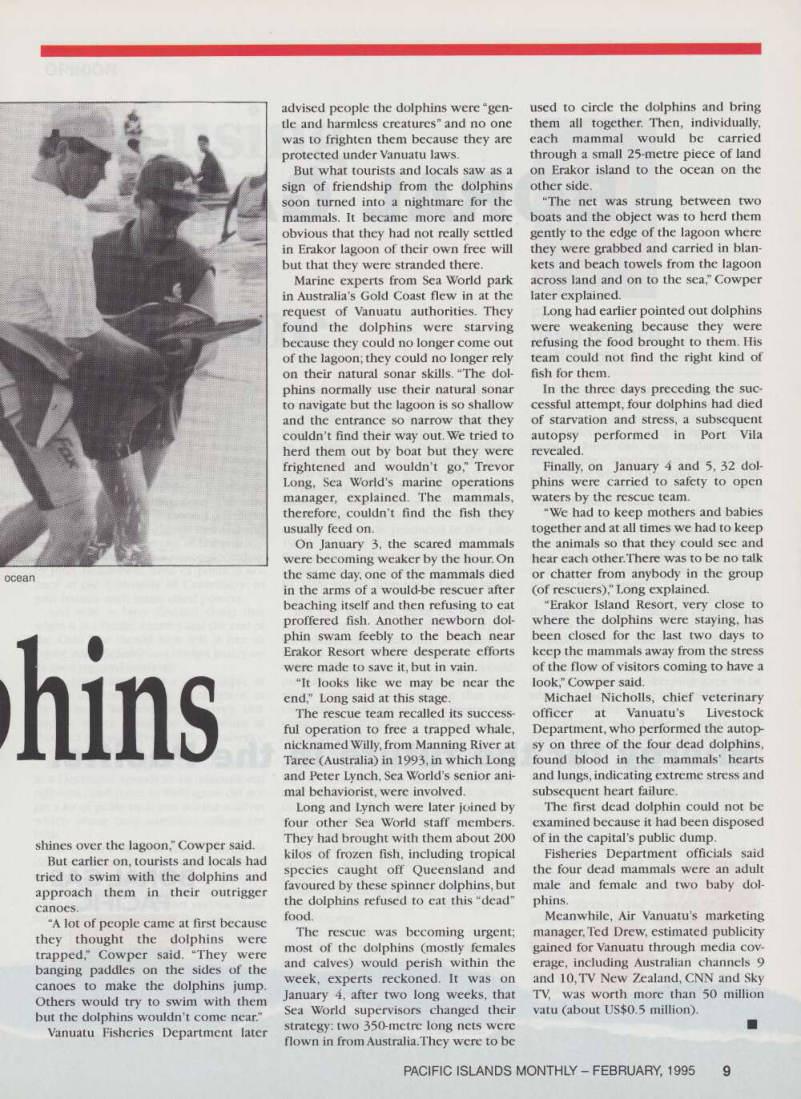
Sea World’s Trevor Long (left) and two other colleagues carry a dolphin to safety (left); Marine life experts carry dolphins across land to the safety of
shines over the lagoon,” Cowper said.
But earlier on, tourists and locals had tried to swim with the dolphins and approach them in their outrigger canoes.
“A lot of people came at first because
they thought the dolphins were
trapped,” Cowper said. “They were banging paddles on the sides of the canoes to make the dolphins jump.
Others would try to swim with them but the dolphins wouldn’t come near.”
Vanuatu Fisheries Department later
advised people the dolphins were “gen tle and harmless creatures” and no one was to frighten them because they are protected under Vanuatu laws.
But what tourists and locals saw as a sign of friendship from the dolphins soon turned into a nightmare for the mammals. It became more and more obvious that they had not really settled in Erakor lagoon of their own free will but that they were stranded there.
Marine experts from Sea World park in Australia’s Gold Coast flew in at the request of Vanuatu authorities. They found the dolphins were starving because they could no longer come out of the lagoon; they could no longer rely on their natural sonar skills. “The dol phins normally use their natural sonar to navigate but the lagoon is so shallow and the entrance so narrow that they couldn’t find their way out. We tried to herd them out by boat but they were frightened and wouldn’t go,” Trevor Long, Sea World’s marine operations manager, explained. The mammals, therefore, couldn’t find the fish they usually feed on.
On January 3, the scared mammals were becoming weaker by the hour. On the same day, one of the mammals died in the arms of a would-be rescuer after beaching itself and then refusing to eat proffered fish. Another newborn dol phin swam feebly to the beach near Erakor Resort where desperate efforts were made to save it, but in vain.
“It looks like we may be near the end,” Long said at this stage.
The rescue team recalled its success ful operation to free a trapped whale, nicknamed Willy, from Manning River at Taree (Australia) in 1993, in which Long and Peter Lynch, Sea World’s senior ani mal behaviorist, were involved.
Long and Lynch were later joined by four other Sea World staff members.
They had brought with them about 200 kilos of frozen fish, including tropical species caught off Queensland and favoured by these spinner dolphins, but the dolphins refused to eat this “dead” food.
The rescue was becoming urgent; most of the dolphins (mostly females and calves) would perish within the week, experts reckoned. It was on January 4, after two long weeks, that Sea World supervisors changed their strategy: two 350-metre long nets were flown in from Australia. They were to be
used to circle the dolphins and bring them all together. Then, individually, each mammal would be carried through a small 23-metre piece of land on Erakor island to the ocean on the other side.
“The net was strung between two boats and the object was to herd them gently to the edge of the lagoon where they were grabbed and carried in blan kets and beach towels from the lagoon across land and on to the sea,” Cowper
later explained.
Long had earlier pointed out dolphins were weakening because they were refusing the food brought to them. His team could not find the right kind of fish for them.
In the three days preceding the suc cessful attempt, four dolphins had died of starvation and stress, a subsequent autopsy performed in Port Vila revealed.
Finally, on January 4 and 5, 32 dol phins were carried to safety to open waters by the rescue team.
“We had to keep mothers and babies together and at all times we had to keep the animals so that they could see and hear each other. There was to be no talk or chatter from anybody in the group (of rescuers),” Long explained.
“Erakor Island Resort, very close to where the dolphins were staying, has been closed for the last two days to keep the mammals away from the stress of the flow of visitors coming to have a look,” Cowper said.
Michael Nicholls, chief veterinary officer at Vanuatu’s Livestock Department, who performed the autop sy on three of the four dead dolphins, found blood in the mammals’ hearts and lungs, indicating extreme stress and subsequent heart failure.
The first dead dolphin could not be examined because it had been disposed of in the capital’s public dump.
Fisheries Department officials said the four dead mammals were an adult male and female and two baby dol phins.
Meanwhile, Air Vanuatu’s marketing manager, Ted Drew, estimated publicity gained for Vanuatu through media cov erage, including Australian channels 9 and 10, TV New Zealand, CNN and Sky TV, was worth more than 50 million vatu (about US$O.5 million). ■
ocean