New York
pp. 36-37 · Read in the full issue
Profile
Our man in New York
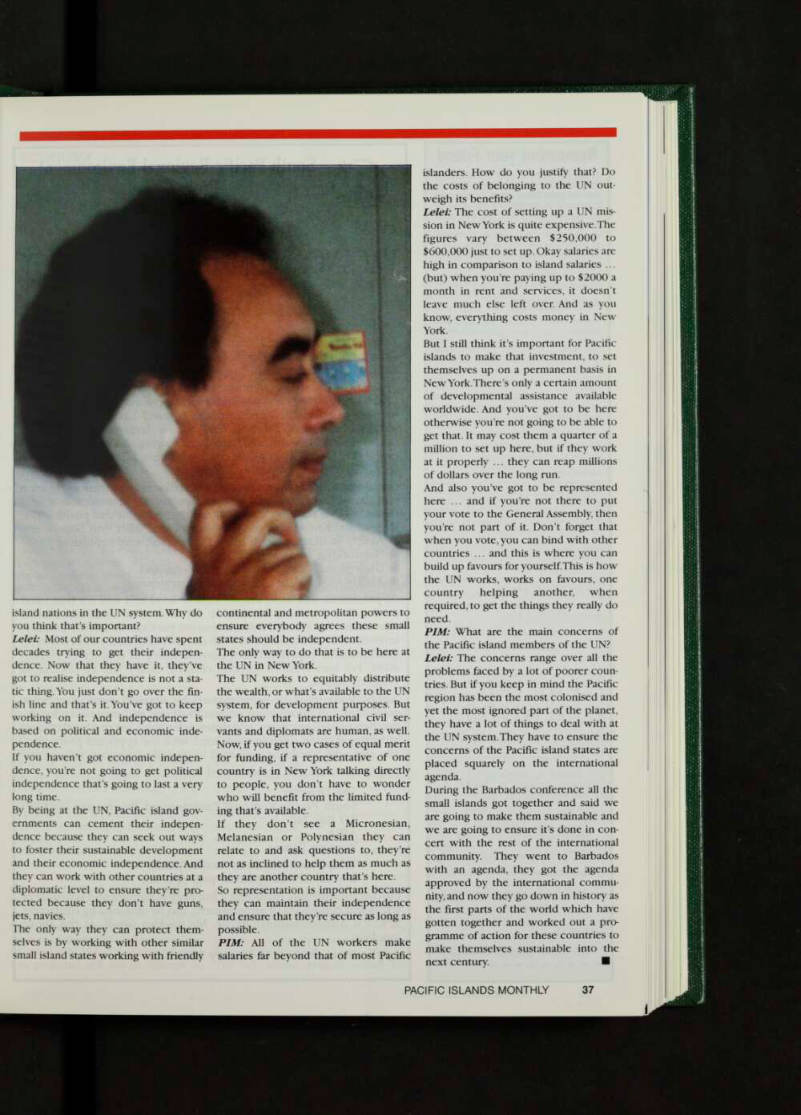
Lelei Lelaulu is an international civil servant and the
first Polynesian employee of
tt * at at the United Nations in New York city. After many years in the Big Apple, be may have become a Samoan city slicker, as sophisticated as any urbane Manhattanite, but he . „ has never forgotten his South Seas roots and tries to get home as often as possible.
Ed Rampell interviews Lelei at bis office in tbe United
Nations Building.
° DMi X¥ru , , , , .
PIM: What do you do at the United Nations? 7 rnini. i f „ Leleu I m the outreach coordmator for roordinat o H c ’' Y
Devefonment M ''V
Development. My tasks centre on helpmg with the organisation of global contprPIV . ( . t M ‘, Terences, especially as they relate to sus toimKio j a 7 tamable development. So, I was involved in the global conference for sustainable development of small island developing states, which was held in Barbados in AprU/May.
PIM: Where are you originally from?
Lelei: I was born in Apia. My family is from Falealili on my father s side, and also from Pololi on the beautiful island of Savaii ... From there I went to high school and university training in New Zealand ... at Auckland University and
Wellington University ... with a 8.A...
From there 1 moved into broadcasting Wlth the New Zealand Broadcasting Corporation in radio and television,and then moved on to Asia and then to Europe, Africa, and the Middle East, where I served as a foreign correspon dent for a number of years... I did some work for the Far East Economic f'T’ . p ' us the A “ st, ; alian Broadcasting Corporation ... but large ly worldng as a freelancer in Asia , In Africa and the Middle East I worked for the largest publishing group in English ... a whole slew of expensive, confldential newsletters on business and , politics tbat volatUe rc « ion - And then in the States, I came over to start the American bureau ... for T ,„ , . , International Communications, which groups together these publications here , The UN was P of beat a " d then I ended up in the UN as a SusUmMe result of my work for International Communications m f ... . . , TTXT PIM - What year did you join the UN as an international civil servant? r , . T 1 B ° l my ** m 1978 “ Z I
Zr “ '"T Z C
PaClf,C So 1 Started a radl ° P ro Bramme “ W3S mCd ° u Ut °" Short WaVe hT' ° Ut VP ° and “ Mia ’ called “ UN Calling Asia”. ™ hapPV t 0 *“ ' tS StiU « oin S' l want ‘ p '° Z ° f the “‘ slands a ' ldAs ' a *e UN sys- Th ' S SCCmed the beSt to do “■
through a UN radio programme.
PIM: What is it like for you being a Samoan in New York city?
Lelei: Well, as I keep telling Americans who ask me what on earth I’m doing here, I say that when I was growing up in Samoa, I always used to think places like the Bronx were exotic, so here I am.
I tell them we’re all islands after all.
Manhattan is a small island, much small er than Upolu where I’m from.
It’s just a matter of the space around you, and the people you deal with. It doesn’t matter where you are. I think most islanders can live anywhere because they can work on a space with in themselves, and within their family and community settings, to allow them to travel further.
PIM: Of course, Polynesians are the most notable migratory people in histo ry. You once wrote a very witty piece for PIM magazine. Can you tell us about it?
Lelei: It was over the whole debate about (anthropologists) Margaret Mead vs Derek Freeman. I thought it was all rather amusing. I thought I’d have a bit of fun and sort of put the questions back to them a little bit. I said first of all, Mead came along; she portrayed us as happy-go-lucky South Sea natives forev er making love on beaches as the magic Pacific Ocean lapped at our happy brown feet. Which was, you know, okay, but it was difficult to deal with this image. Amd them along comes this char acter Freeman from Harvard who said no, no, no, it’s incorrect because Samoans, and most Polynesians, in fact suffer from tremendous neuroses and they’re all suicidal and wife beaters and all this stuff. So we had two contrasting images of what we’re supposed to be.
So I looked at these terms and said, obviously we’re a bit of both, we’re just like anybody else.
So I wrote, everytime a plane landed on my grass airstrip in Savaii, there seemed to be at least six candidates for Ph.D.s in anthropology stumbling onto the tar mac.
So I said, look, I have some advice for anyone seeking a Ph.D. : I live on an island, which is riven asunder with trib al tensions and where sexual neuroses are rife and which could certainly do with the tourist buck. And it’s called Manhattan.
PIM: Let’s talk about the role of Pacific
island nations in the UN system. Why do you think that’s important?
Lelei: Most of our countries have spent decades trying to get their indepen dence. Now that they have it, they’ve got to realise independence is not a sta tic thing. You just don’t go over the fin ish line and that’s it. You’ve got to keep working on it. And independence is based on political and economic inde pendence.
If you haven’t got economic indepen dence, you’re not going to get political independence that’s going to last a very long time.
By being at the UN, Pacific island gov ernments can cement their indepen dence because they can seek out ways to foster their sustainable development and their economic independence. And they can work with other countries at a diplomatic level to ensure they’re pro tected because they don’t have guns, jets, navies.
The only way they can protect them selves is by working with other similar small island states working with friendly
continental and metropolitan powers to ensure everybody agrees these small states should be independent.
The only way to do that is to be here at the UN in New York.
The UN works to equitably distribute the wealth, or what’s available to the UN system, for development purposes. But we know that international civil ser vants and diplomats are human, as well.
Now, if you get two cases of equal merit for funding, if a representative of one country is in New York talking directly to people, you don’t have to wonder who will benefit from the limited fund ing that’s available.
If they don’t see a Micronesian, Melanesian or Polynesian they can relate to and ask questions to, they’re not as inclined to help them as much as they are another country that’s here.
So representation is important because they can maintain their independence and ensure that they’re secure as long as possible.
PIM: All of the UN workers make salaries far beyond that of most Pacific
islanders. How do you justify that? Do the costs of belonging to the UN out weigh its benefits?
Lelei: The cost of setting up a UN mis sion in New York is quite expensive. The figures vary between $230,000 to $600,000 just to set up. Okay salaries are high in comparison to island salaries ... (but) when you’re paying up to $2OOO a month in rent and services, it doesn’t leave much else left over. And as you know, everything costs money in New York.
But I still think it’s important for Pacific islands to make that investment, to set themselves up on a permanent basis in NewYork.There’s only a certain amount of developmental assistance available worldwide. And you’ve got to be here otherwise you’re not going to be able to get that. It may cost them a quarter of a million to set up here, but if they work at it properly ... they can reap millions of dollars over the long run.
And also you’ve got to be represented here ... and if you’re not there to put your vote to the General Assembly, then you’re not part of it. Don’t forget that when you vote, you can bind with other countries ... and this is where you can build up favours for yourself. This is how the UN works, works on favours, one country helping another, when required, to get the things they really do need.
PIM: What are the main concerns of the Pacific island members of the UN?
Lelei: The concerns range over all the problems faced by a lot of poorer coun tries. But if you keep in mind the Pacific region has been the most colonised and yet the most ignored part of the planet, they have a lot of things to deal with at the UN system. They have to ensure the concerns of the Pacific island states are placed squarely on the international agenda.
During the Barbados conference all the small islands got together and said we are going to make them sustainable and we are going to ensure it’s done in con cert with the rest of the international community. They went to Barbados with an agenda, they got the agenda approved by the international commu nity, and now they go down in history as the first parts of the world which have gotten together and worked out a pro gramme of action for these countries to make themselves sustainable into the next century. ■