Lights,
pp. 32-33 · Read in the full issue
Films
Lights, Camera, Action
The Pacific isands have captured the film makers’ imagination as a record number of films were churned out last year. Ed Rampell looks at the not-so-bright side of the impact this is having on the Pacific economies.
A bumper crop of TV programmes and films have been shot on location in the Pacific islands in the wake of the 1992 success of the The Piano. Movies and televi sion spots have been filmed at a wide range of isles ranging from Easter Island to Kauai to Moorea to Lanai to Tahiti. Some of them cost more than the entire budget of many island governments.
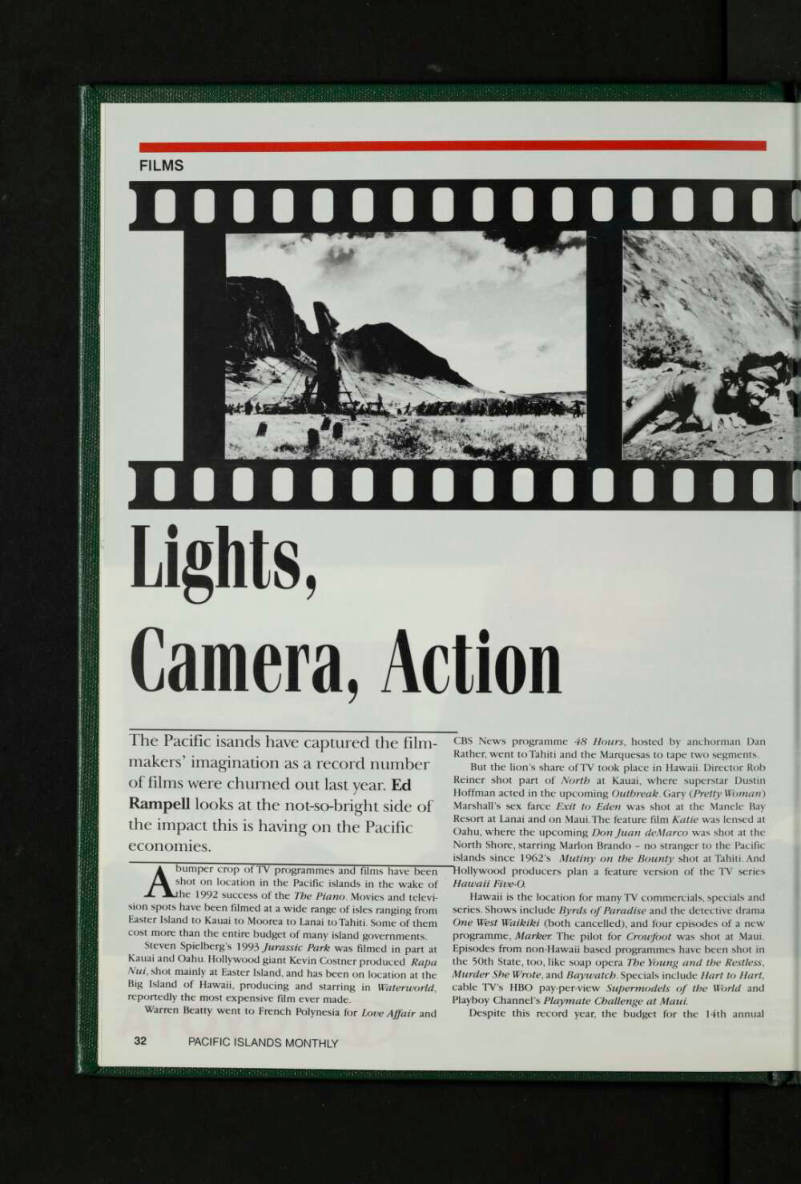
Steven Spielberg’s 1993 Jurassic Park was filmed in part at Kauai and Oahu. Hollywood giant Kevin Costner produced Rapa Nui, shot mainly at Easter Island, and has been on location at the Big Island of Hawaii, producing and starring in Waterworld, reportedly the most expensive film ever made.
Warren Beatty went to French Polynesia for Love Affair and
CBS News programme 48 Hours , hosted by anchorman Dan Rather, went to Tahiti and the Marquesas to tape two segments.
But the lion’s share of TV took place in Hawaii. Director Rob Reiner shot part of North at Kauai, where superstar Dustin Hoffman acted in the upcoming Outbreak. Gary ( Pretty Woman ) Marshall’s sex farce Exit to Eden was shot at the Manele Bay Resort at Lanai and on Maui. The feature film Katie was lensed at Oahu, where the upcoming Don Juan deMarco was shot at the North Shore, starring Marlon Brando - no stranger to the Pacific islands since 1962’s Mutiny on the Bounty shot at Tahiti. And Tfollywood producers plan a feature version of the TV series Hawaii Five-O.
Hawaii is the location for many TV commercials, specials and series. Shows include Byrds of Paradise and the detective drama One West Waikiki (both cancelled), and four episodes of a new programme, Marker. The pilot for Crowfoot was shot at Maui.
Episodes from non-Hawaii based programmes have been shot in the 50th State, too, like soap opera The Young and the Restless , Murder She Wrote , and Baywatch. Specials include Hart to Hart, cable TV’s HBO pay-per-view Supermodels of the World and
Playboy Channel’s Playmate Challenge at Maui.
Despite this record year, the budget for the 14th annual
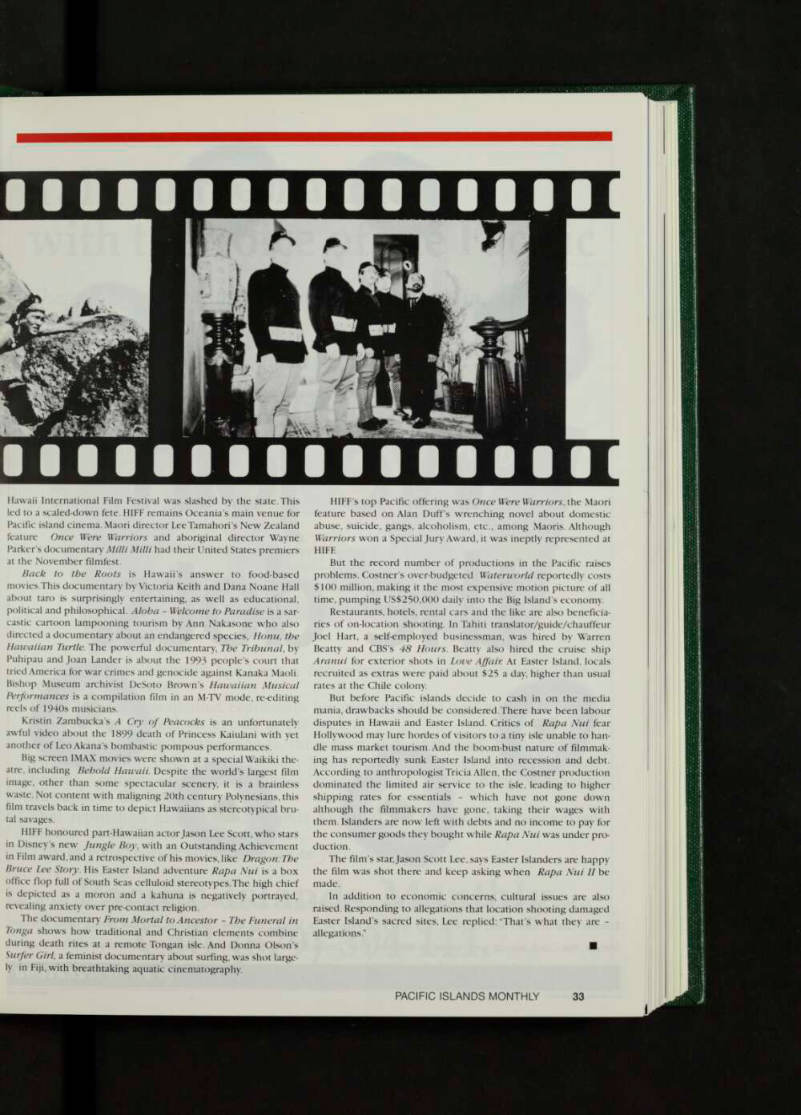
Hawaii International Film Festival was slashed by the state. This led to a scaled-down fete. HIFF remains Oceania’s main venue for Pacific island cinema. Maori director LeeTamahori’s New Zealand feature Once Were Warriors and aboriginal director Wayne Parker’s documentary Milli Milli had their United States premiers at the November filmfest.
Back to the Roots is Hawaii’s answer to food-based movies. This documentary by Victoria Keith and Dana Noane Hall about taro is surprisingly entertaining, as well as educational, political and philosophical. Aloha - Welcome to Paradise is a sar castic cartoon lampooning tourism by Ann Nakasone who also directed a documentary about an endangered species, Honu, the Hawaiian Turtle. The powerful documentary, The Tribunal , by Puhipau and Joan Lander is about the 1993 people’s court that tried America for war crimes and genocide against Kanaka Maoli.
Bishop Museum archivist DeSoto Brown’s Hawaiian Musical Performances is a compilation film in an M-TV mode, re-editing reels of 1940 s musicians.
Kristin Zambucka’s A Cry of Peacocks is an unfortunately awful video about the 1899 death of Princess Kaiulani with yet another of LeoAkana’s bombastic pompous performances.
Big screen IMAX movies were shown at a special Waikiki the atre, including Behold Hawaii. Despite the world’s largest film image, other than some spectacular scenery, it is a brainless waste. Not content with maligning 20th century Polynesians, this film travels back in time to depict Hawaiians as stereotypical bru tal savages.
HIFF honoured part-Hawaiian actor Jason Lee Scott, who stars in Disney’s new Jungle Boy, with an Outstanding Achievement in Film award, and a retrospective of his movies, like Dragon. The Bruce Lee Story. His Easter Island adventure Rapa Nui is a box office flop full of South Seas celluloid stereotypes. The high chief is depicted as a moron and a kahuna is negatively portrayed,
revealing anxiety over pre-contact religion.
The documentary From Mortal to Ancestor - The Funeral in Tonga shows how traditional and Christian elements combine during death rites at a remote Tongan isle. And Donna Olson’s Surfer Girl, a feminist documentary about surfing, was shot large ly in Fiji, with breathtaking aquatic cinematography.
HIFF’s top Pacific offering was Once Were Warriors, the Maori feature based on Alan Duff’s wrenching novel about domestic abuse, suicide, gangs, alcoholism, etc., among Maoris. Although Warriors won a Special Jury Award, it was ineptly represented at
Hiff.
But the record number of productions in the Pacific raises problems. Costner’s over-budgeted Waterworld reportedly costs $lOO million, making it the most expensive motion picture of all time, pumping U 55230,000 daily into the Big Island’s economy.
Restaurants, hotels, rental cars and the like are also beneficia ries of on-location shooting. In Tahiti translator/guide/chauffeur Joel Hart, a self-employed businessman, was hired by Warren Beatty and CBS’s 48 Hours. Beatty also hired the cruise ship Aranui for exterior shots in Love Affair. At Easter Island, locals recruited as extras were paid about $25 a day, higher than usual rates at the Chile colony.
But before Pacific islands decide to cash in on the media mania, drawbacks should be considered. There have been labour disputes in Hawaii and Easter Island. Critics of Rapa Nui fear Hollywood may lure hordes of visitors to a tiny isle unable to han dle mass market tourism. And the boom-bust nature of filmmak ing has reportedly sunk Easter Island into recession and debt.
According to anthropologist Tricia Allen, the Costner production dominated the limited air service to the isle, leading to higher shipping rates for essentials - which have not gone down although the filmmakers have gone, taking their wages with them. Islanders are now left with debts and no income to pay for the consumer goods they bought while Rapa Nui was under pro duction.
The film’s star, Jason Scott Lee, says Easter Islanders are happy the film was shot there and keep asking when Rapa Nui II be made.
In addition to economic concerns, cultural issues are also raised. Responding to allegations that location shooting damaged Easter Island’s sacred sites, Lee replied: “That’s what they are allegations.” ■