ocean bottom
pp. 18-19 · Read in the full issue
Mining
Dividing up the ocean bottom
By David North
Quietly, if not secretly, the major powers divided the mineral wealth lying in the deep Pacific beyond the island nations’ 200-mile EEZs, just as they divided up the islands 100 years earlier.
Many of the names are the same - the US, Britain, France and Germany - and the mineral wealth sought may be as elusive as the hoped-for tropical economic goodies of the old days, but many of the asset-grab bing techniques are identical to the old ones. The major powers confer far from the Pacific and quietly divide the spoils with little or no input from the islands.
The potential wealth drawing the atten tion consists of rocks usually ranging in size from that of golf balls to small pota toes. Literally trillions of these objects lie on the ocean floor mostly at depths of three to six kilometres, each containing signifi cant amounts of nickel, copper, cobalt and a great deal of not very valuable man ganese. They are often called manganese nodules.
Importantly, and mysteriously, the nod ules do not become buried by debris Ming from higher in the ocean; one spec ulation is that perhaps the living organisms that apparently attract the minerals out of the sea water and onto the nodules also keep the nodules on the top of the ocean floor Each of the nodules is formed around a hard object, such as piece of volcanic rock, a shark tooth or sometimes a bit of manufactured metal. It is not clear how rapidly the nodules are formed, but some must grow quite quickly.
According to Carl Jugel of the (US) National Oceanic and Atmospheric Administration, it is unlikely anyone will go to the expense of mining the sea-bottom for at least 10 years or so, because: a) it will take at least five years to start such an oper ation once someone decides to do it, and
b) the price of nickel will have to rise to about US$7.OO - $B.OO a pound until any one decides to take the risk.
Nickel, which is produced primarily in New Caledonia, Canada and Russia, now sells for about $3.00 a pound, but was over $6.00 a pound in 1989.
Although there is less cobalt in the nod ules than any other metal, it is currently the most valuable of the metals, selling for
about $28.00 a pound. It is used in high strength steel alloys, as a chemical catalyst and as a colouring agent. Cobalt prices are currently high because political chaos has seriously reduced production in Zaire, the former Belgian Congo, which was once the principal exporter of this metal.
“Why would anyone want to go through miles of seawater to bring up rocks with these small percentages of metals?” we asked Jugel.
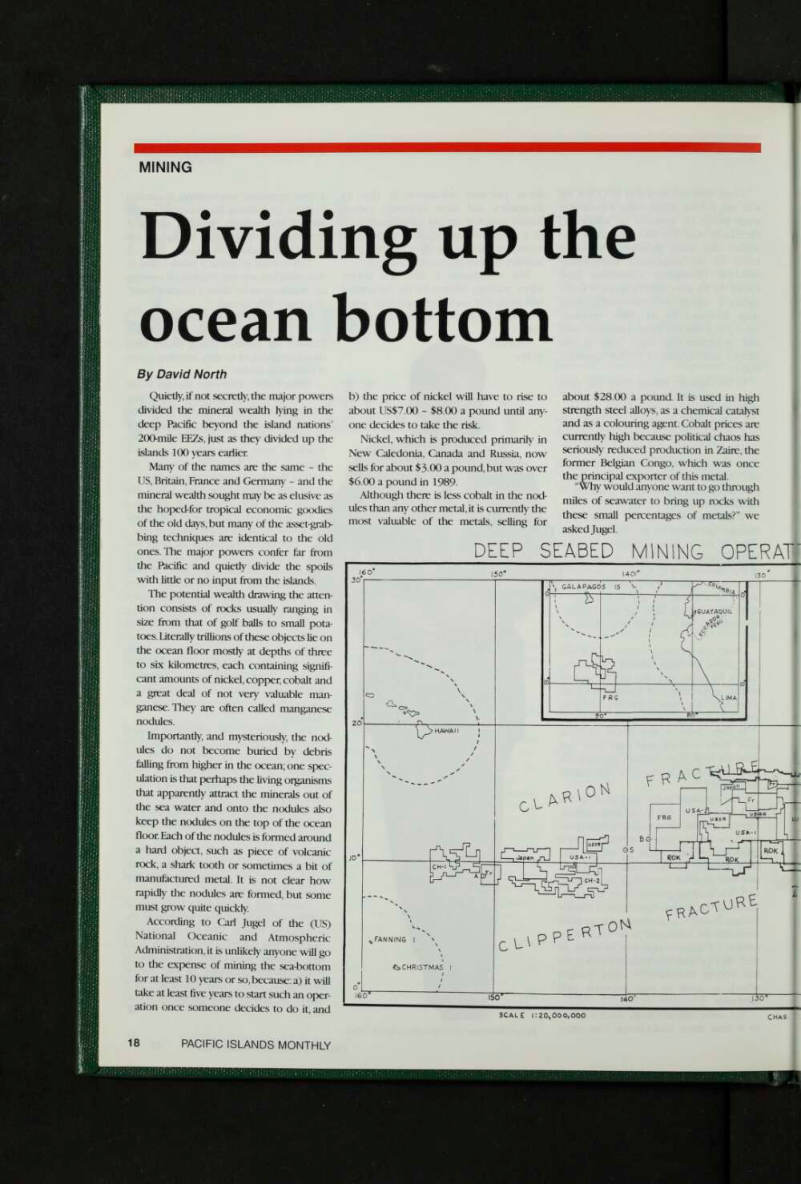
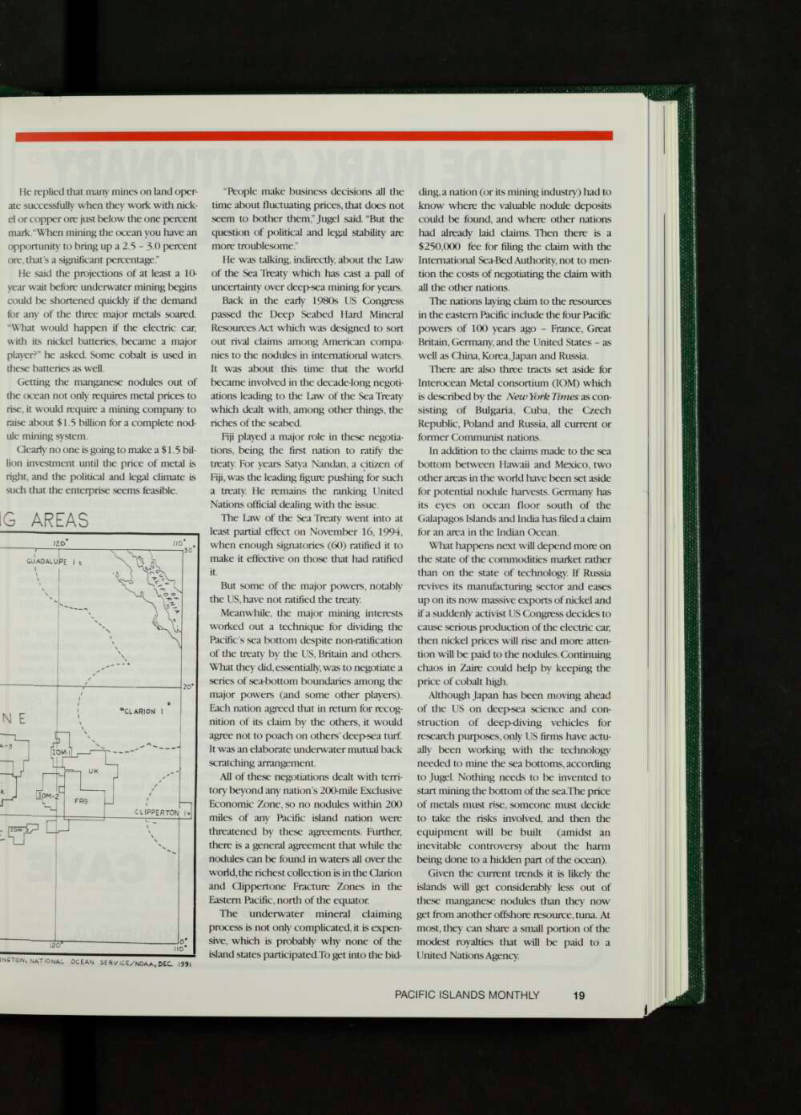
Deep Seabed Mining Operatt
Ig Areas
He replied that many mines on land oper ate successfully when they work with nick el or copper ore just below the one percent mark. “When mining the ocean you have an opportunity to bring up a 2.5 - 3 0 percent ore, that’s a significant percentage.”
He said the projections of at least a 10year wait before underwater mining begins could be shortened quickly if the demand for any of the three major metals soared.
“What would happen if the electric car, with its nickel batteries, became a major player?” he asked. Some cobalt is used in these batteries as well.
Getting the manganese nodules out of the ocean not only requires metal prices to rise, it would require a mining company to raise about $1.5 billion for a complete nod ule mining system.
Clearly no one is going to make a $ 1.5 bil lion investment until the price of metal is right, and the political and legal climate is such that the enterprise seems feasible.
“People make business decisions all the time about fluctuating prices, that does not seem to bother them,” Jugel said. “But the question of political and legal stability are more troublesome.”
He was talking, indirectly, about the Law of the Sea Treaty which has cast a pall of uncertainty over deep-sea mining for years.
Back in the early 1980 s US Congress passed the Deep Seabed Hard Mineral Resources Act which was designed to sort out rival claims among American compa nies to the nodules in international waters.
It was about this time that the world became involved in the decade-long negoti ations leading to the Law of the Sea Treaty which dealt with, among other things, the riches of the seabed.
Fiji played a major role in these negotia tions, being the first nation to ratify the treaty. For years Satya Nandan, a citizen of Fiji, was the leading figure pushing for such a treaty. He remains the ranking United Nations official dealing with the issue.
The Law of the Sea Treaty went into at least partial effect on November 16, 1994, when enough signatories (60) ratified it to make it effective on those that had ratified it.
But some of the major powers, notably the US, have not ratified the treaty.
Meanwhile, the major mining interests worked out a technique for dividing the Pacific’s sea bottom despite non-ratification of the treaty by the US, Britain and others.
What they did, essentially, was to negotiate a series of sea-bottom boundaries among the major powers (and some other players).
Each nation agreed that in return for recog nition of its claim by the others, it would agree not to poach on others’ deep-sea turf.
It was an elaborate underwater mutual back scratching arrangement.
All of these negotiations dealt with terri tory beyond any nation’s 200-mile Exclusive Economic Zone, so no nodules within 200 miles of any Pacific island nation were threatened by these agreements. Further, there is a general agreement that while the nodules can be found in waters all over the world, the richest collection is in the Clarion and Clippertone Fracture Zones in the Eastern Pacific, north of the equator.
The underwater mineral claiming process is not only complicated, it is expen sive, which is probably why none of the island states participated.To get into the bid
ding, a nation (or its mining industry) had to know where the valuable nodule deposits could be found, and where other nations had already laid claims. Then there is a $250,000 fee for filing the claim with the International Sea-Bed Authority, not to men tion the costs of negotiating the claim with all the other nations.
The nations laying claim to the resources in the eastern Pacific include the four Pacific powers of 100 years ago - France, Great Britain, Germany, and the United States - as well as China, Korea, Japan and Russia.
There are also three tracts set aside for Interocean Metal consortium (IOM) which is described by the New York Times as con sisting of Bulgaria, Cuba, the Czech Republic, Poland and Russia, all current or former Communist nations.
In addition to the claims made to the sea bottom between Hawaii and Mexico, two other areas in the world have been set aside for potential nodule harvests. Germany has its eyes on ocean floor south of the Galapagos Islands and India has filed a claim for an area in the Indian Ocean.
What happens next will depend more on the state of the commodities market rather than on the state of technology. If Russia revives its manufacturing sector and eases up on its now massive exports of nickel and if a suddenly activist US Congress decides to cause serious production of the electric car, then nickel prices will rise and more atten tion will be paid to the nodules. Continuing chaos in Zaire could help by keeping the price of cobalt high.
Although Japan has been moving ahead of the US on deep-sea science and con struction of deep-diving vehicles for research purposes, only US firms have actu ally been woridng with the technology needed to mine the sea bottoms, according to Jugel. Nothing needs to be invented to start mining the bottom of the sea. The price of metals must rise, someone must decide to take the risks involved, and then the equipment will be built (amidst an inevitable controversy about the harm being done to a hidden part of the ocean).
Given the current trends it is likely the islands will get considerably less out of these manganese nodules than they now get from another offshore resource, tuna. At most, they can share a small portion of the modest royalties that will be paid to a United Nations Agency.