New salary
pp. 16-17 · Read in the full issue
The Forum
New salary structure causes dismay
Salaries and benefits offered by the South Pacific Forum Secretariat are to be slashed by as much as 25 percent from this month. This means all new contracts offered by the regional organisation will be affected, raising the concern that future recruitees may not necessarily be the most qualified.
The decision, which could have a “flow-on” effect to other regional organi sations, was taken by the Forum Officials Committee - the South Pacific Forum Secretariat’s governing body - at its meet ing in Suva in November.
It was a decision everyone knew was coming.
In fact, it was last June that battle lines were drawn over salary packages offered by regional organisations in the South Pacific. On one hand, a consultant’s report called for drastic cuts in some salaries and benefits. On the other, regional organisa tions resisted, arguing that in order to attract and maintain high calibre staff, existing terms and conditions must be maintained.
The consultant’s terms of reference were to “produce a common package that will attract high calibre staff at minimum cost”. The NZ$ 1000-a-day,six-month study was completed last June.
Funded by the New Zealand govern ment, the author of the report, Doug Ruhen, of management consultants Deloiite, Touche and Tohmatsu, argued that most of the seven regional organisa tions under the umbrella of South Pacific Organisation Coordinating Committee overpay their staff by as much as 35 per
cent. This extra fat must be trimmed, he said.
For instance, the head of one regional organisation receives a tax-free package of US$l2O,OOO a year. The consultant wants this reduced, arguing that similar jobs in Australia or New Zealand could be done at two-thirds the cost.
He argued that by slashing salaries and conditions for all SPOCC member organi sations net savings would amount to around Fsl.B million per annum. Internal calculations by some organisations being affected, however, showed different results.
Angered by the report, heads of region al organisations hit back. They described the report as “riddled with inaccuracies”.
And riddled with inaccuracies it was. The Forum Officials Committee was told con tents were changed three times since the Forum meeting in Brisbane in August.
In many circles, the report continues to be unpopular. In some quarters it has earned the nickname “the ruin report”.
The wrangling over terms and condi tions of SPOCC members came to a head in Brisbane at pre-Forum sessions of senior officials. Officials had agreed to have the recommendations re-examined.
A sub-committee comprising Australia, New Zealand, Federated States of Micronesia, Fiji, Papua New Guinea, Republic of Marshall Islands and Tuvalu, and representatives of six SPOCC mem bers was set up to do the job. The sub committee met seven times in Suva.
Fiji, Forum Fisheries Agency (FFA) and the Tourism Council of the South Pacific
attended only once. Only Australia, New Zealand and the South Pacific Forum Secretariat attended all seven meetings.
Despite low attendance, the “razor gang” (the sub-committee) brought down its recommendations in late November.
Although the impact of the decisions are still being absorbed, the Suva-based Secretariat will be the first to cope with the effects. It is not clear whether the new terms and conditions will apply to other regional bodies such as the South Pacific Commission and the South Pacific Regional Environment Programme. They have their own governing bodies which decide on terms and conditions.
As for the Forum Secretariat, salaries and benefits of new contracts will be reduced by as much as 25 percent. For some jobs the salary component alone has been cut by up to 16 percent. A num ber of other significant changes was agreed to.
For instance, the six-monthly Cost of Living Adjustment being enjoyed by staff of the Secretariat for the past four years would be abolished. Salaries of staff are adjusted every six months to account for the official inflation rate in Fiji. This will now be done away with from January 1.
Instead the committee has agreed to introduce Special Drawing Rights using a basket of regional currencies with a mechanism which will take into account inflation.
Annual leave entitlements of 30 work ing days will be reduced by five.
Education allowances paid to contract staff will be limited to the first three chil dren only. New contract staff with more children will be responsible for the cost of educating their additional children.
Working hours have been increased by two to a 37-hour week from January.
Permanent staff, that is Fiji employees who are not on contract, are the overall winners. Except for the increase in the number of working hours, their terms and conditions are untouched.
New contract staff from Fiji also came out winners. After a long battle, new con tract staff will get a minimum housing allowance of Fslooo a month or the equivalent of 17 percent of their base salary.
While the new salary package and ben efits may seem a big dive down for new staff, they are lenient, especially in light of initial cuts recommended by the consul tant.
Some countries, including Fiji, had wanted blood. They did not get it.
Along with the abolition of COLA, Fiji was said to have insisted that a three-year wage freeze be imposed on salaries of Secretariat staff. Fiji had reportedly also argued that salary increases should be based on the employer’s ability-to-pay principle. (Budgetary constraints have forced the Fiji government to reject a con sultant’s report recommending huge wage increases for its public servants.
Ironically, it was the same consultant who had recommended huge cuts in the salaries and benefits of SPOCC organisa tions.) In the intense debate over the new terms and conditions, Australia and New Zealand were said to have argued strong ly against the Forum Secretariat’s top job commanding more pay than their prime ministers.
As well, they were said to have argued that directors of divisions should not be paid more than government ministers in the two countries.
While the decision on salaries and benefits appeared to be the main out come of the review, a number of areas remain vague. Among them, the question i of the abolition of COLA. Staff on exist-1 ing contracts say they understand the 1 won’t be affected by any of the deci sions. The management of the Forum Secretariat is yet to clarify its position on this.
Under the previous system, COLA was part of the package offered to contract staff. It, therefore, can only be changed by mutual agreement. (All Forum staff have received COLA since it was brought in in 1991.) Is there more to this whole exercise than mere cost-cutting? And why are Australia and New Zealand pushing for new terms and conditions at the Forum Secretariat?
One argument is that they pick up the bulk of the salary tab in the organisation.
Tight economic circumstances now ques tion whether the generous funding levels provided over the years by both coun tries would be maintained. Through assessed member contributions, Australia and New Zealand provide more than two thirds of the Forum Secretariat’s regular budget. F0r1993, contributions from both countries are estimated to be over Fsl.6 million - a massive injection of funds. As well, they provide the bulk of funding for the Forum Secretariat’s extra budget which is used to run regional pro grammes.
But some officials think there is more to it than mere cost-cutting. One argu
ment privately advanced is that in Australia’s and New Zealand’s views, Pacific islanders do not command much of a salary package back in their home countries due, among other things, to the inability of their governments to pay.
The conclusion is that the lowest salary package offered by the Secretariat will be readily accepted, especially when it carries a tax-free component as a sweet ener.
Others offer
a more pragmatic explanation. According to them, by pushing for sweeping cuts in salaries and benefits, Australia and New Zealand are deliberately trying to run down the organisation.
“They want to prove a point - that is, that islanders are not capable of running an organisation, let alone a regional body,” one angry official said.
“They want to be seen as saviours.”
On the other hand, Australia and New Zealand are perhaps trying to tell their island neighbours to start learning to live within their means.
What baffles everyone though is the fact that in the mid-80s Australia and New Zealand had instigated moves to bolster salary packages offered by the South Pacific Forum Secretariat. Why are they reacting now, especially when their nationals (apart from Fiji) dominate the staff of the organisation numerically?
In the mid-80s (perhaps when the going was good) a consultant reviewed m the terms and conditions of the oigani- BL sation, resulting in the sizing of jobs.
St This means the higher the point size of a job, the more pay there is. In a ■ number of cases, job sizes of posi tions held by Australians, New r Zealanders and those funded by donor agencies were slightly higher than those held by their island counterparts, (hi one case, a contract officer was hired at an adviser level. The moment he came in, he was promoted to director level. This became a topic of debate two years ago when some countries demanded to know the criteria used to determine the level of salaries.) In 1988/89, an Australian-funded review was again conducted, this time by Rod Tinning. (He later did one for the South Pacific Commission and Apia-based SPREP) His recommended salary struc ture and benefits were adopted by the Forum Secretariat and gradually phased in from 1991. Among the recommendations is the six-monthly COLA which is now being thrown out. Staff who have been with the Secretariat for 10 years or more confirmed it was during this time that salary levels sky-rocketed.
Nauru was said to have been just as baffled as everyone else, reminding the November Forum Officials Committee meeting that Australia and New Zealand had actually supported the generous remuneration packages of the Forum Secretariat. Now, both countries have taken the lead in recommending reduc tions. ■
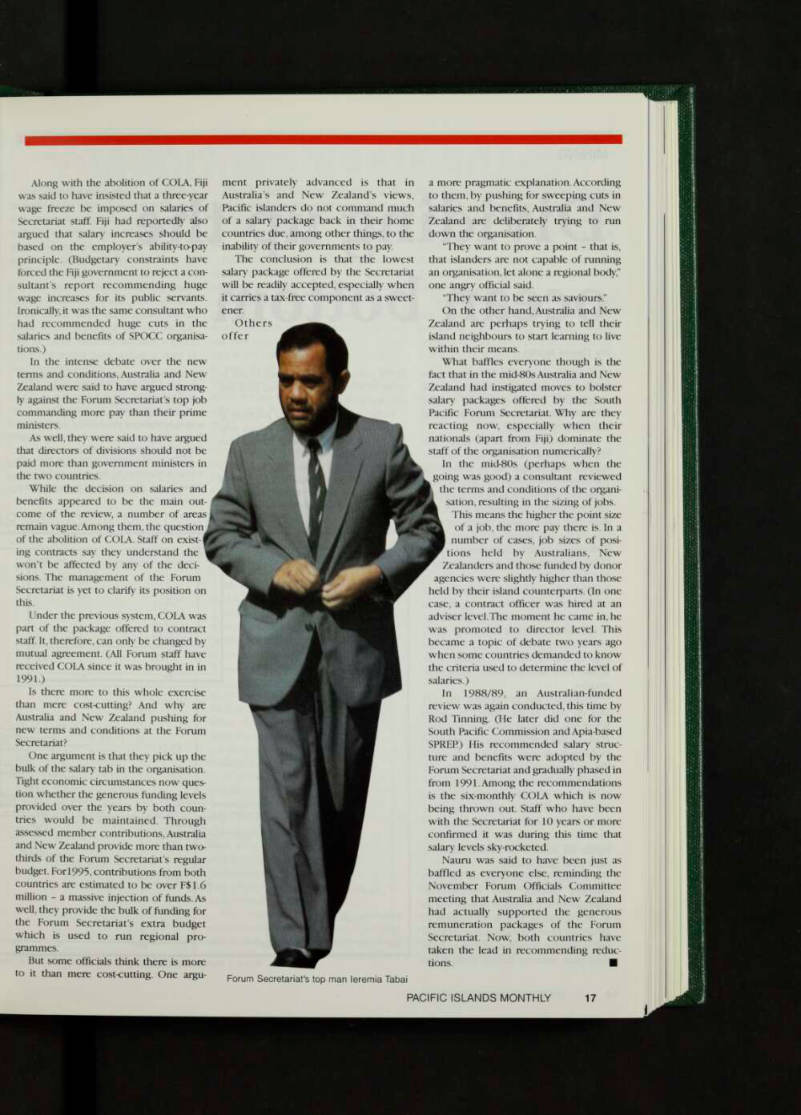
Forum Secretariat’s top man leremia Tabai