League’S
pp. 54-55 · Read in the full issue
Sports
here to stay
By Shailendra Singh
Rugby League, still striving to increase its international membership, is gaining a stronghold in the South Pacific.
Mixing sports and culture,league scored a valuable point with the success ful staging of last month’s Pacific Cup tournament in Suva.
It was an important step forward in its battle to gain recognition in island nations , especially where rugby union holds sway over the vast majority of the population.
Over 6000 people came to watch the Tonga-Fiji final and third/fourth place play off between Western Samoa and the Australian Aborigines.
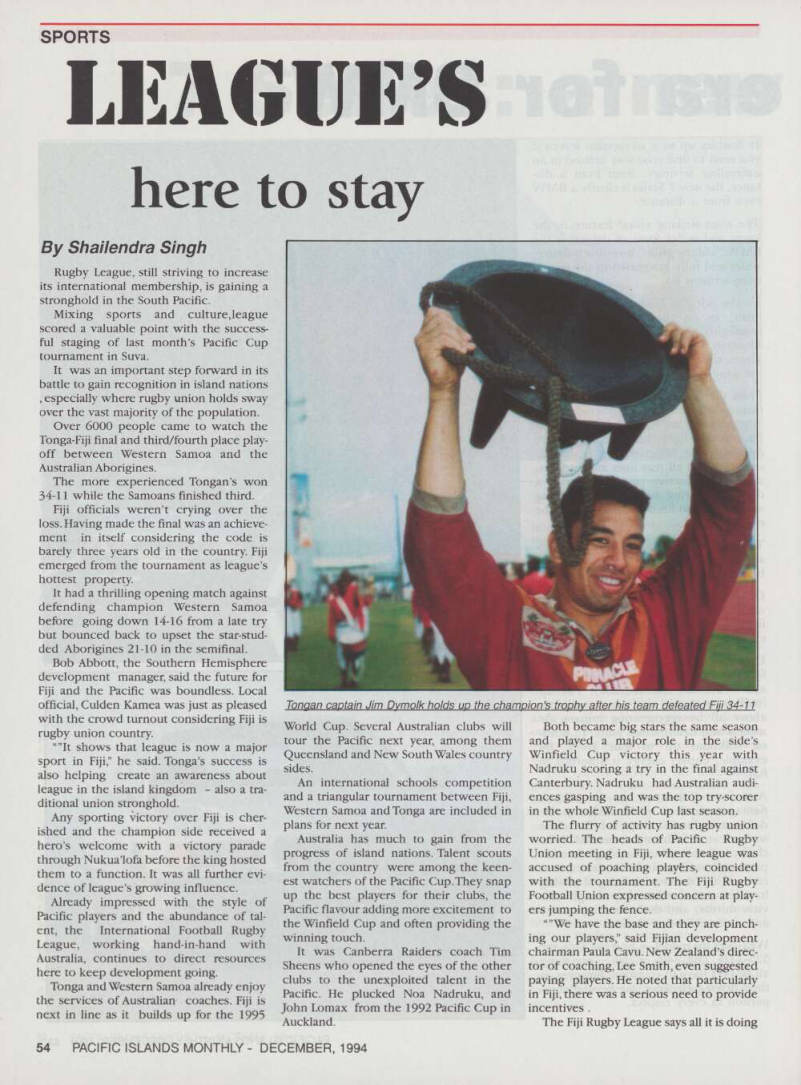
The more experienced Tongan’s won 34-11 while the Samoans finished third.
Fiji officials weren’t crying over the loss. Having made the final was an achieve ment in itself considering the code is barely three years old in the country. Fiji emerged from the tournament as league’s hottest property.
It had a thrilling opening match against
defending champion Western Samoa
before going down 14-16 from a late try but bounced back to upset the star-stud ded Aborigines 21-10 in the semifinal.
Bob Abbott, the Southern Hemisphere development manager, said the future for Fiji and the Pacific was boundless. Local official, Gulden Kamea was just as pleased with the crowd turnout considering Fiji is rugby union country.
“”It shows that league is now a major sport in Fiji,” he said. Tonga’s success is also helping create an awareness about league in the island kingdom - also a tra ditional union stronghold.
Any sporting victory over Fiji is cher ished and the champion side received a hero’s welcome with a victory parade through Nukualofa before the king hosted them to a function. It was all further evi dence of league’s growing influence.
Already impressed with the style of
Pacific players and the abundance of tal ent, the International Football Rugby League, working hand-in-hand with Australia, continues to direct resources here to keep development going.
Tonga and Western Samoa already enjoy the services of Australian coaches. Fiji is next in line as it builds up for the 1995
World Cup. Several Australian clubs will tour the Pacific next year, among them Queensland and New South Wales country sides.
An international schools competition and a triangular tournament between Fiji, Western Samoa and Tonga are included in plans for next year.
Australia has much to gain from the progress of island nations. Talent scouts from the country were among the keen est watchers of the Pacific Cup. They snap up the best players for their clubs, the Pacific flavour adding more excitement to the Winfield Cup and often providing the winning touch.
It was Canberra Raiders coach Tim Sheens who opened the eyes of the other clubs to the unexploited talent in the Pacific. He plucked Noa Nadruku, and John Lomax from the 1992 Pacific Cup in Auckland.
Both became big stars the same season and played a major role in the side’s Winfield Cup victory this year with Nadruku scoring a try in the final against Canterbury. Nadruku had Australian audi ences gasping and was the top try-scorer in the whole Winfield Cup last season.
The flurry of activity has rugby union worried. The heads of Pacific Rugby Union meeting in Fiji, where league was accused of poaching players, coincided with the tournament. The Fiji Rugby Football Union expressed concern at play ers jumping the fence.
“”We have the base and they are pinch ing our players,” said Fijian development chairman Paula Cavu.New Zealand’s direc tor of coaching, Lee Smith, even suggested paying players. Fie noted that particularly in Fiji, there was a serious need to provide incentives .
The Fiji Rugby League says all it is doing
Tongan captain Jim Dymolk holds up the champion’s trophy after his team defeated Fiji 34-11
is offering an alternative sport, and for players who are good at league, perhaps a better life. This season alone, Australian clubs snapped up nine players from Fiji’s eight clubs, offering wages and opportu nities they could only dream of previously.
More such opportunities are in the making with the Pacific Cup growing from strength to strength and being a far cry from its shaky start in the 1970s.The bien nial tournament was initiated for the development of the code within the Pacific basin countries and open only to teams made up of indigenous players.
After fizzling out because of financial problems, it was revived in 1986 and staged in the Cook Islands. This year, the New Zealand Maoris, Auckland Rotumans Invitation, Niue, Cook Islands, Fiji President’s XIII and American Samoa made up the other 10 teams.
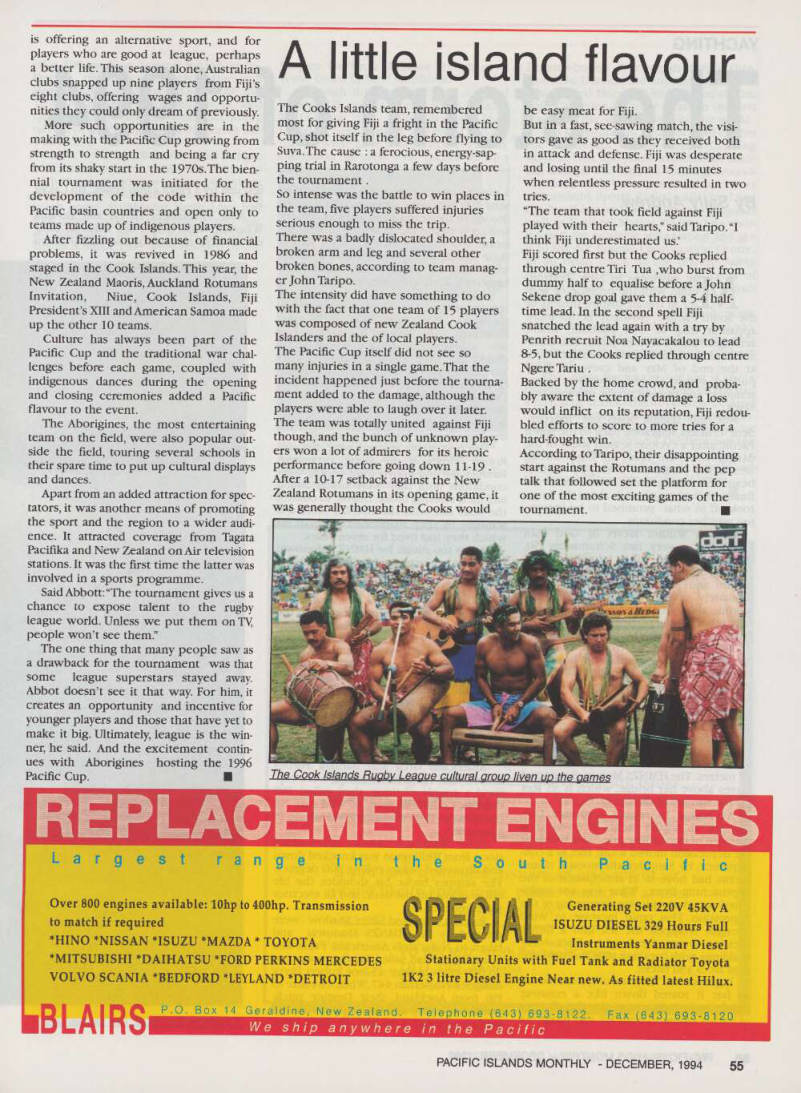
Culture has always been part of the Pacific Cup and the traditional war chal lenges before each game, coupled with indigenous dances during the opening and closing ceremonies added a Pacific flavour to the event.
The Aborigines, the most entertaining team on the field, were also popular out side the field, touring several schools in their spare time to put up cultural displays and dances.
Apart from an added attraction for spec tators, it was another means of promoting the sport and the region to a wider audi ence. It attracted coverage from Tagata Pacifika and New Zealand on Air television stations. It was the first time the latter was involved in a sports programme.
Said Abbott: “The tournament gives us a chance to expose talent to the rugby league world. Unless we put them on Ty people won’t see them.”
The one thing that many people saw as a drawback for the tournament was that some league superstars stayed away.
Abbot doesn’t see it that way. For him, it creates an opportunity and incentive for younger players and those that have yet to make it big. Ultimately, league is the win ner, he said. And the excitement contin ues with Aborigines hosting the 1996 Pacific Cup. ■