7 Series: a new ear for BMW
pp. 52-53 · Read in the full issue
BMW 7 Series
advertising feature
By Arvind Kumar
BWM’s new 7 Series car has heralded a new era for top of the range executive
luxury vehicles.
Launched at the Sheraton Mirage Resort in Port Douglas, Australia in October the 7 Series is a ear in which you feel at home, a car which is simply fun to drive.
The new “third generation” BMW 7 Series has everything it takes to continue the outstanding success of the second generation 7 Series launched in 1986.
The “second generation” 7 Series was the car that gave BMW the final breakthrough to the top in the luxury performance market. A car with a concept combining typical BNIW features such as safety and dynamic performance with discreet elegance-making 7 series an entirely new type of automobile at the top end of the market.
AltlinnoT the 7 series will nnr hp in Fiii this year, die 3 series and 5 series are due jji tfig country early next month, says Jack Reddy of CAR Corporation Ltd.
CAR Corporation, a joint venture between Reddy’s Tyre Power (Fiji) Ltd and Australia-trained BMW engineer Glenn Cupit, will sell and service the cars at its workshop at Raiwaqa.
The first shipment of 12 cars include
the BMW 316 i Compact (hatchback),
316 i, 318 i (four-door, sedan), 320 i sedan, 520iT (sedan 5.2 litre), 525-TDS (sedan diesel turbo), and the 525iX (full time 4W'D), M 3 (racing model) and the 730 i
of the 7 Series which will be available in Fiji next year.
On the demanding road test drive from Port Douglas to Kuranda and back, the BMW 730 i and the 740 i took the challenge head-on and emerged winners - with flying colours.
With more than enough leg room and the seats adjustable to every curve of the body, the 180-kilometre drive to Kuranda was a breeze.
Both, the 730 i and the 740 i proved amazingly sturdy on the long and winding road towards Mareeba, almost halfway to Kuranda.
The new 7 Series is entering the world market as an all-new saloon with fourvalve, eight-cylinder power units developing 160 kW (218bhp) in the 730 i and 210 kW (286bhp) in the 740 i power units offering the very best in terms of performance, motoring comfort and fuel economy.
Although the 740 i tackled with ease the many sharp bends and proved a more gutsy performer on the stretches, the 730 i, I feel, is better suited for Fiji roads.
Perhaps the single most important feature that gives the German-made BMWs its unique behaviour on the road is its high performance suspension.
This is further enhanced by the extra large disc brakes and the sophisticated anti-lock brake system fitted as standard.
The new 7 Series is only a bit longer and wider than its predecessor while its
interior dimensions have grown much more than the exterior dimensions.
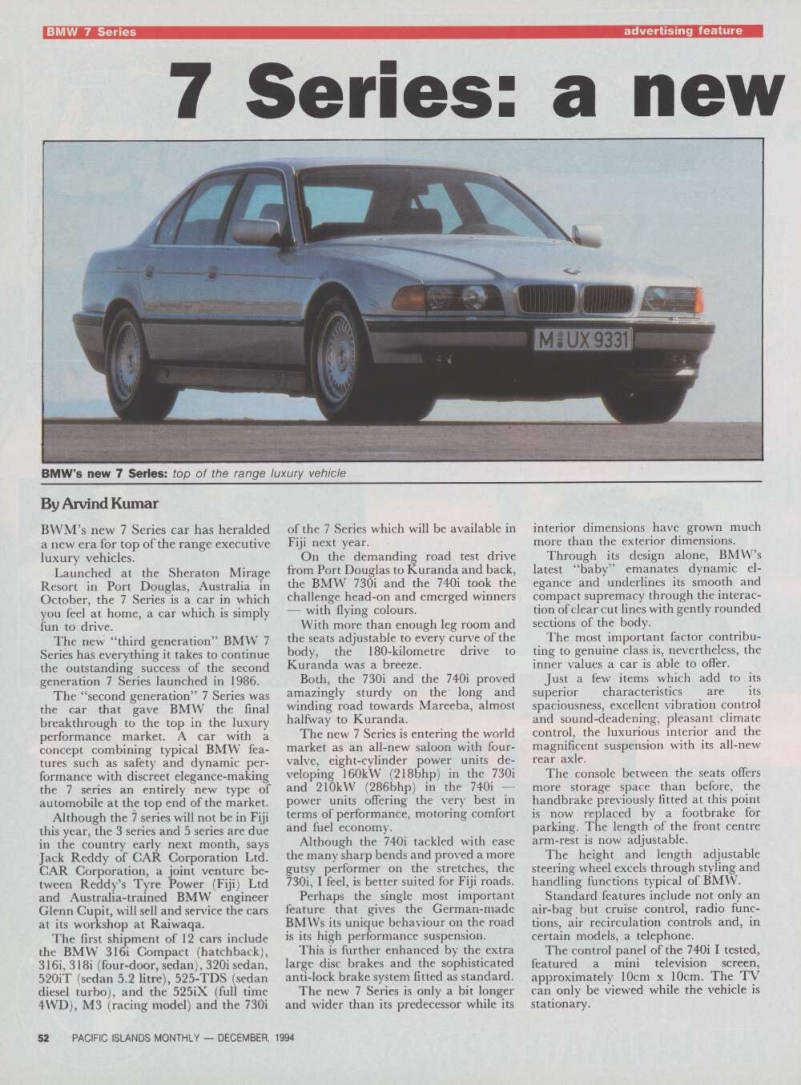
Through its design alone, BMW’s latest “baby” emanates dynamic el egance and underlines its smooth and compact supremacy through the interac tion of clear cut lines with gently rounded sections of the body.
The most important factor contribu ting to genuine class is, nevertheless, the inner values a car is able to offer.
Just a few items which add to its superior characteristics are its spaciousness, excellent vibration control and sound-deadening, pleasant climate control, the luxurious interior and the magnificent suspension with its all-new rear axle.
The console between the seats offers more storage space than before, the handbrake previously fitted at this point is now replaced by a footbrake for parking. The length of the front centre arm-rest is now adjustable.
The height and length adjustable steering wheel excels through styling and handling functions typical of BMW.
Standard features include not only an air-bag but cruise control, radio func tions, air recirculation controls and, in certain models, a telephone.
The control panel of the 740 i I tested, featured a mini television screen, approximately 10cm x 10cm. The TV can only be viewed while the vehicle is stationary.
BMW’s new 7 Series: top of the range luxury vehicle
It doubles up as a navigation screen if you need to find your way around in an unfamiliar territory. Seen from a dis tance, the new 7 Series is clearly a BMW even from a distance.
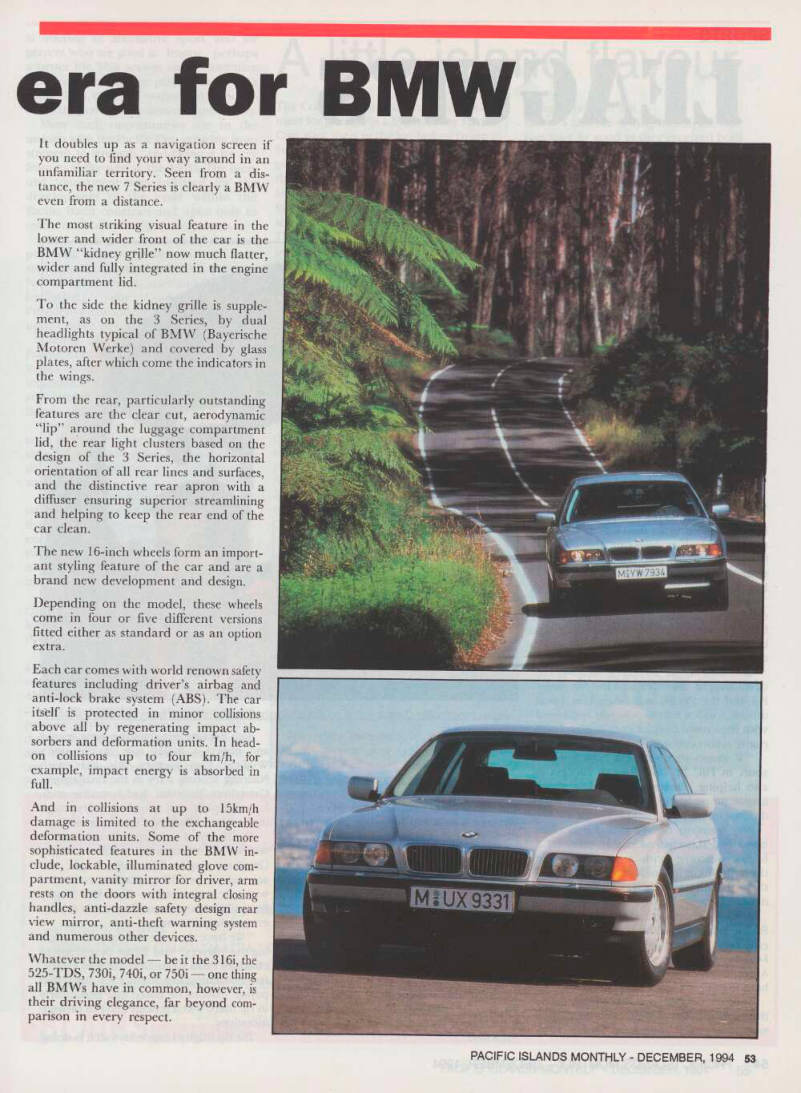
The most striking visual feature in the lower and wider front of the car is the BMW “kidney grille” now much flatter, wider and fully integrated in the engine compartment lid.
To the side the kidney grille is supple ment, as on the 3 Series, by dual headlights typical of BMW (Bayerische Motoren Werke) and covered by glass plates, after which come the indicators in
the wings.
From the rear, particularly outstanding features are the clear cut, aerodynamic “lip” around the luggage compartment lid, the rear light clusters based on the design of the 3 Series, the horizontal orientation of all rear lines and surfaces, and the distinctive rear apron with a diffuser ensuring superior streamlining and helping to keep the rear end of the car clean.
The new 16-inch wheels form an import ant styling feature of the car and are a brand new development and design.
Depending on the model, these wheels come in four or five different versions fitted either as standard or as an option extra.
Each car comes with world renown safety features including driver’s airbag and anti-lock brake system (ABS). The car itself is protected in minor collisions above all by regenerating impact ab sorbers and deformation units. In head on collisions up to four km/h, for example, impact energy is absorbed in full.
And in collisions at up to 15km/h damage is limited to the exchangeable deformation units. Some of the more sophisticated features in the BMW in clude, lockable, illuminated glove com partment, vanity mirror for driver, arm rests on the doors with integral closing handles, anti-dazzle safety design rear view mirror, anti-theft warning system and numerous other devices.
Whatever the model —be it the 316 i, the 525-TDS, 730 i, 740 i, or 750 i one thing all BMWs have in common, however, is their driving elegance, far beyond com parison in every respect.