Angry
pp. 46-47 · Read in the full issue
Tee
By Ed Rampell
“I am the most hated Maori in New Zealand,” declares Alan Duff, the indige nous author of the novel-turned-film, Once Were Warriors that just beat Oscar-winning The Piano for New Zealand’s best picture award. The politi cally incorrect Polynesian writer “had no formal schooling” and did time in “various penal institutions ... By the time I was 15,1 was doing my first spell of solitary confinement for assault, bur glary, just normal kid things when you’re mucking around with the wrong crowd”.
The prize winning novelist who was unpublished until he turned 40, says that at 38, he “was a highly accom
plished failure”.
After years of unsuccessful writing, Duff burst upon New Zealand’s literary scene with Once Were Warriors in November, 1990, during the 150th anniversary of Waitangi Treaty. At this time, attention was focused on native issues, and Duff’s first novel dealt with Maori gangs, domestic violence, incest, rape, suicide, and nationalism. Its suc cess (the first printing ran out in weeks, and Warriors has sold more than 30,000 copies and been reprinted at least eight times) landed Duff a position as a syn dicated columnist for New Zealand’s major newspapers. His second work of friction, One Night Out Stealing was published in 1992 and is about Maori thieves who scoff at the straight, nine to-five workaday world.
His novels are the literary equivalent of the traditional tongue wagging by Maori warriors during the fierce haka dances.
The wordsmith contends: “A lot of the academics in the universities hate me because they think my message to Maoris is too hard. Because they’ve been busy telling my people that whafs
New Zealand’s politically incorrect author ; Alan Duff, shatters the Maori myth.
wrong with us is the colonial process, and, you know, we’ve been oppressed.
And I’ve been saying, I agree with you up to a point. But what’s the use of lying down and crying about it? Do some thing ... I am a doer ... Stop walking around and thinking you’re inferior to the white guy; instead of working for him, why don’t you have him working for you? I’m just trying to tell them any
thing’s possible.”
As for Maoris turning to other Maoris for a solution to their problems, Duff strongly believes, “We’ve got to help ourselves. I’m not a believer in lying down and dying ... I can’t stand vic tims.
“We’re 54 percent of the prison pop ulation ... responsible for six times more the criminal offending than our white counterparts. You name it, bad statistic, and we’re it.” Duff maintains: “Our universities say that anything and everything is excusable as far as bad behaviour goes by Maori people because we’ve been colonised and oppressed. Whereas Alan Duff comes along and says:‘We have been colonised
and we have been oppressed. I could n’t agree more. And our land was stolen from us in many cases. But I’m saying nothing, but nothing, is going to change that situation, we’ve got to take advan tage of the education system ... I’ve always said it’s easier to lie down and cry and to articulate and make eloquent everything that’s wrong with you, and it’s a lot harder to stand up, and in com plete silence, make an internal vow to yourself to do something about it to fix the problem”.
This is something Duff himself did. “One day I heard myself making an excuse, and it echoed back. I felt sick; I knew I was telling a lie.” A failed business venture, when he was about 38, “was someone else’s fault.” Duff realised that he was rationalizing his own failure by blaming white racism.
The author sums up his old fashioned philosophy as: “Work hard, get an edu cation, look after your children, leave the booze alone, stop beating your wives, and start loving your children.
Because that’s all I ever said; that’s all this book (Warriors) is about.”
He says the message of One Night Out Stealing is simply;“Don’t bring your children up to be losers.” He points out that New Zealand was a social welfare forerunner, and that Maoris, who are about 10 percent of the population,
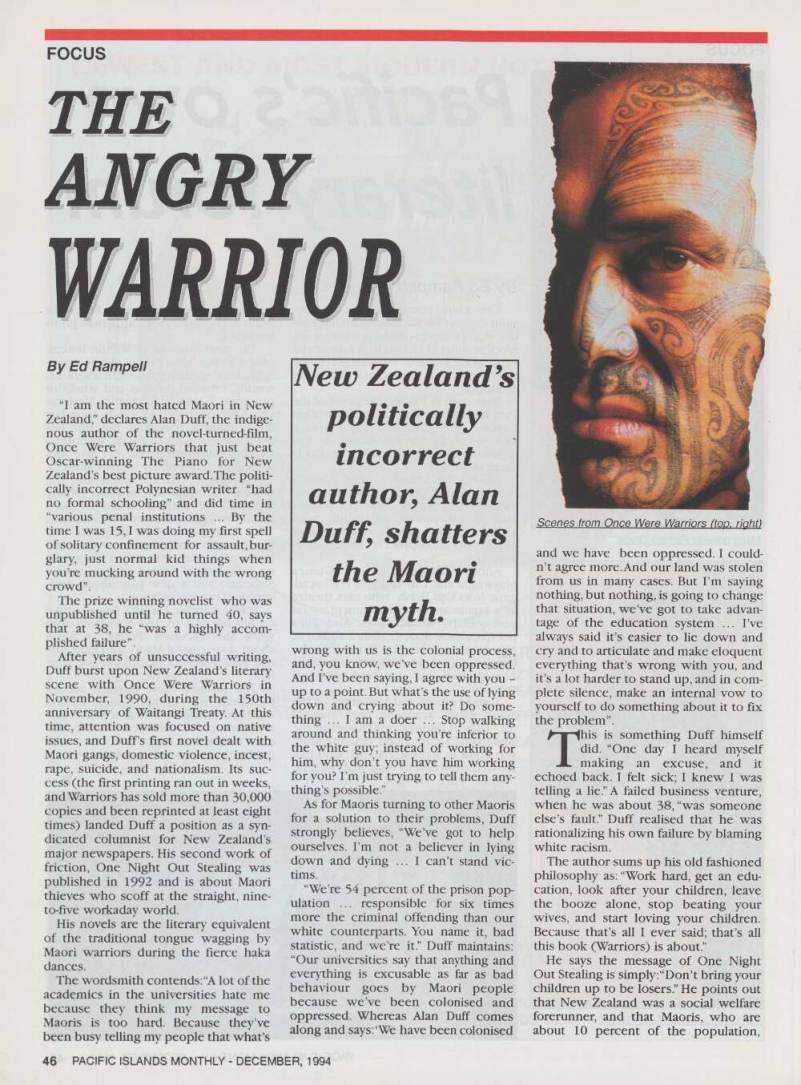
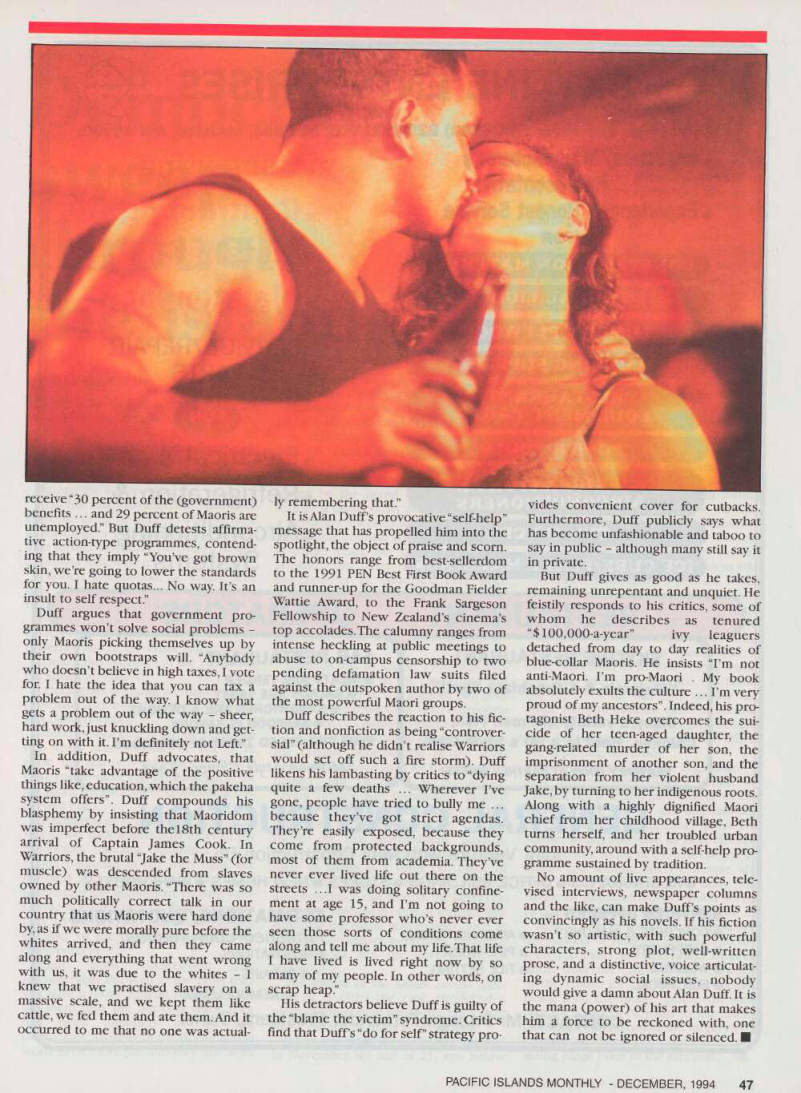
Scenes from Once Were Warriors (top, right )
receive 30 percent of the (government) benefits ... and 29 percent of Maoris are unemployed. But Duff detests affirmalive action-type programmes, contendmg that they imply “You’ve got brown skin, we’re going to lower the standards tor you. I hate quotas... No way. It’s an iHsultt o self respect.”
Duff argues that government programmes won’t solve social problems only Maoris picking themselves up by their own bootstraps will. “Anybody who doesnt believe in high taxes, I vote tor. 1 hate the idea that you can tax a problem out of the way. I know what gets a problem out of the way - sheer, hard work, just knuckling down and getting on with it. I’m definitely not Left.” !n addition Duff advocates, that Maoris take advantage of the positive things like^education which the pakeha system offers . Duff compounds his blasphemy by insisting that Maoridom was imperfect before the 18th century amva! of Captain James Cook. In Warnors, the brutal Jake the Muss” (for muscle) was descended from slaves owned by other Maoris. “There was so much politically correct talk in our countiy that us Maoris were hard done y, as if we were morally pure before the whites arrived, and then they came along and everything that went wrong with us it was due to the whites - I new that we practised slavery on a massive scale, and we kept them like cattle, we fed them and ate them. And it occurred to me that no one was actual-
ly remembering that.”
It is Alan Duffs provocative “self-help” message that has propelled him into the spotlight, the object of praise and scorn.
The honors range from best-sellerdom to the 1991 PEN Best First Book Award and runner-up for the Goodman Fielder Wattie Award, to the Frank Sargeson Fellowship to New Zealand’s cinema’s top accolades. The calumny ranges from intense heckling at public meetings to abuse to on-campus censorship to two pending defamation law suits filed against the outspoken author by two of the most powerful Maori groups.
Duff describes the reaction to his fiction and nonfiction as being “controversial” (although he didn’t realise Warriors would set off such a fire storm). Duff likens his lambasting by critics to “dying quite a few deaths ... Wherever I’ve gone, people have tried to bully me ... because they’ve got strict agendas.
They’re easily exposed, because they come from protected backgrounds, most of them from academia. They’ve never ever lived life out there on the streets ...I was doing solitary confinement at age 15, and I’m not going to have some professor who’s never ever seen those sorts of conditions come along and tell me about my life. That life I have lived is lived right now by so many of my people. In other words, on
scrap heap.”
His detractors believe Duff is guilty of the “blame the victim” syndrome. Critics find that Duff’s “do for self” strategy pro-
vides convenient cover for cutbacks, Furthermore, Duff publicly says what has become unfashionable and taboo to say in public - although many still say it in private But Duff gives as good as he takes remaining unrepentant and unquiet. He feistily responds to his critics, some of whom he describes as tenured “$lOO,OOO-a-year” ivy leaguers detached from day to day realities of blue-collar Maoris. He insists “I’m not anti-Maori. I’m pro-Maori . My book absolutely exults the culture ... I’m very proud of my ancestors”. Indeed, his pro tagonist Beth Heke overcomes the sui cide of her teen-aged daughter the gang-related murder of her son the imprisonment of another son, and the separation from her violent husband Jake, by turning to her indigenous roots, Along with a highly dignified Maori chief from her childhood village Beth turns herself, and her troubled urban community, around with a self-help pro gramme sustained by tradition, No amount of live appearances tele vised interviews, newspaper columns and the like, can make Duff’s points as convincingly as his novels. If his fiction wasn’t so artistic, with such powerful characters, strong plot well-written prose, and a distinctive, voice articulat ing dynamic social issues, nobodv would give a damn about Alan Duff. It is the mana (power) of his art that makes him a force to be reckoned with one that can not be ignored or silenced. ■