literary forum
p. 45 · Read in the full issue
Focus
Pacific's own literary forum
By Ed Rampell
The most comprehensive sympo sium ever on Pacific writing highlighted the world’s newest literature with a six week seminar at Honolulu in August and September. The goal was to replace out sider South Seas stereotypes with insid er images.
Nine writers formed the panel of the Pacific Writers Forum at East-West Center who discussed their writing and speakers’ presentations. A few queries were taken from a generally small audience.
Among the speakers were Hawaii’s
Haunani-Kay Trask, University of
Hawaii’s director of Hawaiian Studies and an outspoken nationalist, who asserted:“art is political... writing is part of the restitution process” of decolono sation.
Another was Papua New Guinea playwright and University of PNG acad emic Nora Vagi Brash who uses theatre as a humourous social commentary on post-colonial island elites. And Fiji’s poet/academic Sudesh Mishra, author of “Tandava” and the play Ferringhi who burned Fiji’s “vile, obscene, appalling constitution” and admitted “political motives”.
Tongan satirist and University of the South Pacific academic Epeli Hau’ofa (of “Tales of Tikongs” and “Kisses in the Nederends”) contended oral literature was equal to writing. Hau’ofa, who has n’t written fiction in nine years said he “writes when enraged ... I’m such a
bourgeois, happy, contented fellow to write ... I’d rather play cards than go to seminars”.
The poet laureate of Pacific letters Albert Wendt, gave one of the best pre sentations, speaking at length about his writing, creative process and works in progress. Cooks academic Marjorie Crocombe managed to touch upon her white father’s pancakes, but not her main contributions to Pacific literature forming the South Pacific Creative Arts Society and the literary journal Mana.
Playwright Victoria Kneubuhl the niece of Pago Pago screenwriter Johnny Kneubuhl, vibrantly discussed her plays about Hawaiian history - “Ka’iulani”
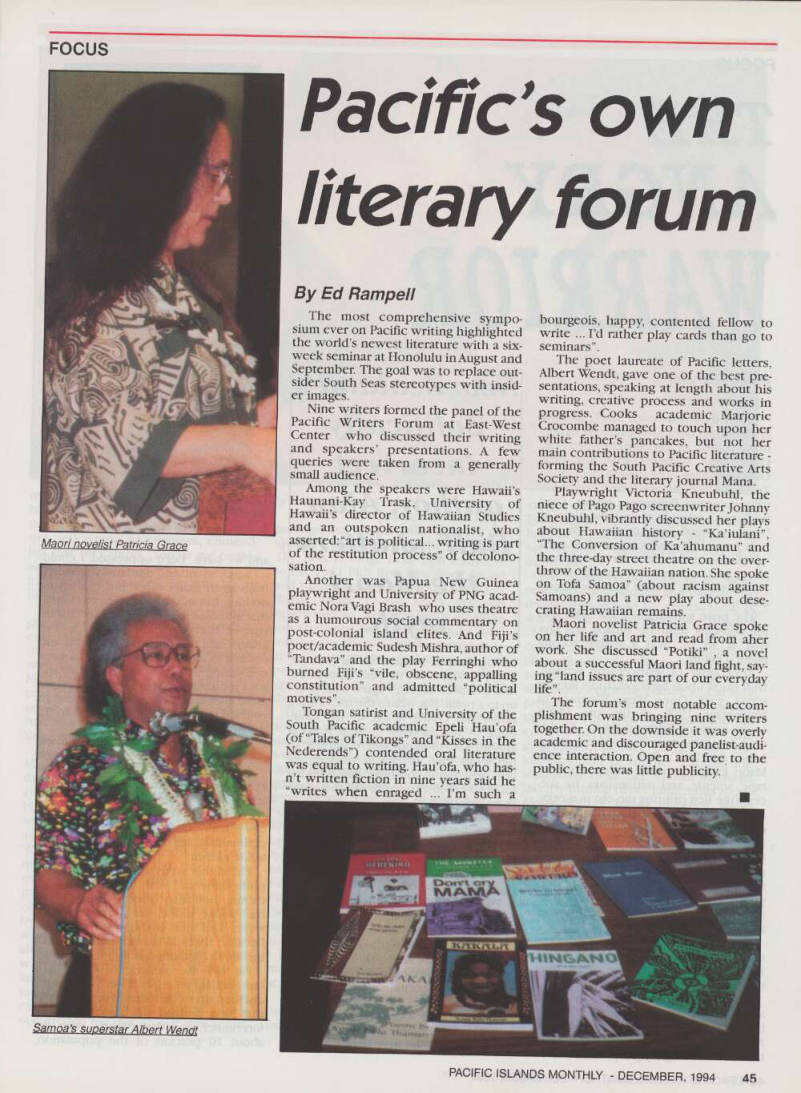
“The Conversion of Ka’ahumanu” and the three-day street theatre on the over throw of the Hawaiian nation. She spoke on Tofa Samoa” (about racism against Samoans) and a new play about dese crating Hawaiian remains, Maori novelist Patricia Grace spoke on her life and art and read from aher work. She discussed “Potiki” , a novel about a successful Maori land fight sav ing “land issues are part of our evervdav life”. phe forum’s most notable accom plishment was bringing nine writers together. On the downside it was overly academic and discouraged panelist-audi ence interaction. Open and free to the public, there was little publicity,
Maori novelist Patricia Grace
Samoa’s superstar Albert Wendt