logging
pp. 44-45 · Read in the full issue
Forestry
A united approach to
Solomon Islands Minister for Forestry, Environment and Conservation, Joses Tuhanuku, in August visited Papua New Guinea and Vanuatu. The move followed a recent Melanesian Spearhead Group decision urging member countries (Vanuatu, Solomon Islands and Papua New Guinea) to have a common approach on logging matters. It was an occasion for the two countries to adopt the same stand on the con troversial logging issue, despite pressure from foreign logging companies. Tuhanuku explains his stand to Vanuatu correspondent, Patrick Decloitre.
PIM: Mr Tuhanuku, you were recently appointed Minister for Forestry, Environment and Conservation in the government of the Solomon Islands.
What is the purpose of your visit in Vanuatu?
J. T : My visit is a follow-up of an under standing reached during the last Melanesian Spearhead Group (MSG) meeting in the Solomon Islands. And for Forestry, in the region, Papua New Guinea, Solomon Islands and Vanuatu are among the few countries in the world who still have a primary forest.
So we feel it’s important that we take some common position in dealing with our timber resources, because by doing that, we will have a better chance of withstanding the pressures from out side.
PIM.: And there are pressures?
J.T :Yes, and to deal with those pres sures individually is quite difficult. But collectively it’s easier. If we don’t take a common position, we can be used against each other by companies and by outsiders. And it will be very hard for them to exert those pressures if we take this common approach.
PIM ; So that’s why you took this trip?
J.T ; Yes, I’ve just visited Papua New Guinea, and now Vanuatu. Also, the Solomon Islands government is cur rently carrying out its inventory report this month (September) and once this report is adopted and accepted by the government, I will have to proceed to make recommendations to the cabinet.
PIM :What other steps is the Solomon Islands government currently taking?
J. T: We are working on a new forestry legislation. At this stage, we have the
recommendations already drafted. I am also going to call a summit next month that will involve provinces, ministries which are dealing with the issue and companies in the industries, non-gov ernment organisations: this will be a wide consultation. After that, whatever recommendation will come out will be incorporated in the recommendations to the cabinet. So these are the things we are preparing to do. Also a person has been sent from Australia to help us in the drafting of a common Code of Conduct. That is another very impor tant thing for us .This code would apply to the logging companies, and the code would be the same in the three MSG countries.
PIM : But what about enforcement of these regulations and codes?
J.T. : Once we have decided on a level of sustainable harvest, then surveillance becomes very important. Because if there are quotas, log export regulations, codes of conduct, they will have to be respected.
And surveillance is a question we’re already considering. We’ve already had preliminary talks with a Swiss company which is currently working in Papua New Guinea, and if we reach an agree ment, they will do our forest surveil lance for us. At the same time, they will train people who could do the job in the long run.
Without any proper surveillance, we can just forget about sustainable log ging. And the way it goes, I hope that by next year, the new legislation will be in
place.
PIM : Would there be a focus on a par ticular side of surveillance?
J.T. : That would be export of logs.
There is currently every indication that a lot of logs have left the Solomons without any duty being paid by the companies. This is because we don’t have the means to do it at the moment.
So shipments will have to be thorough ly checked.
PIM : Do you feel that more than ever, there is an urgent need in the region for action?
J.T. : Forestry in those three countries has been neglected, although it’s a very important resource for us. The resources required by the minister responsible are not there, the training needed is not provided; all those things have been neglected. As a result the agenda of this very important industry has probably been set by outsiders.
I think the keyword is management. For example, we have another resource in the Solomon Islands, and that is tuna.
Our tuna resource is managed by the FFA, the Forum Fisheries Agency. We should have done that with our timber
resource a long time ago.
The best thing would have been that the licences to export the logs are held by local people because the amount of money that we are losing at the moment is just incredible.
PIM :How does all this fit in with your visit to Vanuatu and Papua New Guinea?
J.T. : It’s very useful for me to have a look at what’s going on in the other two MSG countries. We are exchanging views on the common issues that we have to address together.
On policy matters, I think the Prime Minister ofVanuatu is very strong on the issue. It’s obvious to me that he has been thinking about the issue.
PIM : Do you feel your respective views on the matter arc identical?
J.T. :The Vanuatu position is the same as the one we have taken; they have advanced in that they have stopped the export of round logs (on June 20) and this is something that we’re still looking
at. I’m very impressed with the position of the prime minister.
PIM : A Malaysian company director attempted to bribe you very recently. Do you feel that corruption is now a thing of the past?
J.T. : In the logging industry corruption seems to be something that has been in practice for so many years in the region. This question is something that will have to be addressed as a separate issue. It’s something to do with the indi viduals, it involves not only ministers, but officials.
PIM : So this is also preparation for a meeting in October?
J.T. : This will be an officials’ meeting due to take place in the Solomon Islands. We know our forestry is in a cri sis situation and we want to do some thing before it’s too late.
This requires political will. If the leaders are undecided, there must be something wrong. ■
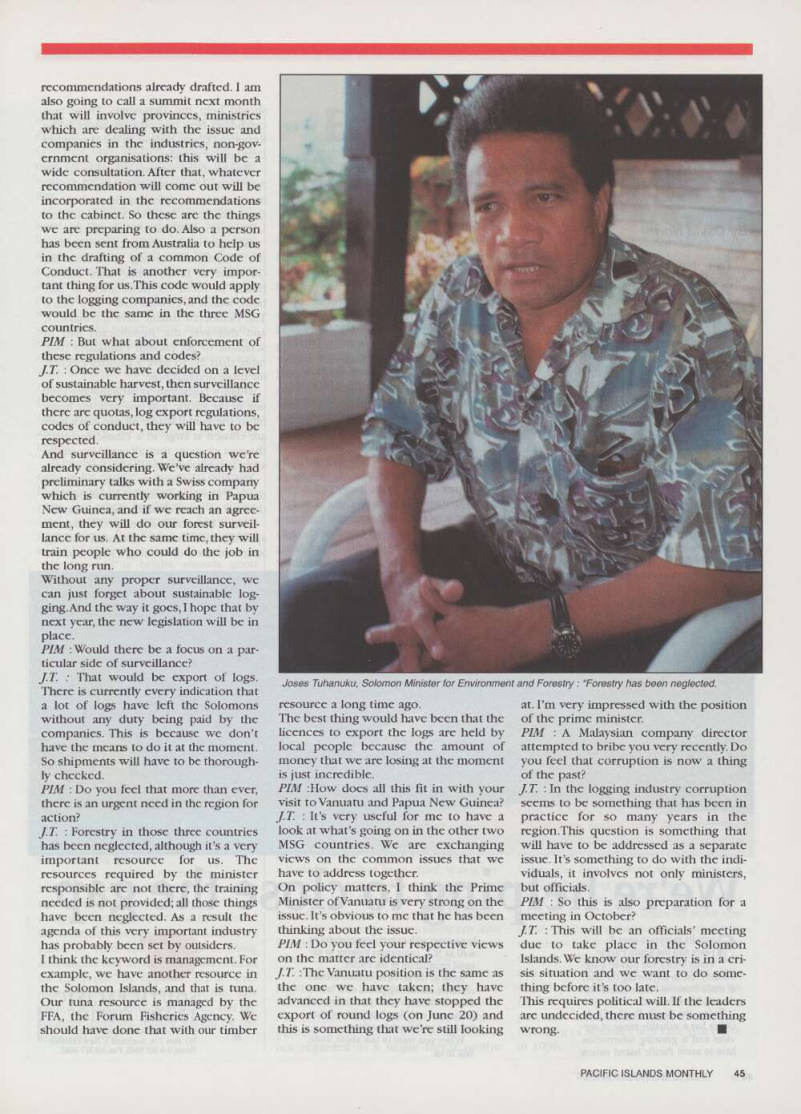
Joses Tuhanuku, Solomon Minister for Environment and Forestry: “Forestry has been neglected.