Stubborn
pp. 42-43 · Read in the full issue
Mystery
One
Gal
Hollywood and historians are once again trying to unravel the mystery behind American aviator Amelia Earhart’s disappear ance. As a new movie about her hits the screen, historians are attempting to piece together her last days.
By David North
Both Hollywood and the historians have been busy with the Amelia Earhart mystery recently.
The American aviator, seeking a record making round-the-world flight in 1937, took off from Lae, Papua New Guinea, and never reached her goal, Howland Island, probably dying in what is now Kiribati.
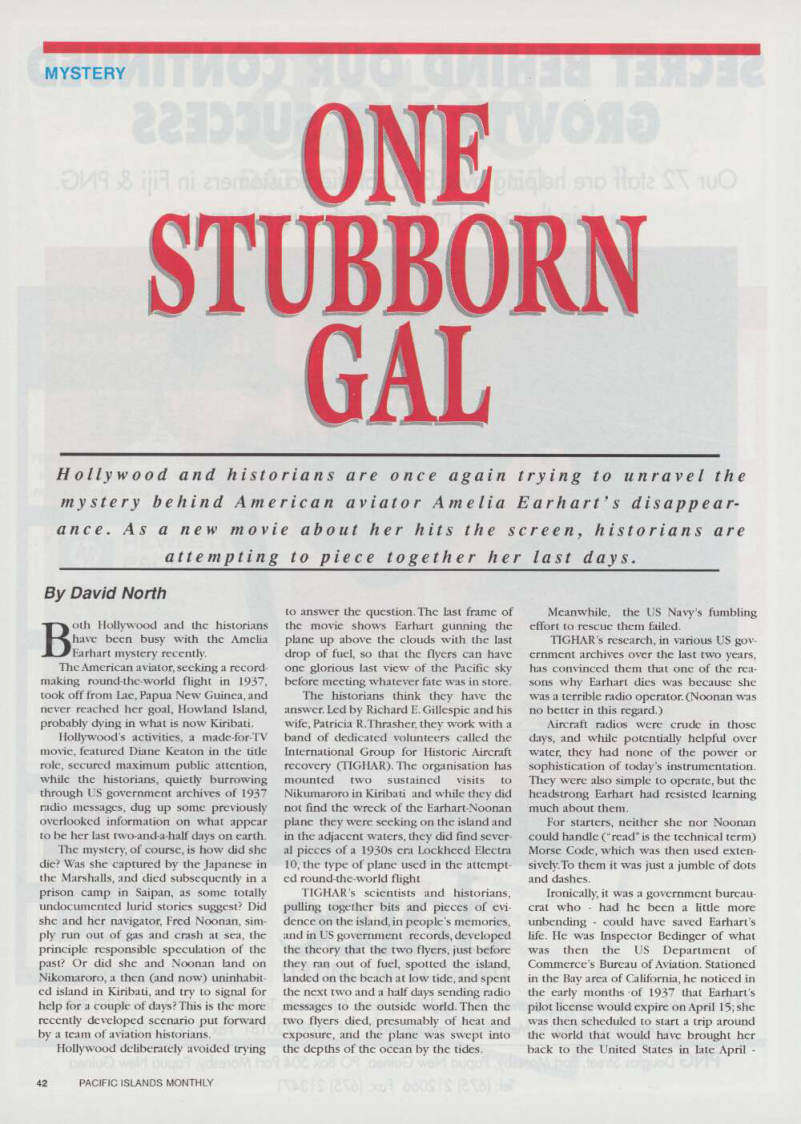
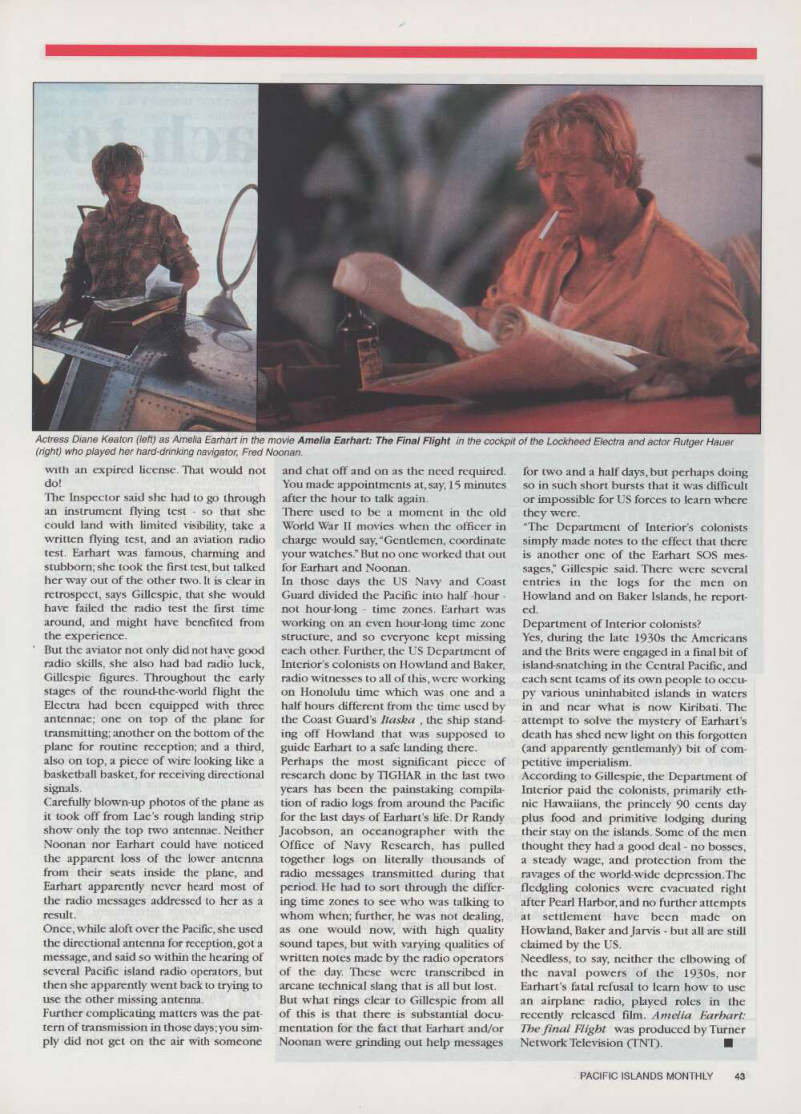
Hollywood’s activities, a made-for-TV movie, featured Diane Keaton in the title role, secured maximum public attention, while the historians, quietly burrowing through US government archives of 1937 radio messages, dug up some previously overlooked information on what appear to be her last two-and-a-half days on earth.
The mystery, of course, is how did she die? Was she captured by the Japanese in the Marshalls, and died subsequently in a prison camp in Saipan, as some totally undocumented lurid stories suggest? Did she and her navigator, Fred Noonan, sim ply run out of gas and crash at sea, the
principle responsible speculation of the
past? Or did she and Noonan land on Nikomaroro, a then (and now) uninhabit ed island in Kiribati, and try to signal for help for a couple of days? This is the more recently developed scenario put forward by a team of aviation historians.
Hollywood deliberately avoided trying
to answer the question. The last frame of the movie shows Earhart gunning the plane up above the clouds with the last drop of fuel, so that the flyers can have one glorious last view of the Pacific sky before meeting whatever fate was in store.
The historians think they have the answer. Led by Richard E. Gillespie and his wife, Patricia R.Thrasher, they work with a band of dedicated volunteers called the International Group for Historic Aircraft recovery (TIGHAR). The organisation has mounted two sustained visits to Nikumaroro in Kiribati and while they did not find the wreck of the Earhart-Noonan plane they were seeking on the island and in the adjacent waters, they did find sever al pieces of a 1930 s era Lockheed Electra 10, the type of plane used in the attempt ed round-the-world flight TIGHAR’s scientists and historians, pulling together bits and pieces of evi dence on the island, in people’s memories, and in US government records, developed the theory that the two flyers, just before they ran out of fuel, spotted the island, landed on the beach at low tide, and spent the next two and a half days sending radio messages to the outside world. Then the two flyers died, presumably of heat and exposure, and the plane was swept into the depths of the ocean by the tides.
Meanwhile, the US Navy’s fumbling effort to rescue them failed.
TIGHAR’s research, in various US gov ernment archives over the last two years, has convinced them that one of the rea sons why Earhart dies was because she was a terrible radio operator. (Noonan was no better in this regard.) Aircraft radios were crude in those
days, and while potentially helpful over
water, they had none of the power or
sophistication of today’s instrumentation.
They were also simple to operate, but the headstrong Earhart had resisted learning much about them.
For starters, neither she nor Noonan could handle (“read” is the technical term) Morse Code, which was then used exten sively. To them it was just a jumble of dots and dashes.
Ironically, it was a government bureau crat who - had he been a little more unbending - could have saved Earhart s life. He was Inspector Bedinger of what was then the US Department of Commerce’s Bureau of Aviation. Stationed in the Bay area of California, he noticed in the early months of 1937 that Earhart’s pilot license would expire on April 15; she was then scheduled to start a trip around the world that would have brought her back to the United States in late April -
with an expired license. That would not do!
The Inspector said she had to go through an instrument flying test - so that she could land with limited visibility, take a written flying test, and an aviation radio test. Earhart was famous, charming and stubborn; she took the first test, but talked her way out of the other two. It is clear in retrospect, says Gillespie, that she would have failed the radio test the first time around, and might have benefited from
the experience.
But the aviator not only did not have good radio skills, she also had bad radio luck,
Gillespie figures. Throughout the early
stages of the round-the-world flight the Electra had been equipped with three antennae; one on top of the plane for transmitting; another on the bottom of the plane for routine reception; and a third, also on top, a piece of wire looking like a basketball basket, for receiving directional
signals.
Carefully blown-up photos of the plane as it took off from Lae’s rough landing strip show only the top two antennae. Neither Noonan nor Earhart could have noticed the apparent loss of the lower antenna from their seats inside the plane, and Earhart apparently never heard most of the radio messages addressed to her as a result.
Once, while aloft over the Pacific, she used the directional antenna for reception, got a message, and said so within the hearing of several Pacific island radio operators, but then she apparently went back to trying to use the other missing antenna.
Further complicating matters was the pat tern of transmission in those days;you sim ply did not get on the air with someone
and chat off and on as the need required.
You made appointments at, say, 15 minutes after the hour to talk again.
There used to be a moment in the old World War II movies when the officer in charge would say, “Gentlemen, coordinate your watches.” But no one worked that out for Earhart and Noonan.
In those days the US Navy and Coast Guard divided the Pacific into half -hour not hour-long - time zones. Earhart was working on an even hour-long time zone structure, and so everyone kept missing each other. Further, the US Department of Interior’s colonists on Howland and Baker, radio witnesses to all of this, were working on Honolulu time which was one and a half hours different from the time used by the Coast Guard’s Itaska , the ship stand ing off Howland that was supposed to guide Earhart to a safe landing there.
Perhaps the most significant piece of
research done by TIGHAR in the last two years has been the painstaking compila tion of radio logs from around the Pacific for the last days of Earhart’s life. Dr Randy Jacobson, an oceanographer with the
Office of Navy Research, has pulled
together logs on literally thousands of
radio messages transmitted during that period. He had to sort through the differ ing time zones to see who was talking to whom when; further, he was not dealing, as one would now, with high quality sound tapes, but with varying qualities of written notes made by the radio operators of the day. These were transcribed in arcane technical slang that is all but lost.
But what rings clear to Gillespie from all of this is that there is substantial docu mentation for the fact that Earhart and/or Noonan were grinding out help messages
for two and a half days, but perhaps doing so in such short bursts that it was difficult or impossible for US forces to learn where
they were.
“The Department of Interior’s colonists simply made notes to the effect that there is another one of the Earhart SOS mes sages,” Gillespie said. There were several entries in the logs for the men on Howland and on Baker Islands, he report ed.
Department of Interior colonists?
Yes, during the late 1930 s the Americans and the Brits were engaged in a final bit of island-snatching in the Central Pacific, and each sent teams of its own people to occu py various uninhabited islands in waters in and near what is now Kiribati. The attempt to solve the mystery of Earhart’s death has shed new light on this forgotten (and apparently gentlemanly) bit of com
petitive imperialism.
According to Gillespie, the Department of Interior paid the colonists, primarily eth nic Hawaiians, the princely 90 cents day
plus food and primitive lodging during
their stay on the islands. Some of the men thought they had a good deal - no bosses, a steady wage, and protection from the ravages of the world-wide depression. The fledgling colonies were evacuated right after Pearl Harbor, and no further attempts at settlement have been made on Howland, Baker and Jarvis - but all are still claimed by the US.
Needless, to say, neither the elbowing of the naval powers of the 19305, nor Earhart’s fatal refusal to learn how to use an airplane radio, played roles in the recently released film. Amelia Earhart: The final Flight was produced by Turner Network Television (TNT). ■
Actress Diane Keaton (left) as Amelia Earhart in the movie Amelia Earhart: The Final Flight in the cockpit of the Lockheed Electra and actor Rutger Hauer (right) who played her hard-drinking navigator, Fred Noonan.