Air Pacific soars
pp. 43-47 · Read in the full issue
to new heights
By Yunus Rashid
WHILE many island nations are barely coping with their airlines, Fiji’s Air Pacific, having opted for a “taking the bull by horn” approach, is soaring with flying colours. In September the airline also paid out dividends for the first time in 30 years, indicating success and the airline’s confidence in its future.
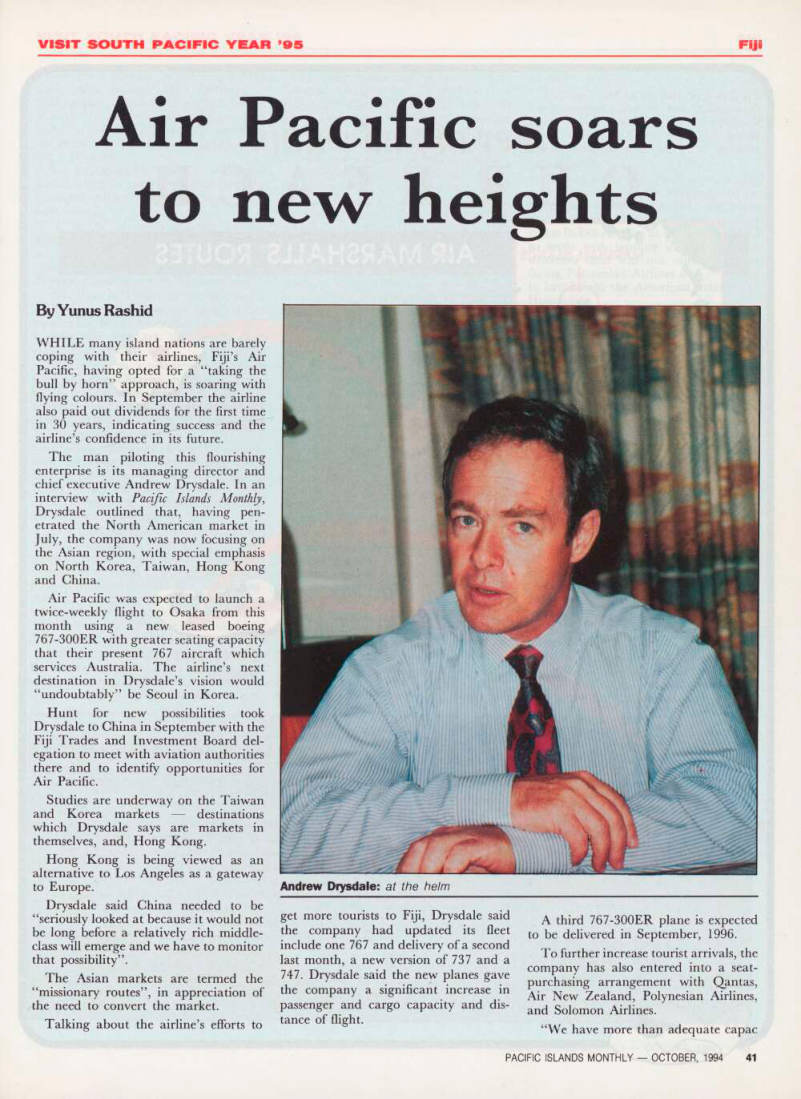
The man piloting this flourishing enterprise is its managing director and chief executive Andrew Drysdale. In an interview with Pacific Islands Monthly , Drysdale outlined that, having pen etrated the North American market in July, the company was now focusing on
the Asian region, with special emphasis
on North Korea, Taiwan, Hong Kong
and China.
Air Pacific was expected to launch a twice-weekly flight to Osaka from this month using a new leased boeing 767-300 ER with greater seating capacity that their present 767 aircraft which services Australia. The airline’s next destination in Drysdale’s vision would “undoubtably” be Seoul in Korea.
Hunt for new possibilities took Drysdale to China in September with the Fiji Trades and Investment Board del egation to meet with aviation authorities there and to identify opportunities for Air Pacific.
Studies are underway on the Taiwan and Korea markets destinations which Drysdale says are markets in
themselves, and, Hong Kong.
Hong Kong is being viewed as an alternative to Eos Angeles as a gateway
to Europe.
Drysdale said China needed to be “seriously looked at because it would not be long before a relatively rich middle class will emerge and we have to monitor
that possibility”.
The Asian markets are termed the “missionary routes”, in appreciation of the need to convert the market.
Talking about the airline’s efforts to
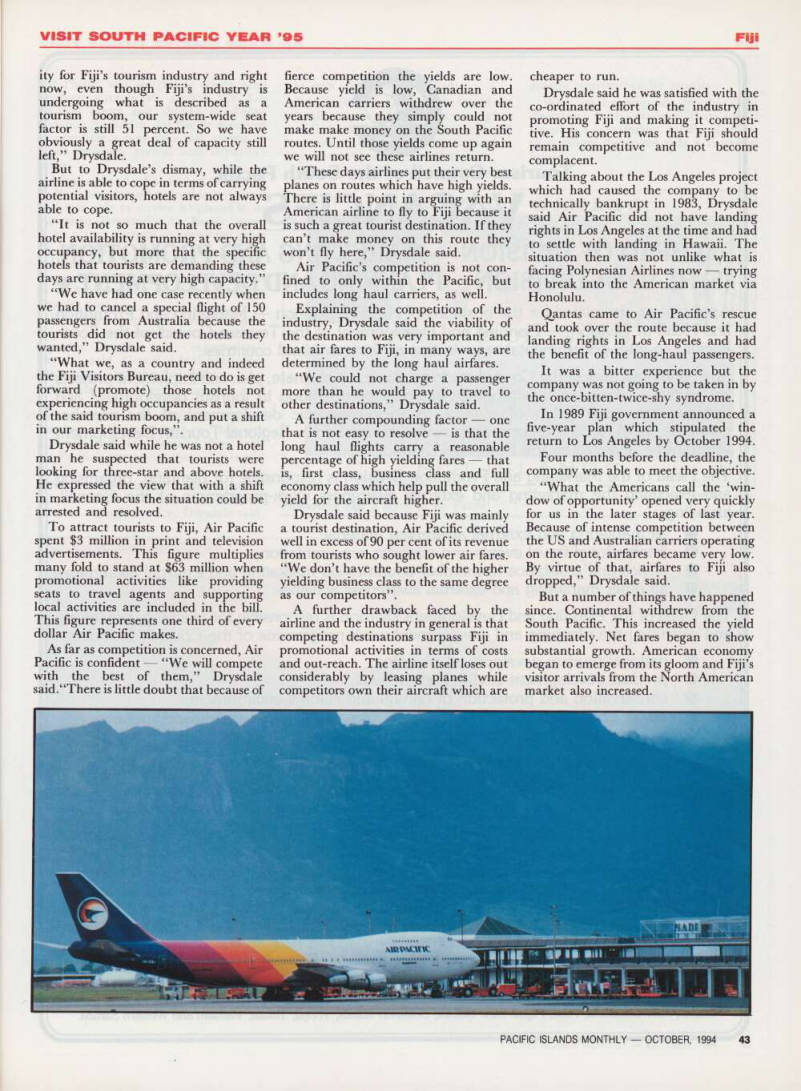
get more tourists to Fiji, Drysdale said the company had updated its fleet include one 767 and delivery of a second last month, a new version of 737 and a 747. Drysdale said the new planes gave the company a significant increase in passenger and cargo capacity and dis tance of flight.
A third 767-300 ER plane is expected to be delivered in September, 1996.
To further increase tourist arrivals, the company has also entered into a seat purchasing arrangement with Qantas, Air New Zealand, Polynesian Airlines, and Solomon Airlines.
“We have more than adequate capac
Andrew Drysdale: at the helm
ity for Fiji’s tourism industry and right now, even though Fiji’s industry is undergoing what is described as a tourism boom, our system-wide seat factor is still 51 percent. So we have obviously a great deal of capacity still left,” Drysdale.
But to Drysdale’s dismay, while the airline is able to cope in terms of carrying potential visitors, hotels are not always able to cope.
“It is not so much that the overall hotel availability is running at very high occupancy, but more that the specific hotels that tourists are demanding these days are running at very high capacity.”
“We have had one case recently when we had to cancel a special flight of 150 passengers from Australia because the tourists did not get the hotels they wanted,” Drysdale said.
“What we, as a country and indeed the Fiji Visitors Bureau, need to do is get forward (promote) those hotels not experiencing high occupancies as a result of the said tourism boom, and put a shift in our marketing focus,”.
Drysdale said while he was not a hotel man he suspected that tourists were looking for three-star and above hotels.
He expressed the view that with a shift in marketing focus the situation could be arrested and resolved.
To attract tourists to Fiji, Air Pacific spent $3 million in print and television advertisements. This figure multiplies many fold to stand at $63 million when promotional activities like providing seats to travel agents and supporting local activities are included in the bill.
This figure represents one third of every dollar Air Pacific makes.
As far as competition is concerned, Air Pacific is confident — “We will compete with the best of them,” Drysdale said.“There is little doubt that because of
fierce competition the yields are low.
Because yield is low, Canadian and American carriers withdrew over the years because they simply could not make make money on the South Pacific routes. Until those yields come up again we will not see these airlines return.
“These days airlines put their very best Zu™ ? n J°y tes which have high yields.
T here 18 htt K P omt ar S u ! n g Wlth an • mei can air l me to fly to Fiji because it is such a great tourist destination. If they can t make money on this route they won t fly here, Drysdale said.
Air Pacific’s competition is not confined to only within the Pacific, but includes long haul carriers, as well.
Explaining the competition of the industry, Drysdale said the viability of the destination was very important and at aiT . to Fiji, m many ways, are determined by the long haul airfares.
“We could not charge a passenger more than he would pay to travel to other destinations,” Drysdale said.
A further compounding factor - one that is noe ~a sy resolvl-is that the long haul flights carry a reasonable percentage of high yielding fares that is, first class, business class and full economy class which help pull the overall yield for the aircraft higher.
Drysdale said because Fiji was mainly a tourist destination, Air Pacific derived well in excess of 90 per cent of its revenue from tourists who sought lower air fares.
“We don’t have the benefit of the higher yielding business class to the same degree as our competitors”.
A further drawback faced by the airline and the industry in general is that competing destinations surpass Fiji in promotional activities in terms of costs and out-reach. The airline itself loses out considerably by leasing planes while competitors own their aircraft which are
cheaper to run.
Drysdale said he was satisfied with the co-ordinated effort of the industry in promoting Fiji and making it competi dve pji s concern was that Fiji should remain competitive and not become complacent.
Talking about the I os Anp-eles nroiert wh [ c h had caused the compinyV be technically bankrupt in 1983, Drysdale sa j d A i r p ac if] c d i d no t have landing rights in Los Angeles at the time and had to settle with landing in Hawaii. The situation then was not unlike what is f ac i ng Polynesian Airlines now trying to break into the American market via Honolulu, Qa ntas came to Air Pacific ’ s rescue and took over the route because it had landing rights in Los Angdes and had t h e benefit of the long-haul passengers.
T .. , , '' was a bl “ er tbe company was not gomg to be taken m by
the once-b.tten-tw,ce-shy syndrome,
In 1989 T’J 1 government announced a [ 0 fiv e-year plan which stipulated the return to Los Angeles by October 1994.
Four months before the deadline, the company was able to meet the objective.
“What the Americans call the ‘win
dow of opportunity’ opened very quickly
for us in the later stages of last year.
Because of intense competition between the US and Australian carriers operating on the route, airfares became very low.
By virtue of that, airfares to Fiji also dropped,” Drysdale said, But a number of things have happened since. Continental withdrew from the South Pacific. This increased the yield immediately. Net fares began to show substantial growth. American economy began to emerge from its gloom and Fiji’s visitor arrivals from the North American market also increased.
Air Pacific was worried it would need another aircraft to service the Los Angeles route but thanks to Tokyo Aviation Authority, Air Pacific managed to negotiate a new time slot, saving 26 hours between arrival and departure times.
Meanwhile, Air Pacific had completed its Nadi hangar and trained its engineers and was able to service its planes in its own time. Previously, Air Pacific would fly its planes overseas at appointed times for servicing.
Drysdale said the company quickly assessed the situation and took the matter to its board which agreed to the Los Angeles plan.
“We have seen such an enormous response and the first few weeks saw capacity double our expectation,”
Drysdale said. A total of 2445 passengers have flown since the first flight.
Fiji has never been promoted as a tourist destination in the Northern Am erican market where Fiji was treated merely as a stop-over, en route to Australia and New Zealand. Now with Air Pacific’s operations there, Fiji is sold as Fiji.
Air Pacific is already contemplating the option of a second and third service because a single service, Drysdale said,
was very costly and inefficient.
“At the moment crew fly on board the aircraft, stay in a hotel for three nights, then fly back on Qantas and are replaced by another set of crew who fly to Los Angeles on Qantas,” Drysdale said.
Additional flights would also mean
greater convenience for tourists.
With its bearings set in the right direction, it is obvious that under Drysdale’s captainship, Air Pacific is set to continue flying towards a colourful future. □
Fiji Visitors Bureau Promoting FIJI: a boon to Air Pacific