Room to improve
pp. 39-41 · Read in the full issue
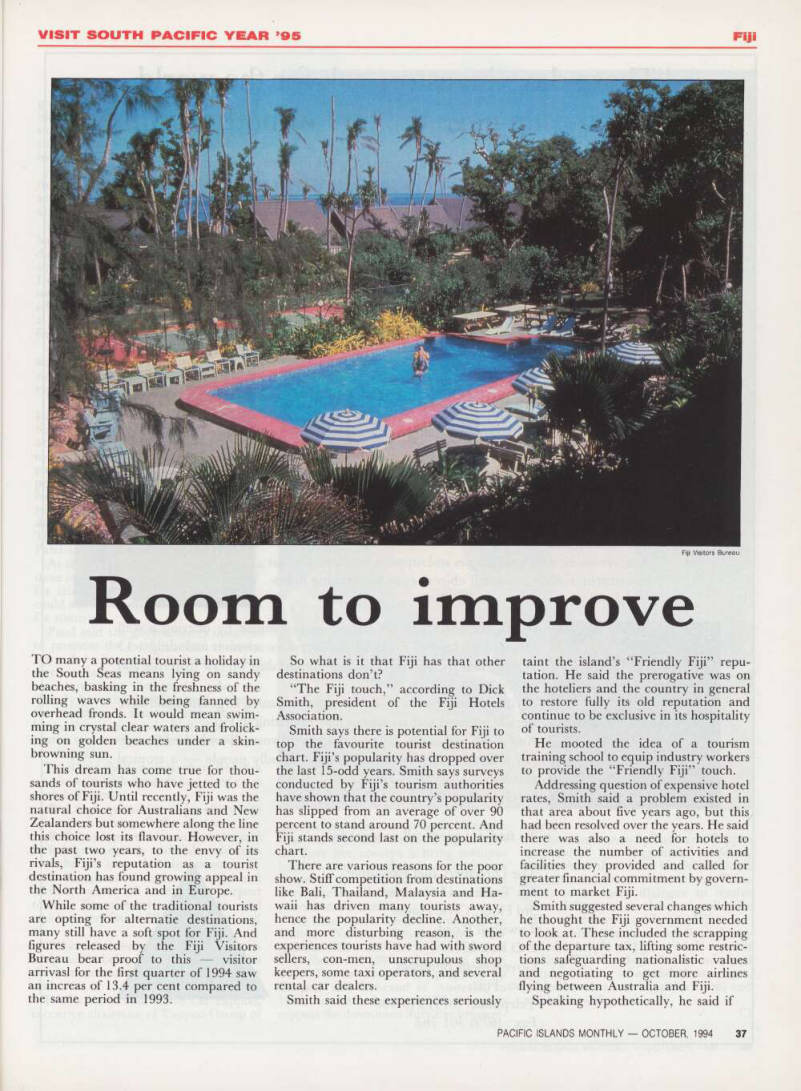
TO many a potential tourist a holiday in the South Seas means lying on sandy beaches, basking in the freshness of the
rolling waves while being fanned by
overhead fronds. It would mean swimming in crystal clear waters and frolicking on golden beaches under a skin-
browning sun.
This dream has come true for thousands of tourists who have jetted to the shores of Fiji. Until recently, Fiji was the natural choice for Australians and New Zealanders but somewhere along the line this choice lost its flavour. However, in the past two years, to the envy of its rivals, Fiji’s reputation as a tourist destination has found growing appeal in the North America and in Europe.
While some of the traditional tourists are opting for alternatie destinations, many still have a soft spot for Fiji. And
figures released by the Fiji Visitors
Bureau bear proof to this visitor arrivasl for the first quarter of 1994 saw an increas of 13.4 per cent compared to the same period in 1993.
So what is it that Fiji has that other destinations don’t?
“The Fiji touch,” according to Dick Smith, president of the Fiji Hotels Association.
Smith says there is potential for Fiji to top the favourite tourist destination chart. Fiji’s popularity has dropped over the last 15-odd years. Smith says surveys conducted by Fiji’s tourism authorities have shown that the country’s popularity has slipped from an average of over 90 percent to stand around 70 percent. And Fiji stands second last on the popularity chart.
There are various reasons for the poor show. Stiff competition from destinations like Bali, Thailand, Malaysia and Hawaii has driven many tourists away, hence the popularity decline. Another, and more disturbing reason, is the experiences tourists have had with sword sellers, con-men, unscrupulous shop keepers, some taxi operators, and several rental car dealers.
Smith said these experiences seriously
taint the island’s “Friendly Fiji” repu tation. He said the prerogative was on the hoteliers and the country in general to restore fully its old reputation and continue to be exclusive in its hospitality °f tourists.
He mooted the idea of a tourism
training school to equip industry workers
to provide the “Friendly Fiji” touch,
Addressing question of expensive hotel
rates, Smith said a problem existed in that area about five years ago, but this had been resolved over the years. He said there was also a need for hotels to increase the number of activities and facilities they provided and called for greater financial commitment by govern ment to market Fiji.
Smith suggested several changes which he thought the Fiji government needed to look at. These included the scrapping of the departure tax, lifting some restric tions safeguarding nationalistic values and negotiating to get more airlines flying between Australia and Fiji, Speaking hypothetically, he said if
Fiji Visitors Bureau
government were to inject at least $3 million in the industry then with the existing infrastructure, hotels could ac commodate 40,000 more tourists and intake at least 5000 workers.
Turning to shopping, the problem is that many of the so-called duty free shops around towns did not actually sell goods at ‘duty-free’ prices.
A leading duty free dealer who does have duty free prices, Mahendra Patel, director of Prouds chain of stores and operator of the duty free outlet at Nadi International Airport, said the govern ment’s more-than-generous duty free allowance per visitor to the country was a further snag in in the growth of duty
free shopping.
Any further increases, he said, would not improve the situation as tourists would already have spent substantially even before leaving their country.
“Shopping or duty free shopping as we know it in Fiji was based on the Singapore/Hongkong model and it achieved its initial objectives in a very meaningful manner. However, as time passed, and with deregulation in our prime source markets (Australia and New Zealand), people continued to come to Fiji, but shopping or duty free shopping was not the motivating factor.
They come primarily to relax, enjoy ...,”
Patel said.
At the same time the duty charged on these items in Fiji has steadily increased.
He said with a change in attitude, Fiji could still offer a lucrative shopping deal for tourists.
Patel said the government’s intention to promote the establishment of down town duty free stores to boost tourism was a nebulous idea first, because it was targetting the tourist who was already here and therefore not increasing the number of visitors, and secondly, because recent trends had shown the tourist was not spending money or time on shopping.
Patel said the downtown duty free idea was fraught with dangers and cited cases occuring overseas • Large quantities of jewellery was sold which never left the country; • Television sets were supposedly sold to foreign nationals with fake addresses and the sets never left the country; • Instances of bottles of vodka and whiskey were left behind in airport toilets. These bottles of vodka and whiskey were found filled with water and tea.
“There is every possibility of this malpractice being introduced into Fiji to the detriment of government coffers,” he said.
Patel’s main rival, Kanti Lai Tappoo, executive chairman of Tappoo Group of
Companies, does not see agree. Tappoo is all for the idea. While he agrees that the duty free concept is being manipulated by some traders to lure tourists shoppers, he feels licensed downtown duty free operators would be able to prevent malpractice.
He cited research reports compiled by United Nations Development Programme office and the World Tourism Organisation in 1989 and a second report titled Tourism Master Plan prepared by Coopers and Lybrand of Australia in 1989, to back his case. The reports support the downtown duty free arrange-
ment.
These arguments by Patel and Tappoo and indeed the suggestions made by Smith show that there is a break down in communication somewhere. There needs to be more dialogue to resolve these differences to have a collective effort to promote tourism in Fiji.
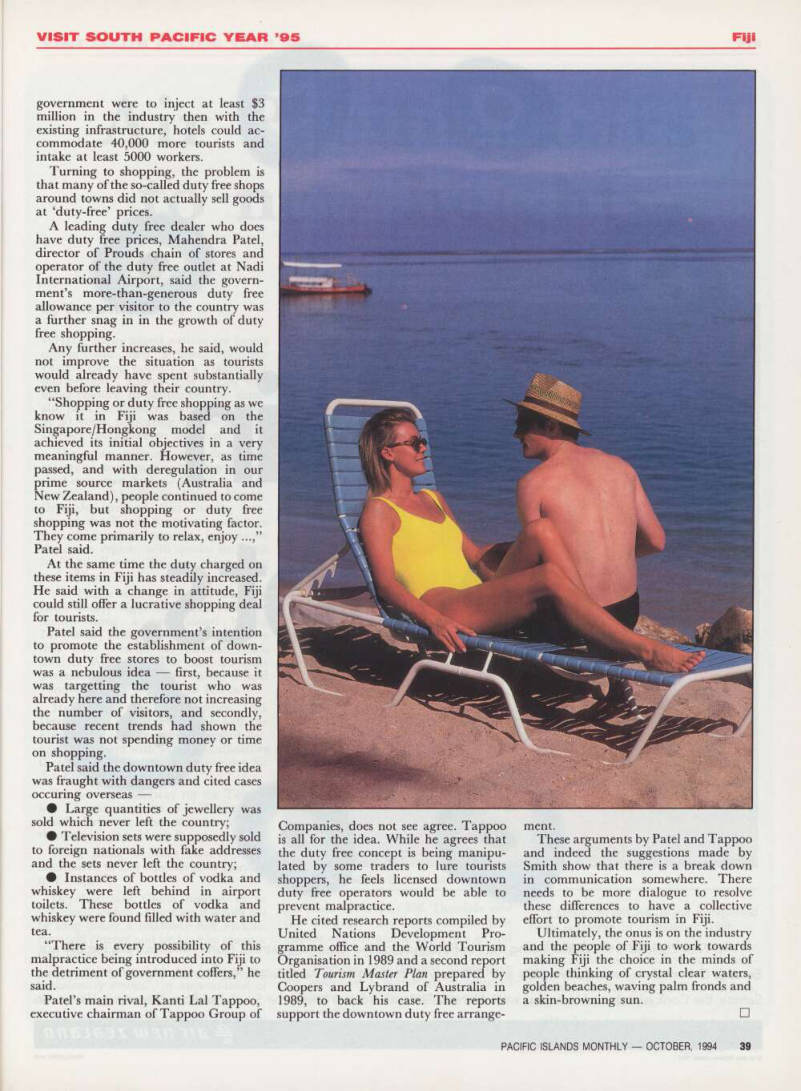
Ultimately, the onus is on the industry and the people of Fiji to work towards making Fiji the choice in the minds of people thinking of crystal clear waters, golden beaches, waving palm fronds and a skin-browning sun. □