The military’s
pp. 24-25 · Read in the full issue
Economy
Guam is re-thinking its economic policies as it shifts its focus to a civilian-based future. Barbara Ray examines the options available.
SINCE 1989, Guam has implored the United States Navy to close its Naval Air Station, Agana. It looks like it will get its wish sooner than expected. April 1995, NAS will close.
Facing serious demand to rein in the prodigious US budget deficit, Congress in 1988 winced and trimmed its pet, military spending. Overnight it seemed, towns and cities across the country faced major job losses as military contracts shriveled and the number of bases fell by 15 percent.
Amid the din of voices clamouring for the survival of military contracts, Guam could be heard asking the military to please remember to turn out the lights behind them.
Today, Governor Ada’s Guam Re-Use Committee, headed by Lt. Governor Frank Bias, is planning for a future independent of the military. Innovation and long-range thinking are what are needed. However, the luxury of time is not on the government’s side. Nor is the blessing of continuity. A new administra tion will come on board next month as Ada’s term ends.
But as Bias notes, “the private-sector involvement on the committee will mitigate any administration change. The driving force is the business and com munity and because of that I wouldn’t think there would be major disruption.”
To understand the earnestness of the government and private sector, one need only look at the figures. In fiscal year 1993, the US military contributed $748 million to Guam’s economy, according to navy spokesperson Lt. Kelly Merrell.
The military paid civilians $lBO million, and paid $52.6 million in taxes to the Government of Guam.
The Department of Education re ceived $11.5 million in Department of Defence subsidies in 1993, according to
Silvia Monkres, Department of Educa tion spokesperson.
In 1993, according to Merrell, total active duty military personnel numbered 10,639, supporting another 11,447 de pendents. The majority are navy re cruits, numbering 7836. Air Force fol lows with 2550. Marines in 1992 reduced ranks from 334 to 55. Army and Coast Guard contribute 198. Civilians on the payroll number 8971.
Today, only one of the original six hom-imported navy ships is scheduled to remain, the marines have all but ledt, all three naval air squadrons are scheduled to leave, and a navy helicopter squadron will move to Andersen Air Force Base.
According to Merrel, navy personnel will be reduced by approximately 2100.
Conceivably, Guam could see military numbers decline by one-fourth to one third from 1992 figures.
A January Department of Defence report listed the two air squadrons as slated to depart, but no official word had been released at the time of this writing.
Conceivably, Guam could see military numbers decline by one-quarter to one third from 1992 figures.
What this means for the economy is clear less revenue through taxes, fewer military dollars for education, and civ ilian personnel facing layoffs. Indirect contributions include air traffic control, some local business revenue, and the prized commissary privileges that many Guam residents now enjoy.
On the positive side, the departures ease housing shortages, release more land, free up a major port, and lessen
island congestion.
The call for less military could be viewed as just one more step in the island’s move to loosen US ties. As Guam strides toward possible Commonwealth
status, the Government of Guam and private industry step forward with inno vative ideas and solutions to guide it through its evolution.
Congressional delegate Robert Under
wood is one of those guiding Guam into the future. This June, Underwood will host the Capitol Hill Economic Confer ence in Washington, D.C., where Guam community leaders will be introduced to contacts and sources critical to Guam’s future.
Island will be selling Guam as a base for operations to those seeking to take advantage of Asia’s booming econ omy. Among those present will be individuals connected with Asia-Pacific
Economic Cooperation (APEC), a
loosely aligned group of 18 nations in Asia and the Pacific fostering economic ties as the Asian economies boom.
“To date,” says Underwood, “There has been no systematic way for Guam to participate in the discussions of regional economic activity. APEC is that larger
systematic way.” He explains that while
the State Department would not allow Guam to join APEC as a member state, Guam can pursue interests as a member economy, or a working group of experts unconnected to political membership of APEC.Currently, Hawaii is taking the
most advantage of this “working group”
status.
“The train is leaving the station and if we can’t be on the first car, we’ll be in the caboose.”
The land freed up from the base closure is making many mouths water.
Guam International Airport has its eye on the land for future expansion, some see industrial parks, others see rec reational parks, and still others just want their land back. How the Navy will treat that land is an open question.
Federal law states that first priority for bids on excess land should go to homeless
organisations, followed by private enter
prise, and finally, local government.
Nevertheless, Guam has its sights pinned on a bill in Congress that puts local redevelopment in the same line with homeless organisations, says Frank Toves of Guam’s Land Re-use Committee.
“We’re going on the assumption right
now,” he says, that the land is going back to the government of Guam.”
Governor Ada sees opportunity in more civilian port space and is asking to share space at the Navy Ship Repair Facility. Ada hopes to attract more commercial shipping to Guam’s harbour by expanding the facilities, possibly as a ship repair facility or dry dock. “We’re
very actively pursuing this,” said
Lieutenant Governor Frank Bias. As one person said, “What the navy will lose, we
will gain.”
A Taiwanese fishery has been eyeing Guam as a transhipment station or as a spot for a cannery.
“It (the transhipment proposal) is
getting high-level attention from the Office of Territorial and Insular Affairs since we brought it to their attention at the Economic Conference,” said Keith
Parksy, spokesperson for Delegate Un
derwood.
Other developments of the conference included a banking agreement that allows Guam banks to branch into the United States and vice versa, a very critical step toward Guam’s goal as a hub for US firms doing business in Asia.
APEC, after discussions in June, is also looking at Guam as a base, says Parksy.
Calls for careful planning and foresight fill the local news. The government appears to be heeding those calls, yet worries remain that Guam may be left
hanging.
“Guam’s tendency to look inward must bee replaced with long-term vision, says one business executive, or Guam will
lose a golden opportunity.
Others are more pessimistic. As one construction industry executive said of the government, “They’ve opened a Pandora’s Box with this one. Nobody believed the military could all leave, but they can. The military assessed the situation and said, ‘what the heck, we’re not wanted here and it’s a painless way to meet our budget cuts’.”
In other words, a trickle could become a flood.
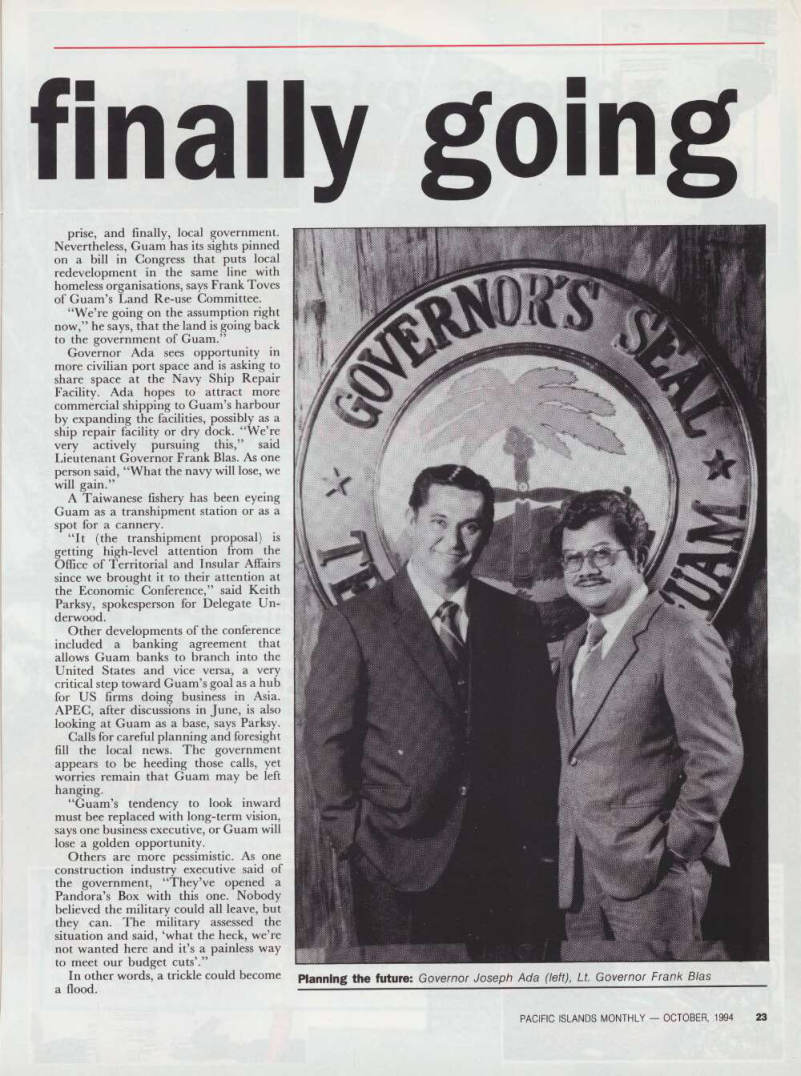
Planning the future: Governor Joseph Ada (left), Lt. Governor Frank Bias