spirit of SPARTECA
p. 23 · Read in the full issue
Business
In keeping with the spirit of SPARTECA
By Yunus Rashid
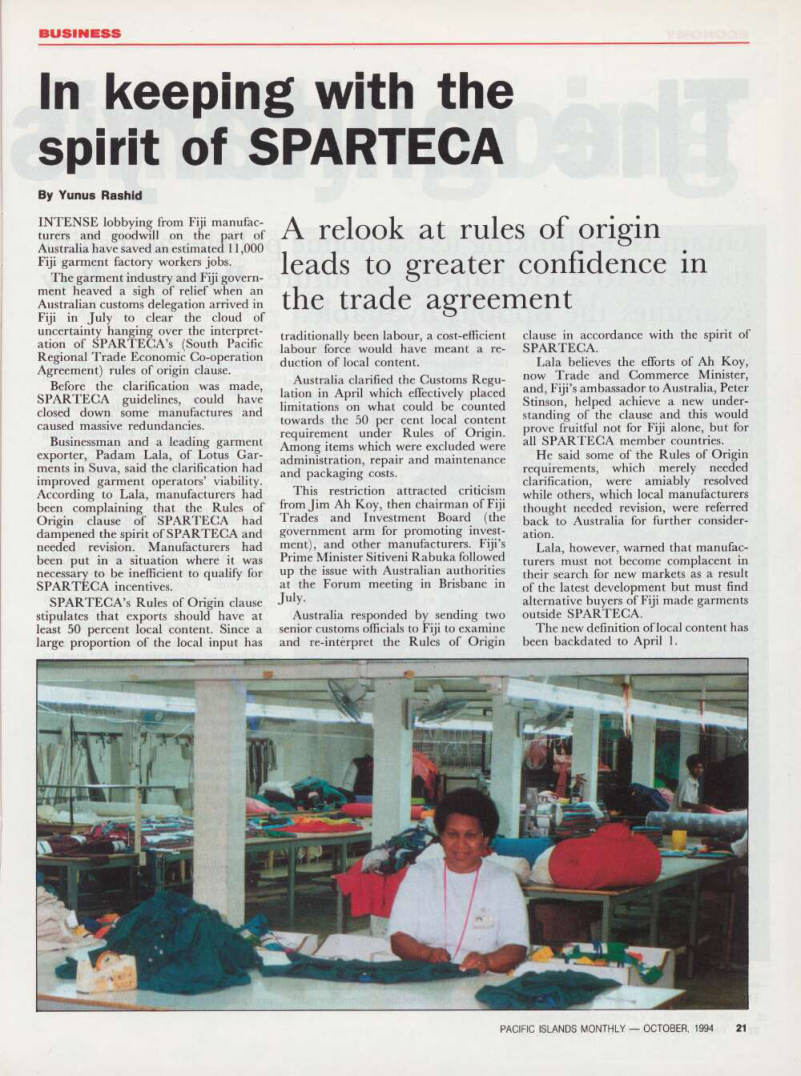
INTENSE lobbying from Fiji manufacturers and goodwill on the part of Australia have saved an estimated 11,000
Fiji garment factory worker, jobs
The garment industry and I iji government heaved a sigh of relief when an Australian customs delegation arrived in Fiji in July to clear the cloud of
uncertainty hanging oyer the interpret-
ation of SPARTECA s (South Pacific
Regional Trade Economic Co-operation
Agreement) rules °f°n g m dame.
Before the clarification was made, SPARTECA guidelines, could have .., 5 ’ r . . closed down some manufactures and caused massive redundancies.
Businessman and a leading garment exporter Padam Lala, of Lotus Garments in Suva, said the clarification had
improved garment operators’ viability.
According to Lala, manufacturers had been complaining that the Rules of Origin clause of SPARTECA had dampened the spirit of SPARTECA and needed revision. Manufacturers had been put in a situation where it was necessary to be inefficient to qualify for SPARTECA incentives.
SPARTECA’s Rules of Origin clause stipulates that exports should have at least 50 percent local content. Since a large proportion of the local input has
A relook at rules of origin leads to greater confidence in the trade agreement
traditionally been labour, a cost-efficient labour force would have meant a re duction of local content.
Australia clarified the Customs Regu
lation in April which effectively placed
limitations on what could be counted towards the 50 per cent local content requirement under Rules of Origin.
Among items which were excluded were administration, repair and maintenance and packaging costs.
This restriction attracted criticism from Jim Ah Koy, then chairman of Fiji Trades and Investment Board (the government arm for promoting invest ment), and other manufacturers. Fiji’s Prime Minister Sitiveni Rabuka followed up the issue with Australian authorities at the Forum meeting in Brisbane in J ul Y-
Australia responded by sending two
senior customs officials to Fiji to examine and re-interpret the Rules of Origin
clause in accordance with the spirit of
Sparteca.
Lala believes the efforts of Ah Koy, now Trade and Commerce Minister, and, Fiji’s ambassador to Australia, Peter Stinson, helped achieve a new under standing of the clause and this would prove fruitful not for Fiji alone, but for all SPARTECA member countries.
He said some of the Rules of Origin
requirements, which merely needed
clarification, were amiably resolved while others, which local manufacturers thought needed revision, were referred back to Australia for further consider ation.
Eala, however, warned that manufac turers must not become complacent in their search for new markets as a result of the latest development but must find alternative buyers of Fiji made garments outside SPARTECA.
The new definition of local content has been backdated to April 1.