Liquid gas next on the list
pp. 43-47 · Read in the full issue
By Wally Himbohn
dadtta TVT i • i c FArUA New Guinea is on the brink of , . . T /T . . c , N^tural^Gas) 6 exiiortine nation the Asia-Pacific reeion rj. u ■ ' , .. ey pom o e coun ry s repu a ion as being gas prone and its proximity to sea routesi linking the country with the leading LNG importers of Asia as major reasons whv PNG will have at least two reasons why ri\ljr will have at least two LNG trains in operation Within the next in vears ycais.
At a recent statement to parliament, Masket langaho as Mining and Pet roleum Minister (he is now finance and planning minister) was very optimistic about the future of LNG development.
Here is an edited version of langalio’s statement “During the last few months, significant and very positive steps have taken place in our gas resources sector.
“These events leave little doubt that we are moving rapidly towards the establishment of a massive natural gas
exports industry.
“At the outset, I must inform parlia ment that the development of our natural resources will overshadow all
previous resource developments. This will be in the sheer size of the project, the impact on the economy and benefits to r , 1 our people.
“If we are successful in the next few years in matching markets with our huge natural gas developments, we will em- 3ar j on a decade-long programme of h natural developments. » T he V will reouire a hinartisan an 1 hey will require a bipartisan ap proach. An investment of between K 6 •«. /'about ffiTJSfi S billion') and KlO J 3 };}! 011 X r , bllllon ) and , U billion ($11810.5 billion) will not be made if international investors are at- ‘‘ uwernattonal investors arc at , J . •, , . f A LNG export project would be of a scale four or five times the size of Kutubu or Porgera projects. , “While petroleum exploration has been declining internationally, we are seeing a major upsurge.
“Clearly, we not only have attractive resources but our government policies are also being judged as right by international petroleum developers.
“The outcome of several of these wells will be most important in setting some future trends, notably in speeding up gas
development commitments.
“By far the most important will be another well on the Hides structure, now
proved to have a gas column 1000 metres
deep.
“The other wells to watch will include c *w j . • that at South Last Mandana, where it is possible that a resource approaching that of the size of Kutubu exists.
“Just as important will be the wells in the foreland of the Papuan Fold belt, which may open up new prospects.
“Also to be watched will be the dpvp i nnrnpnt of the offshore nrommme development ol the onshore programme headed by Mobil at Pandora. This is alreadv a cfonifirflnt eras disroverv and already a sigmhcant gas discovery, and With the hopes for adjacent dISCOVeriCS, cou)d a feed for LNG “In all of this we should never forget that pNG is pr i mar ily a gas province, akhough muck of the exploration ac tivity is directed at finding oil « Before j turn tQ gome details of the Hides • and tQ the imme diate prospects of starting an LNG project, a short overview is necessary, “A major study of the known 15 oil and gas fields was completed by the Department of Mining and Petroleum, The study assessed our recoverable oil and gas reserves to internationally ac
cepted standards.
“OIL A possible 400 million barrels of oil, of which 215 barrels is considered proved, and is in production in the
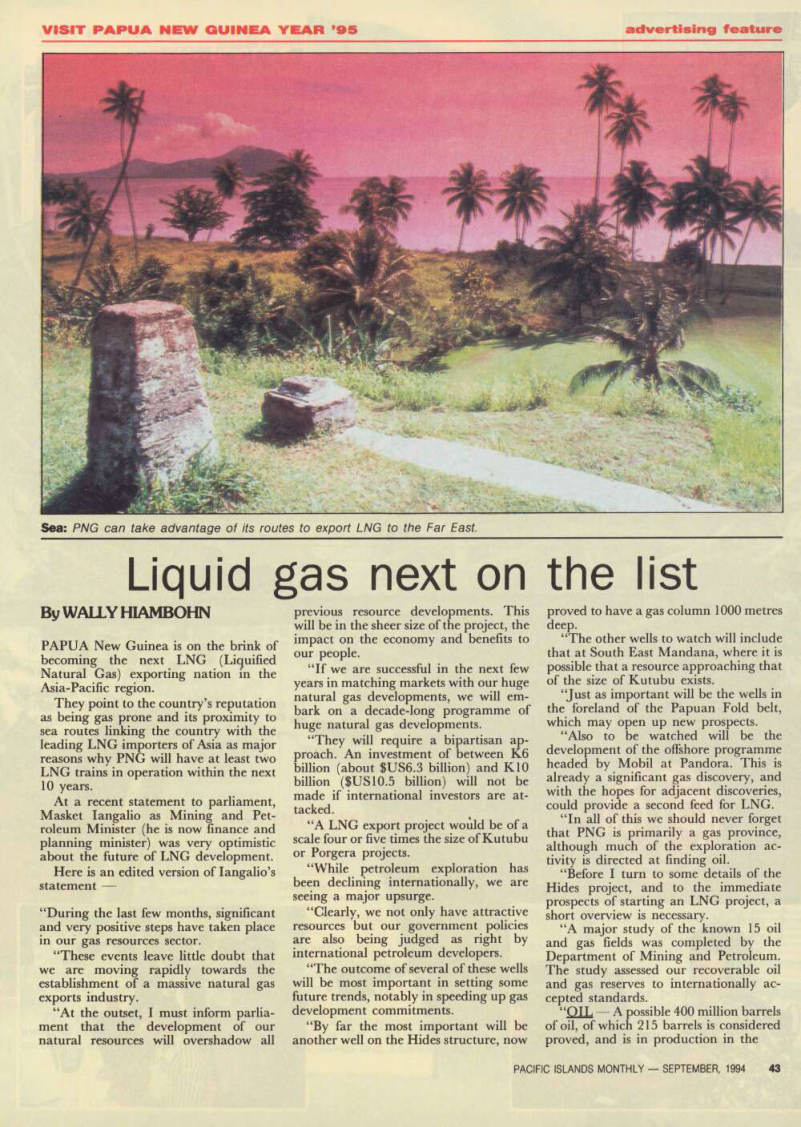
Sea: PNG can take advantage of its routes to export LNG to the Far East.
Kutubu project; and “GAS A possible 20 trillion cubic feet of gas, of which at least three trillion is proved in the Hides gasfield.
“On an energy equivalent basis, the possible gas reserves of PNG now amount to a resource 10 times larger than our oil reserves.
“When we therefore consider the potential development of gas field such as Hides with proven reserves of the order of three trillion cubic feet, gross revenue streams of billions of kina are achievable.
“After the deduction of the billions of Kina in development costs, the supply of the LNG can therefore produce attract ive revenue streams to the resource owner, the State, whilst the developer can achieve a reasonable rate of return on his investment.
“However, there is international com petition. Total world-proven gas reserves are estimated as being in excess of 4300 trillion cubic feet. This may make our reserves seem insignificant, but we have some special advantages that have aroused the interest of not only devel opers but also purchasers.
“Almost half of the LNG in the Far East is sourced from Indonesia, and more that 80 per cent comes from Islamic nations.
“Far East purchasers are acutely aware of the troubles which oil suppliers encounter due to the oil crisis of the
19705, borne our of the Middle East conflict.
“Consequently, LNG purchasers are seeking diversification of supply so that in the event of future conflicts, LNG supplies would in no way be hindered or stopped “PNG is geographically well placed to supply the Far East LNG markets of Japan, Korea and Taiwan, particularly
via a north coast port such as Madang.
“It is close to purchasers, and supply lines do not pass through any strategic sea passages.
“With the growth in demand for LNG, some existing projects in other countries can be expanded by enlarging or streamlining facilities to take up a proportion of the new demands.
“Existing LNG contracts will have
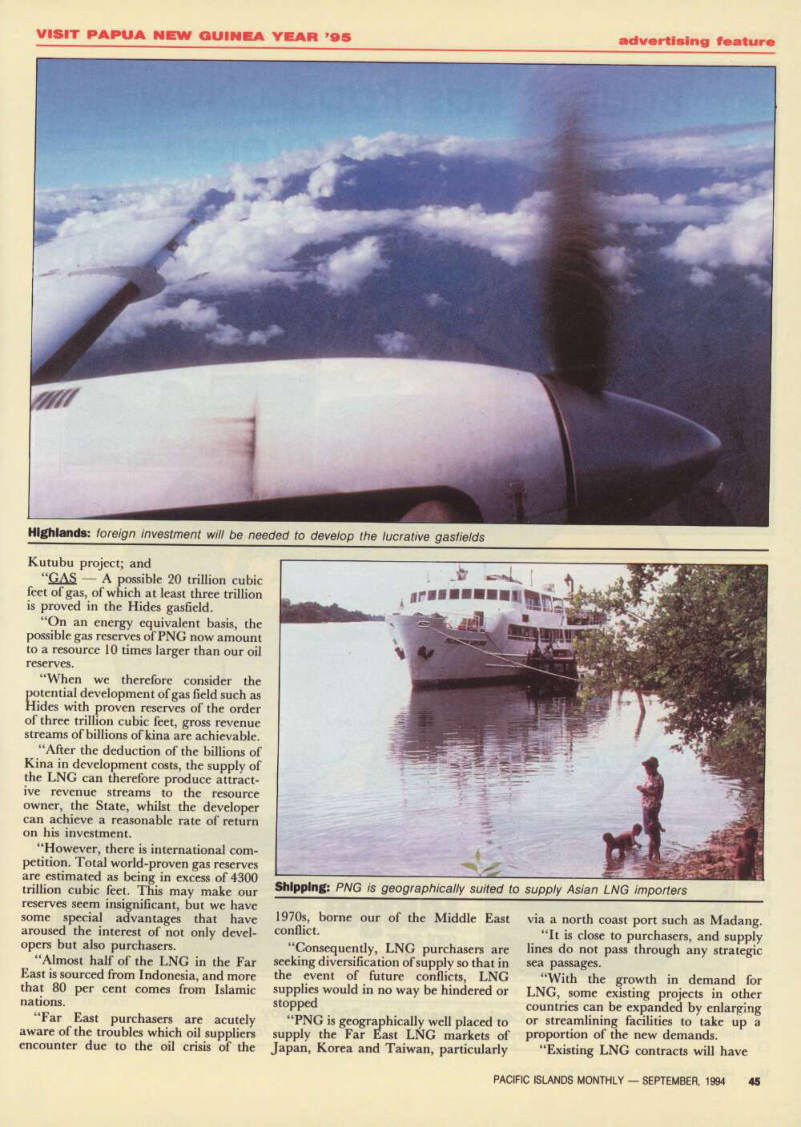
Highlands: foreign investment will be needed to develop the lucrative gasfields
Shipping: PNG is geographically suited to supply Asian LNG importers
exhausted various fields, and new pro
duction projects supported by newly
discovered gas fields will be required.
There are a variety of projects vying for shares of the project increase in demand ranging from Qatar and Oman in the Middle East, to our immediate neigh bours, Indonesia and Australia.
“The confirmation of our large gas reserves, the success of our first oil project, and the advantages that I have talked of, have all placed PNG at the head of the LNG supply list for the next decade.
“If we wish to realise the wealth of our gas resources we need to confirm our interest as a nation.
“LNG projects are hugely capital
intensive, with construction periods of between six to eight years. The mere construction of the facilities and plants represent a major activity which can provide a boost to our economy.
“Once gas production and processing commences, apart from providing excel lent and stable revenue streams, the LNG infrastructure allows for the easier addition of other activities such as power
generation, petrochemical industries and
manufacturing industries which are de pendent on such.
“In order for us to realise a gas-driven economy, we need to understand that we will have to exploit both the investment
capital, as well as the technical and commercial skills of the developers.
“But, at the same time, we need to be the catalyst of development, partner of developers, and the regulation of gas
production, processing and marketing
activities. “The very long lead time during the construction, before pro duction leads to revenue, requires solid
commitment from the buyers, devel opers, sellers, and the governments of both the producing and consuming countries right from the project’s inception.
“The progress towards commer cialisation requires the active and willing participation of all parties. These com mitments must endure and rise above changes in politics, policy or govern ments.
“Whilst companies that have dis covered gas in PNG are keen to reap a return on their sunken exploration ex penditure, an LNG development of gas reserves is so significant a venture that it requires firm endorsement from the government and the people of PNG prior to any steps towards LNG project
development.
“Prior to that endorsement being provided, the policy framework for gas development has to be reviewed and put in place. To this end an inter departmental task force has been estab lished to review the present provisions for gas exploration, development, pro duction, processing and sale.
“A White Paper will result from this which will encapsulate this review and analysis, and place proposals before us.” □
Port Moresby: government will be conducting a White Paper on gas exploration
Government: committment must last