The Pacific giant
pp. 31-41 · Read in the full issue

By Wally Hiambohn
PAPUA New Guinea, the largest of the Pacific island countries, is a rapidly developing vibrant country. It is where Asia meets the Pacific, and is full of
promises of prosperity.
This prosperity can be guaranteed for several reasons. It is politically stable with well-entrenched democratic insti tutions. Government recognition of the private sector in development, and guaranteed safety of foreign investment with a range of concessions and generous assistance to attract investors.
It has an abundance of natural resources in mining and petroleum,
fishing, forestry, agriculture and tourism.
The country and its lands are relatively young. The geography is characterised
by high mountain ranges, deep valleys
and swift rivers.
Its four million people are mainly Melanesians, 80 per cent of whom live in the rural areas. Port Moresby, the capital and major city, has a population of 200,000 with other important towns
being Lae (80,000), Madang (27,000),
Wewak (23,000), Goroka (18,000),
Mount Hagen (18,000) and Rabaul
(17,000). PNG is, in fact, the most heterogenious country in the world.
Because of the isolation of most com munities in the past, over 700 different languages were developed and are still spoken, about one-third of the languages known to man.
Because of the cultural diversity of the country, English is the language of government, commerce and law. English is a compulsory subject in school and, apart from isolated communities, is
widely understood throughout PNG.
PNG was granted independence from Australia in 1975. The democratic heri tage of Melanesian society and the parliamentary traditions of Great Britain have combined to produce a stable democracy in PNG. There have been a number of democratic elections since independence and universal suffrage is enjoyed by the population. There is freedom of the press.
The national government comprises three independent branches the executive, the legislature, and the ju diciary. Executive power is vested in the national executive council which com prises of the prime minister and a number of ministers whom he chooses
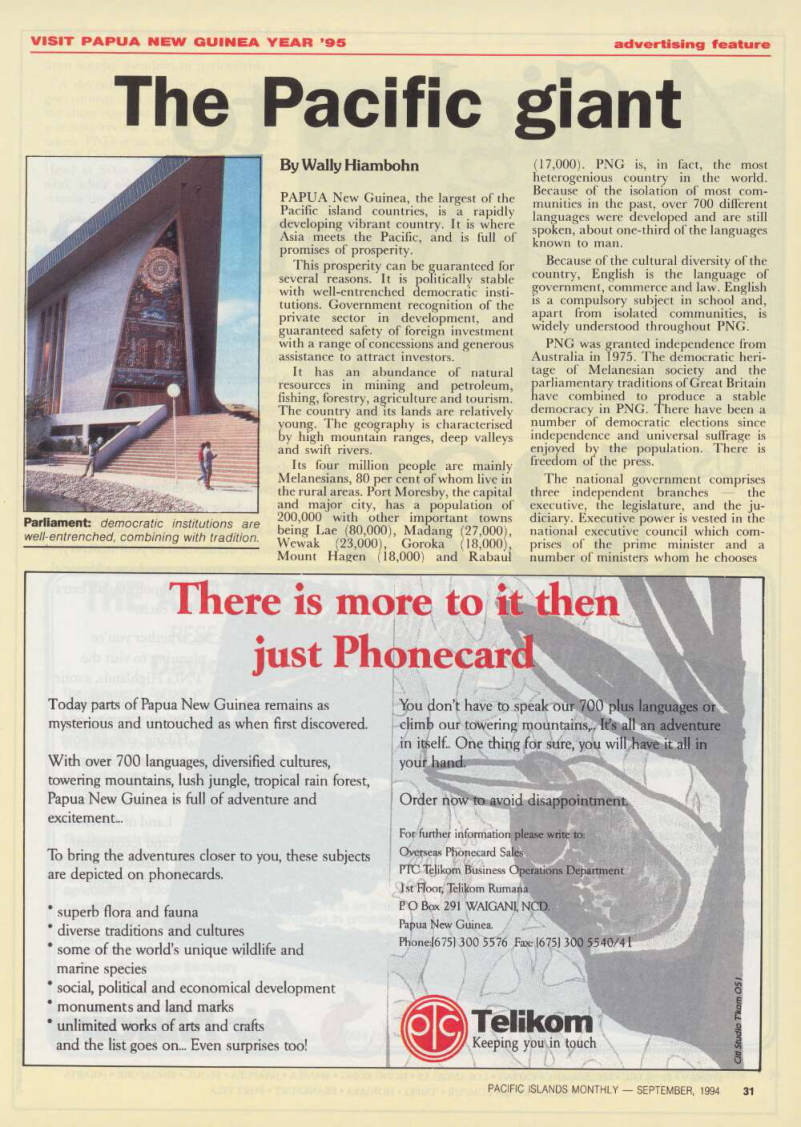
Parliament: democratic institutions are well-entrenched, combining with tradition.
from among members of parliament.
A decentralised system of provincial government also exists in PNG, though the sheer size and cost of this has led to a serious review currently being under taken. PNG is an active member of the British Commonwealth. The ceremonial Head of State is the Governor-General who, while elected by Parliament, rep resents the British Monarch.
PNG has been described as “a moun tain of gold floating in a sea of oil”. While this may somewhat be overstating the situation, it does reflect the importance that PNG’s extensive natural resources have played and will continue to play in
the country’s development.
At present there are two distinct economies traditional, mainly subsistence, farming which supports the majority in the rural areas; and the cash economy which is very much an open economy geared for international trade.
Its major exports are gold, oil, copper, coffee, timber, cocoa and oil palm, with
major imports being machinery and
equipment, manufactured goods, food
and chemicals. Australia, Japan, the United States and Germany ranks as the
biggest trading partners.
The development of several new im portant mineral and oil projects have laid the foundation for strong growth for
the remainder of the 19905.
In 1991 the country’s GDP grew by 9.5 per cent, 11.8 per cent in 1992 and by a sizzling 14.4 per cent in 1993. There are extensive reserves of natural gas and oil. The first oil production began at the Kutubu oil field in mid-1992. A conser
vative estimate of recoverable reserves at the field has been put at 248 million barrels. Other known fields have yet to be developed. The main mineral deposits are copper and gold, but there are also recoverable deposits of other minerals.
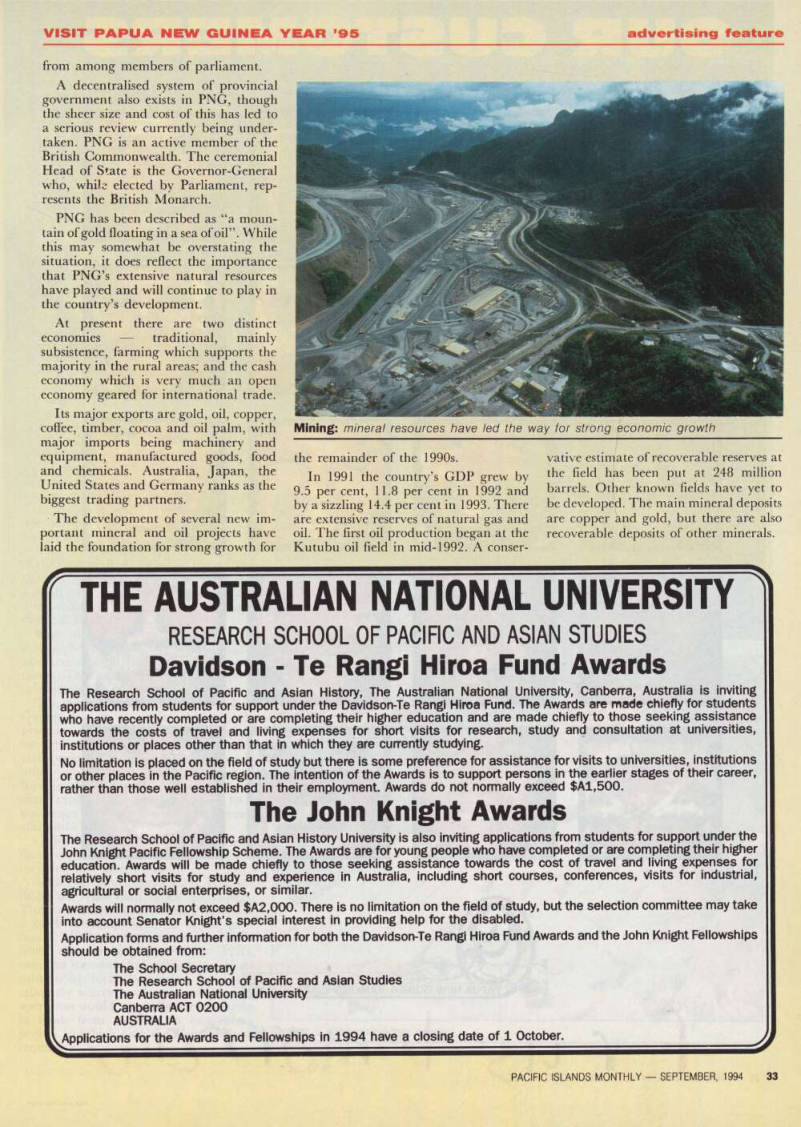
Mining: mineral resources have led the way for strong economic growth
THE Ok Tedi mine is now producing more copper than that produced by the Bougainville mine before its forced clos ure due to an armed rebellion. The Porgera gold mine is one of the world’s largest and is expected to produce 11.3 million ounces of gold over its 20-year life. A medium size gold mine is also based on Misima Island, and soon to come on stream is the Lihir gold mine, said to be the biggest undeveloped gold mine outside South Africa.
The waters around PNG are also rich in marine resources and are almost untapped. Within the 200 mile economic zone are large varieties of fish, including migrating schools of tuna.
Forest products are one of PNG’s major exports but the timber resource of the country remains largely intact. There are 36 million hectares of enclosed forest of which 15 million hectares of high quality tropical hardwood are estimated as suitable for immediate development.
Timber operators are currently harvest ing only around 1.5 million cubic metres of available timber.
The government of PNG is, however, mindful of the important obligations to its environmental heritage. Each major investment project is carefully evaluated in terms of the environmental impact.
Every effort is made to devise appropri ate solutions to meet the needs of both the local people and the investors.
The PNG banking system is made up of the Central Bank (Bank of Papua New Guinea), a number of commercial banks, a small number of finance companies and a development bank, namely the Agri cultural Bank of PNG.
One of the commercial banks, the Papua New Guinea Banking Corpor ation, is wholly owned by the govern ment. The others are subsidiaries of international and Australian banks.
The Agricultural Bank of Papua New Guinea has as its main objective the provision of finance to PNG enterprises for agricultural, industrial and commer cial projects. Another recently estab lished government body, the Small Business Development Corporation, as sists small and medium size local businesses to secure finance and operate efficiently.
Other financial institutions include finance companies, saving and loans societies, and credit unions.
Some companies operating in PNG are listed on Australian Stock Exchanges.
The government also intends to establish a stock exchange in PNG in the near future. While some finance is available from the banking system in PNG, overseas investors are unlikely to secure substantial local borrowing from the relatively scarce local resources. A new operation would normally need to bring in funds from overseas to establish a project in which case the Central Bank requires a
Highlanders: 80 per cent of the population live in rural areas
Copra: a major revenue earner
debt to equity ratio of 3:1 or less.
Exchange controls are applied in PNG and are administered by the Central Bank. These controls are applied to protect the country’s reserves and have been liberalised recently. Approval is readily given for the repatriation of aftertax profits of foreign-owned enterprises, and other current account payments for legitimate business reasons generally present no problems.
Business may be carried out in PNG in a number of forms. These include a sole trader, partnership, private company, public company, branch of a foreign company, business group and trust.
Each type of business organisation is subject to particular regulations. Foreign investors usually establish a private or public company or a branch of a foreign company. Before commencing business in PNG, it is necessary to incorporate a company or register as a branch of a foreign company under the Companies Act. This is a simple formality if a shelf company is purchased.
The legal system in PNG is based largely on the Australian legal system which, in turn, has its roots in the English legal system. There are, however, areas where the traditional or ‘customary’ law applies. Under the constitution, courts are required to have regard to both common law and customary law (called
the underlying law). This underlying law is determined by the courts and can be particularly important when dealing with cases involving land tenure and the use of natural resources.
Court hearings are held in English and the law is applied equally and fairly. The final court of appeal is the Supreme Court of PNG.
Labour
There is an available pool of labour in PNG; but while the wage rates are low by developed country standards, productivity is not high. The Government has taken steps to improve its education standards and qualifications of the people. In 1991, there were over 13,000 enrolled in university, vocational and technical institutions.
Until the local workforce upgrades its skills many new ventures, particularly those requiring technical skills, will have to rely on some managerial and supervisory staff from overseas on short term assignments.
Expatriate Employment
While recognising the legitimate need for overseas personnel for some new ventures, the Government of PNG also insists that there be a training and localisation programme to allow Papua New Guineans to eventually fill these roles.
Before employing expatriates, a busi-
ness must submit a plan to the Depart ment of Labour and Department of Labour and Employment which outlines the training to be given to local PNG staff to enable them to take on the positions filled by the expatriates, Once the requirements are satisfied a new business should have no problem in obtaining work permits for expatriates,
Trade Agreements/Export
Promotion
PNG has preferential access to a number of overseas markets. Products of PNG origin are allowed duty free access to Australia, New Zealand and the EC under the PATCRA and SPARTECA agreements and the Lome Convention, PNG products also have preferential access to numerous other developed countries including Japan and the US under their respective General System of Preferences.
The Department of Trade and Indus try actively assists local producers to export. Activities are targeted at areas where supply capabilities are available or have good potential for development, The Department sponsors selling mis sions and attendance at trade fairs in overseas markets.
Commercial representation offices are located in Sydney and Brussels, while PNG’s diplomatic representatives in other countries are organised to bring
Papuans: training of locals is a necessity with foreign investment
about greater foreign market awareness and demand for PNG products.
Land Tenure
As already mentioned, the ownership and the right to use most land and natural resources is governed by the traditional law of the PNG people.
Only three per cent of land is outside of this ancient system and this is almost entirely owned by the national govern ment. Foreign investors can lease land from the government for particular projects. The recently-established Indus trial Centres Development Corporation is developing industrial sites, which could also be made available to investors, in or
near the major urban areas.
Investors involved in manufacturing operations will usually face no difficulties with land availability. Those involved in resource or agricultural projects should appreciate, however, that access to land resource may be difficult.
The government will assist investors in large projects that are vital to the
economic growth of the country it has the right to do so under the Land Act.
Nonetheless, the government is gener ally restricted to protecting traditional property rights and investors will not be allowed to negotiate directly with the local owners. If handled properly, the government’s investors has shown that a mutually satisfactory agreement can be readily developed. D
Landowners: government committed to protecting traditional rights
Port Moresby: industrial projects won’t have land difficulties