Business
pp. 27-28 · Read in the full issue
Pacific
Economy’s gone bananas but is not yet squashed
By Dr Roman Grynberg
IF you look at the Tongan balance of trade figures you will see right away that there are no more banana exports. As a matter of fact just about all of traditional exports have virtually disappeared off the trade statistics. Coconut oil exports also once a staple was barely worth $lOO,OOO in 1993. Taro, which had been a staple export for so long to Tongan and Samoan residents in New Zealand has
also virtually disappeared.
In 1993 taro exports amounted to no more than $500,000. Fish which has long been one of Tonga’s great hopes, while not disappearing as an export appears to have shown very little growth at US$l.l million in exports at the end of 1993.
Manufactured exports have also done a disappearing act but yet despite all this
exports have been increas ing. Unlike Western Samoa which has experi enced disastrous cyclones and the taro blight, Tonga
has actually managed to
cut back, if slightly, on its trade deficit.
Most of Polynesia and to a lesser degree Micronesia have chronic trade deficits that have only become worse over the years. By and large most of the islands earn their foreign exchange from remittances from relatives working abroad as well as from aid.
What Tonga has managed
to do has been able to at least slightly reverse the trend with the trade deficit decreasing from US$5l million in 1988 to US$4B million in 1993. When one considers that other island countries in the region went backwards in terms of alleviating their trade bal
ance Tonga’s achievement is no small success.
The cause of the turnaround is the
country’s miracle crop squash. Tonga
has over the years responded almost like clockwork to market signals provided to its agricultural exporters. From bananas to watermelons to taro to squash Tonga has moved from one crop to another as prices and opportunities rise and fall.
Proof, that despite what some economists say about the effectiveness of market incentives in other South Pacific countries they have certainly been suc cessful in stimulating agricultural pro duction in Tonga.
The problem with squash is its very success. From small beginnings in the mid-1980’s with relatively low prices Tonga has managed to dominate a niche market in Japan. The reason why the
niche exists is because squash is an important part of the Japanese diet and thei T j s a small gap in the November market J vhe " ) the Japanese demand
cannot be adequa ely supplied either
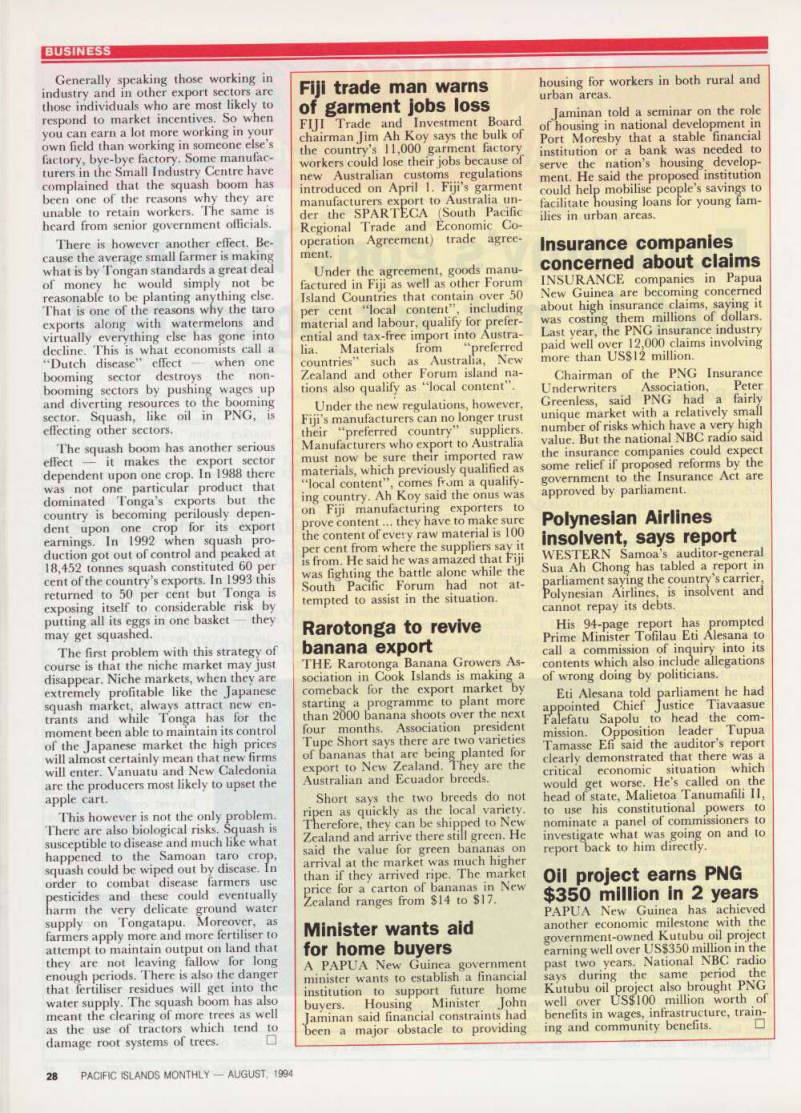
from domestic production or from supplies from New Zealand or the US or any of its other traditional suppliers, Tonga has increased production from 970 tonnes m 1988 to some 17,000 tonnes m 1993/94. But leaving aside the fact that anuatu, New Caledonia and Fiji are all nibbling at the market attempting to get a share of what has become a very lucrative market the sheer profitability of the crop has caused problems in the Kingdom F ° Just how lucrative is squash? The answer is very lucrative. In 1993 unit fob export prices were in the vicinity of US$O.63 per kg. The price was doubled
in comparison to three years ago. But all is not roses and sunshine in the
nation’s squash patch. The
growth of the industry has had some rather peculiar but not entirely unexpec ted results.
The first is that when the harvest comes in October don’t come to offices look ing for people, you are
probably likely to find
them in the fields harvest ing their squash because it is a far more profitable activity than working in an office. If it were just the government offices that
were being depleted from
the nation’s squash boom then some would argue that this would be unlikely to hurt anyone but the fact of it is that the boom in
squash has been directly
linked to the demise of other export sectors.
Preparing the vegetable for export: Tongan youths clean squash bound for Japan
Generally speaking those working in
industry and in other export sectors are those individuals who are most likely to respond to market incentives. So when you can earn a lot more working in your own field than working in someone else’s factory, bye-bye factory. Some manufac turers in the Small Industry Centre have complained that the squash boom has been one of the reasons why they are unable to retain workers. The same is heard from senior government officials.
There is however another effect. Be cause the average small farmer is making what is by Tongan standards a great deal of money he would simply not be reasonable to be planting anything else.
That is one of the reasons why the taro exports along with watermelons and virtually everything else has gone into decline. This is what economists call a “Dutch disease” effect when one booming sector destroys the non
booming sectors by pushing wages up
and diverting resources to the booming sector. Squash, like oil in PNG, is effecting other sectors.
The squash boom has another serious effect it makes the export sector dependent upon one crop. In 1988 there was not one particular product that dominated Tonga’s exports but the
country is becoming perilously depen
dent upon one crop for its export earnings. In 1992 when squash pro duction got out of control and peaked at 18,452 tonnes squash constituted 60 per cent of the country’s exports. In 1993 this returned to 50 per cent but Tonga is exposing itself to considerable risk by putting all its eggs in one basket they may get squashed.
The first problem with this strategy of course is that the niche market may just disappear. Niche markets, when they are
extremely profitable like the Japanese
squash market, always attract new en trants and while Tonga has for the moment been able to maintain its control of the Japanese market the high prices will almost certainly mean that new firms will enter. Vanuatu and New Caledonia are the producers most likely to upset the
apple cart.
This however is not the only problem.
There are also biological risks. Squash is susceptible to disease and much like what happened to the Samoan taro crop, squash could be wiped out by disease. In order to combat disease farmers use pesticides and these could eventually harm the very delicate ground water supply on Tongatapu. Moreover, as farmers apply more and more fertiliser to attempt to maintain output on land that they are not leaving fallow for long enough periods. There is also the danger that fertiliser residues will get into the water supply. The squash boom has also meant the clearing of more trees as well as the use of tractors which tend to damage root systems of trees. □
Fiji trade man warns
of garment jobs loss
FIJI Trade and Investment Board chairman Jim Ah Koy says the bulk of the country’s 11,000 garment factory workers could lose their jobs because of new Australian customs regulations introduced on April 1. Fiji’s garment manufacturers export to Australia un der the SPARTECA (South Pacific Regional Trade and Economic Co
operation Agreement) trade agree
ment.
Under the agreement, goods manu factured in Fiji as well as other Forum Island Countries that contain over 50 per cent “local content”, including material and labour, qualify for prefer ential and tax-free import into Austra lia. Materials from “preferred countries” such as Australia, New Zealand and other Forum island na tions also qualify as “local content”.
Under the new regulations, however, Fiji’s manufacturers can no longer trust
their “preferred country” suppliers.
Manufacturers who export to Australia must now be sure their imported raw materials, which previously qualified as “local content”, comes fiom a qualify ing country. Ah Koy said the onus was on Fiji manufacturing exporters to prove content... they have to make sure the content of every raw material is 100 per cent from where the suppliers say it is from. He said he was amazed that Fiji was fighting the battle alone while the South Pacific Forum had not at tempted to assist in the situation.
Rarotonga to revive
banana export
THE Rarotonga Banana Growers As sociation in Cook Islands is making a comeback for the export market by starting a programme to plant more than 2000 banana shoots over the next four months. Association president Tupe Short says there are two varieties of bananas that are being planted for export to New Zealand. They are the Australian and Ecuador breeds.
Short says the two breeds do not ripen as quickly as the local variety.
Therefore, they can be shipped to New Zealand and arrive there still green. He said the value for green bananas on arrival at the market was much higher than if they arrived ripe. The market price for a carton of bananas in New Zealand ranges from $l4 to $l7.
Minister wants aid
for home buyers
A PAPUA New Guinea government minister wants to establish a financial institution to support future home buyers. Housing Minister John Jaminan said financial constraints had been a major obstacle to providing
housing for workers in both rural and urban areas.
Jaminan told a seminar on the role of housing in national development in Port Moresby that a stable financial institution or a bank was needed to serve the nation’s housing develop ment. He said the proposed institution could help mobilise people’s savings to facilitate housing loans for young fam ilies in urban areas.
Insurance companies
concerned about claims
INSURANCE companies in Papua
New Guinea are becoming concerned about high insurance claims, saving it was costing them millions of dollars.
Last year, the PNG insurance industry paid well over 12,000 claims involving more than US$l2 million.
Chairman of the PNG Insurance Underwriters Association, Peter Greenless, said PNG had a fairly unique market with a relatively small number of risks which have a very high value. But the national NBC radio said the insurance companies could expect some relief if proposed reforms by the government to the Insurance Act are
approved by parliament.
Polynesian Airlines
insolvent, says report
WESTERN Samoa’s auditor-general Sua Ah Chong has tabled a report in parliament saying the country’s carrier, Polynesian Airlines, is insolvent and cannot repay its debts.
His 94-page report has prompted Prime Minister Tofilau Eti Alesana to call a commission of inquiry into its contents which also include allegations of wrong doing by politicians.
Eti Alesana told parliament he had
appointed Chief Justice Tiavaasue
Falefatu Sapolu to head the com mission. Opposition leader Tupua Tamasse Eli said the auditor’s report clearly demonstrated that there was a critical economic situation which would get worse. He’s called on the head of state, Malietqa Tanumafili 11, to use his constitutional powers to nominate a panel of commissioners to investigate what was going on and to report back to him directly.
Oil project earns PNG
$350 million in 2 years
PAPUA New Guinea has achieved another economic milestone with the
government-owned Kutubu oil project
earning well over US$35O million in the past two years. National NBC radio says during the same period the Kutubu oil project also brought PNG well over US$lOO million worth of benefits in wages, infrastructure, train ing and community benefits. □