Cure the ‘Dutch
pp. 24-25 · Read in the full issue
Economy
By David North
AS a recent Asian Development Bank (ADB) report describes it, the Federated States of Micronesia (FSM) and the Republic of the Marshall Islands have contracted an extreme case of the ‘Dutch disease’. If the Republic of Palau doesn’t watch out, it could be the next United States-affiliated Pacific Island to catch
the malady.
Almost two-thirds of the national income of those islands ($155 million annually for the FSM) is derived from a natural resource that is being depleted and will eventually be exhausted US funding under the Compact of Free Association. By 2001, when compact funding is scheduled to expire, the FSM will have received $1.5 billion in US financial aid, while the Marshalls will have received three-quarters of a billion in compact aid, base rental payments, nuclear test victims trust funds, and other US grants. Palau, which expects to implement its Compact in Fiscal Year 1995, will receive an estimated $5OO million over 15 years.
In the meantime the islands’ domestic resources skilled personnel, managers, and capital are being drawn into the sector which benefits from that natural resource, that is, the local governments.
Other productive sectors such as agricul ture, fisheries, and tourism decline or grow slowly because they cannot com plete with wage and income levels set by the public sector.
More importantly, when compact funding for the FSM and the Marshalls ends in seven years, the islands will face a drastic decline in living standards. By ADB estimates that will translate into a drop in per capital income from $lO5O in 1990 to $350 in 2002. In short, unless the islands take immediate steps to cure their ‘Dutch disease’, they face economic catastrophe. The ADB analysis does not come as a surprise to island leaders, who
recently began regular consultation with
the United States to review the prospects for post-compact aid. After the first
reduction (or step-down) in US funding
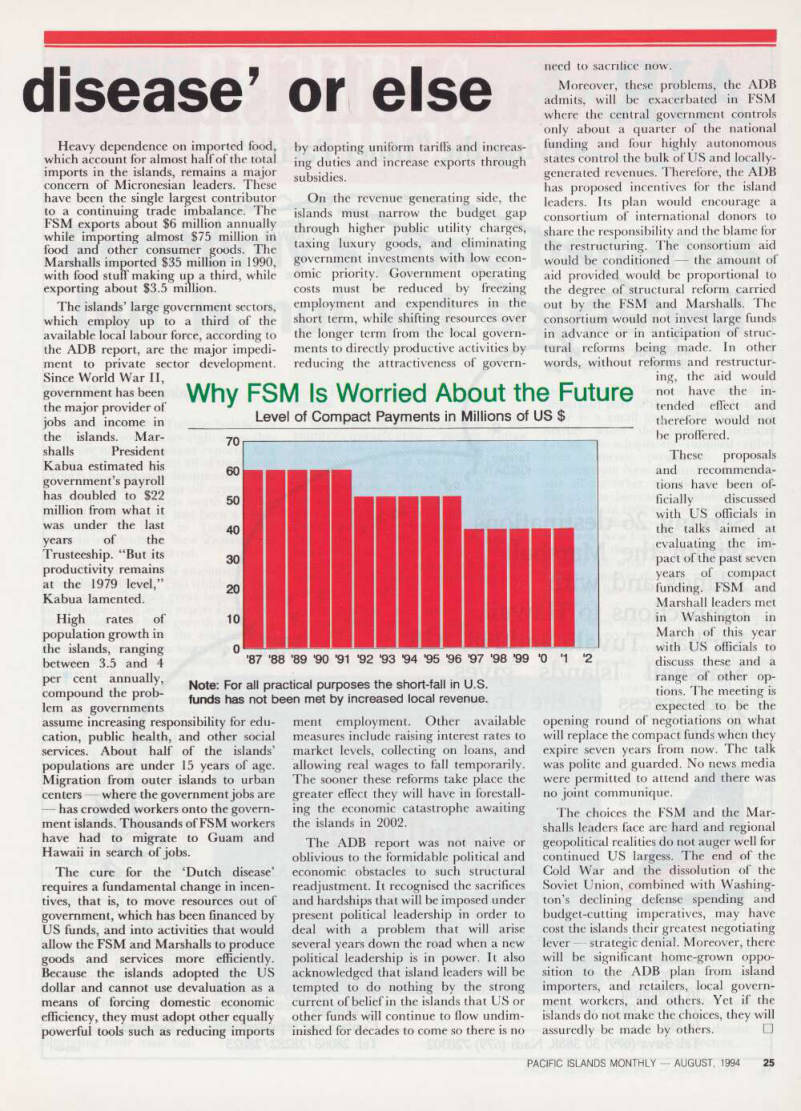
in 1991, FSM and Marshall leaders warned their people that their economic game plan was not working. (The levels of US aid decline in the fifth, tenth and fifteenth years of the compact. The FSM received $6O million annually for the first third of the compact, but dropped to $5l million a year in 1991, and is slated to receive $4O million annually during the last five years of the pact.) FSM President Bailey Offer told the National Congress last year that the islands “have not realised expected revenues from our implemented projects.
All grant monies under the compact and revenues from our fisheries are currently expended annually without creation or replacement of revenue for lost cash under the first step down in US assist ance”. The big question facing the FSM, Offer suggested is “where are FSM
national and state governments going to obtain financial assistance from? Japan, Australia, and China and other countries have extended project finance assistance to the FSM, but without compact finance assistance, lifestyles as they exist today will not be supportable or poss ible”.
Marshalls President Amata Kabua struck a similar tone when he told his constituents that the lack of sustainable economic development could be reversed “if we rise from a wasteful lifestyle and work vigorously together for the common good of the nation”. The failure to sufficiently develop “our own industries that are economically viable and self
sustaining” was the
key to the problem.
If this trend was not reversed by 2001, “when the compact funds run out, this nation may face
financial problems”,
Kabua concluded.
Marshalls Foreign
Secretary Jiba
Kabua was less retrained when he blasted business and social leaders in the islands for failing to “wake up” to stark realities facing them.
He called for businesses, govern ment agencies,
schools, the legal system, and even the churches to revaluate their wholesale adopting of Western ways and to reform themselves to work toward the self reliance they all claim to seek as a common goal. He singled out the island businessmen for special criticism. “The local business community is contaminat ing the bodies and minds of the average Marshallese. They are not going to admit it because they are greedy. It is the conditioning of all these years. Island businesses’ practice of importing all goods and services must be changed if dependency is to be attacked. A change in economic policies will require some people with guts in the Nitijela (legis lature),” Jiba Kabua said. The islands’ economic game plan under the compact was to use at least 40 per cent of the US revenue for capital development build a transportation, communication, and utility foundation in the early years of compact funding, and to entice foreign investors with this infrastructure, tax breaks, and other incentives. These new businesses, in fisheries, tourism, and agriculture, would then provide new tax revenues, which with other international aid, could reduce or supplant the islands’
heavy reliance on the US funding.
The usual suspects are occasionally rounded up to explain why the game plan has not worked. These excuses include small isolated markets, inad equate water, power, and transportation systems, unskilled labour and middle management, and land tenure systems that limit foreigners to leasing land. Yet these factors exist in other Pacific Island developing states and have not prevented the growth of local industries.
Former FSM President John R Haglelgam has suggested another factor that seems to be at the heart of the larger problem. “The Congress of the Feder ated States of Micronesia, along with the
several states, needs to enact legislation to create a more con ducive climate for
foreign investment,”
Haglelgam told
Micronesian leaders last year. “There are two many barriers, too much red tape, in the laws and regu lations currently in
place.”
To date, new busi ness revenue sources for the FSM and the Marshalls have come
primarily from
fisheries and second arily from tourism and small agricul
tural projects. The FSM’s 1.3 million square-mile Exclusive Economic Zone (EEZ) has successfully drawn US and
Asian commercial fishing operations,
generating about $6 million annually in fees. These revenues now account for a quarter of the FSM’s locally-generated revenues. The Marshalls EEZ fishery generates about $2 million annually in license fees.
Tourism has developed more slowly.
About 400 rooms are available in the FSM, while the Marshalls has less than half that number. Tourism spending in the FSM amounts to about $lO million annually, while in the Marshalls, about $2 million a year. FSM officials estimate an additional $lOO million will be required to build 1000 new hotel rooms.
Copra production remains the major
agricultural export of the islands. But other large scale agriculture has not received the investment needed under the economic master plans. Specialty crops like pepper and citrus fruits on Pohnpei have found niches in Japanese and US markets. But the goal of
significantly increasing the production of
food stuff as a way to provide import substitution has not been realised.
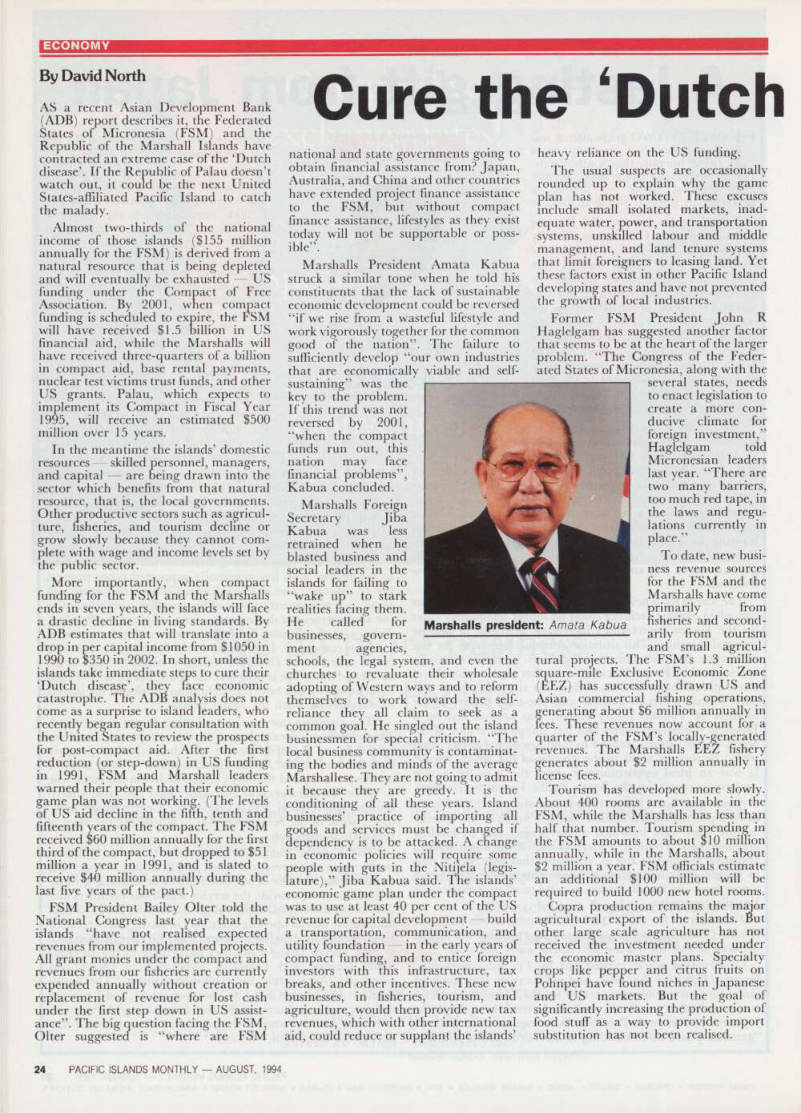
Marshalls president: Amata Kabua
Heavy dependence on imported food,
which account for almost half of the total imports in the islands, remains a major concern of Micronesian leaders. These have been the single largest contributor to a continuing trade imbalance. The FSM exports about $6 million annually while importing almost $75 million in food and other consumer goods. The Marshalls imported $35 million in 1990, with food stuff making up a third, while exporting about $3.5 million.
The islands’ large government sectors, which employ up to a third of the available local labour force, according to the ADB report, are the major impedi ment to private sector development.
Since World War 11, government has been
the major provider of
jobs and income in the islands. Mar shalls President Kabua estimated his
government’s payroll
has doubled to $22 million from what it was under the last years of the Trusteeship. “But its
productivity remains
at the 1979 level,”
Kabua lamented.
High rates of
population growth in
the islands, ranging between 3.5 and 4 per cent annually,
compound the prob
lem as governments
assume increasing responsibility for edu cation, public health, and other social services. About half of the islands’ populations are under 15 years of age.
Migration from outer islands to urban centers where the government jobs are has crowded workers onto the govern ment islands. Thousands of FSM workers have had to migrate to Guam and Hawaii in search of jobs.
The cure for the ‘Dutch disease’ requires a fundamental change in incen tives, that is, to move resources out of government, which has been financed by US funds, and into activities that would allow the FSM and Marshalls to produce goods and services more efficiently.
Because the islands adopted the US dollar and cannot use devaluation as a means of forcing domestic economic
efficiency, they must adopt other equally
powerful tools such as reducing imports
by adopting uniform tariffs and increas ing duties and increase exports through subsidies.
On the revenue generating side, the islands must narrow the budget gap through higher public utility charges, taxing luxury goods, and eliminating government investments with low econ omic priority. Government operating costs must be reduced by freezing employment and expenditures in the short term, while shifting resources over the longer term from the local govern ments to directly productive activities by reducing the attractiveness of govern-
Why FSM Is Worried About the Future Level of Compact Payments in Millions of US $
ment employment. Other available measures include raising interest rates to market levels, collecting on loans, and allowing real wages to fall temporarily.
The sooner these reforms take place the greater effect they will have in forestall
ing the economic catastrophe awaiting
the islands in 2002.
The ADB report was not naive or oblivious to the formidable political and economic obstacles to such structural readjustment. It recognised the sacrifices and hardships that will be imposed under present political leadership in order to deal with a problem that will arise several years down the road when a new political leadership is in power. It also acknowledged that island leaders will be tempted to do nothing by the strong current of belief in the islands that US or other funds will continue to flow undim inished for decades to come so there is no
need to sacrifice now.
Moreover, these problems, the ADB admits, will be exacerbated in FSM where the central government controls only about a quarter of the national funding and four highly autonomous states control the bulk of US and locally generated revenues. Therefore, the ADB has proposed incentives for the island leaders. Its plan would encourage a consortium of international donors to share the responsibility and the blame for the restructuring. The consortium aid would be conditioned the amount of aid provided would be proportional to the degree of structural reform carried out by the FSM and Marshalls. The consortium would not invest large funds in advance or in anticipation of struc tural reforms being made. In other words, without reforms and restructur
ing, the aid would not have the in tended effect and therefore would not
be proffered.
These proposals
and recommenda tions have been of ficially discussed with US officials in the talks aimed at evaluating the im pact of the past seven years of compact funding. FSM and Marshall leaders met in Washington in March of this year with US officials to discuss these and a range of other op tions. The meeting is expected to be the
opening round of negotiations on what will replace the compact funds when they expire seven years from now. The talk was polite and guarded. No news media were permitted to attend and there was
no joint communique.
The choices the FSM and the Mar shalls leaders face are hard and regional geopolitical realities do not auger well for continued US largess. The end of the Cold War and the dissolution of the Soviet Union, combined with Washing ton’s declining defense spending and
budget-cutting imperatives, may have
cost the islands their greatest negotiating lever-- strategic denial. Moreover, there will be significant home-grown oppo sition to the ADB plan from island importers, and retailers, local govern ment workers, and others. Yet if the islands do not make the choices, they will assuredly be made by others. □
Note: For all practical purposes the short-fall in U.S. funds has not been met by increased local revenue.