Return to Raga
p. 60 · Read in the full issue
Yachting
Fellowship gets warm welcome on her Return to Raga
By Sally Andrew
“FISH lips,” I muttered. There was nothing but a large pair of fish lips (with a bit of gill for colour) attached to the lure. Maybe we’d be luckier next time.
I rolled up the fishing line and put it away. We entered the bay and were almost ready to go through the pass at Loltong in northern Vanuatu. I went forward and dropped the jib, then folded the mainsail and secured it. With the engine running, we lined up the range and Fellowship entered the harbour. After watching the anchor dig into the white sand, we rowed ashore. Everyone was
surprised. “Mitufala tink se yutufala no kambak!” Philip was glad to see us, and his Rachel was in tears.
We had returned to Raga.
Philip guided us to his Tiare Restaurant.
Constructed as a roundhouse of tra ditional (kastom) material and newly
opened for
Pentecost’s Island Government Day celebrations in Sep tember, it had screens on the win dows, fresh flowers on the main post,
and gaily-coloured
lavalavas hanging from the rafters. As
we sat inside, many people stopped in to welcome us back.
That night Philip served us kava, and then his wife Juliet brought us some smol kakae from her kitchen chicken, pawpaw and manioc in creamy coconut milk, and coffee. We stayed ashore until after dark, telling Philip where we’d been, listening to all the local gossip, and best of all, planning a fishing trip.
At Loltong, the village gardens are way up in the hills. Everyday families climb the steep hill to plant, weed and harvest their crops. Foster joined Philip on a trip to collect taro and yams for a ceremonial pig-killing later in the week.
I stayed behind: “It’s a long way up to the gardens, too far for you.” It truly was a long way, as I later discovered! Foster dug up assorted big roots, planted taro and learned how to weed. Rachel cooked him a big bush lunch of laplap made
from grated yams poured into a length of bamboo lined with a leaf and cooked over an open fire. At the end of the day, they came down the hill with taro hung from poles balanced on their shoulders.
On Sunday we attended the Anglican church service. A kastom building with open windows and hard wooden benches, it was filled with people , kids in front. Chickens ran around outside, scratching the earth. The service was conducted in three languages and after a short reading in soft-spoken English, it continued first in Raga (the local dialect), then in Bislama. After the service, Mark made a speech on behalf of
his congregation welcoming us as travel lers and as friends. Outside the church door, we shook hands with absolutely everyone, young and old, and exchanged Ranthe vua’s, kisses, hugs, and tears.
As soon as I could, I bought a small dictionary of the Raga language. It was a big help since everyone was trying to teach me the language of northern Pentecost. Like a small child I would point to a pig and say boe or a chicken, toa. There were smiles all round on my great strides in mastering the local
language.
We visited inside Mark’s house. Al though the floors of most cooking huts in the village were earthen, Mark’s was concrete with a large hole cut through to the dirt for the cooking fire! A big basket hung on the wall and contained the beautiful red mats known as bwana.
These soft mats are exchanged at grade
takings, births, marriages and deaths. In Raga, mats and pigs are the traditional mediums of exchange, local cash.
At noontime we were taken to the Tiare Restaurant where the Vatulo String Band set up their equipment bongos, ukulele, three guitars, a homemade string-bass, maracas. Flower leis were placed around our necks, and with all the extended family and friends nearby, the band started playing. Much to our surprise and delight they had written a song about our arrival in Loltong last season. “Gud felaship nambawan Good Fellowship Number One!” We were absolutely thrilled we
had been immortal ised in the island’s oral culture.
Later in the after noon, we held open house on board Fel lowship and had many visitors come aboard. Over cups of tea, biscuits and sec tions of Santo grape fruit, we shared photos of our families in Canada. We had a hard time explain ing, in Bislama, win tertime in Montreal frozen lakes, trees with no leaves and all that snow.
The following
morning we took some friends from the village fishing. With
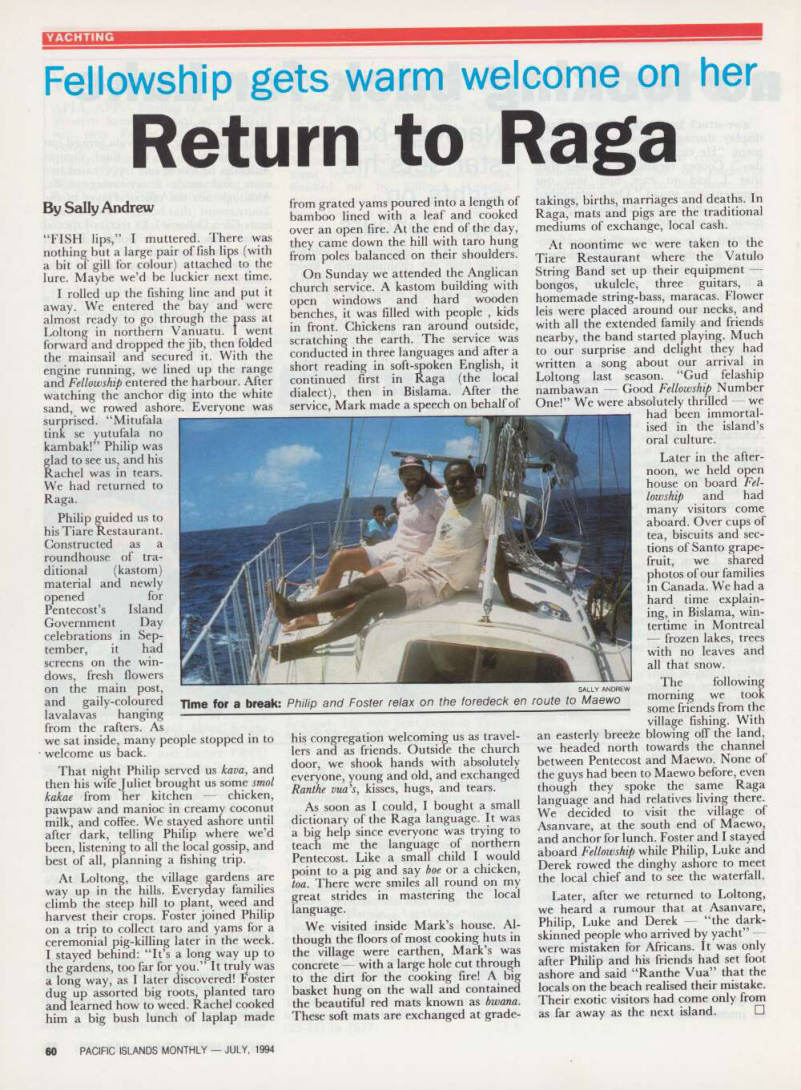
an easterly breeze blowing off the land, we headed north towards the channel between Pentecost and Maewo. None of the guys had been to Maewo before, even
though they spoke the same Raga
language and had relatives living there.
We decided to visit the village of Asanvare, at the south end of Maewo, and anchor for lunch. Foster and I stayed aboard Fellowship while Philip, Luke and Derek rowed the dinghy ashore to meet the local chief and to see the waterfall.
Later, after we returned to Loltong, we heard a rumour that at Asanvare, Philip, Luke and Derek “the dark
skinned people who arrived by yacht”
were mistaken for Africans. It was only after Philip and his friends had set foot ashore and said “Ranthe Vua” that the locals on the beach realised their mistake.
Their exotic visitors had come only from as far away as the next island. □
Sally Andrew
Time for a break: Philip and Foster relax on the foredeck en route to Maewo