There’s
pp. 58-59 · Read in the full issue
By Atama Raganivatu
PERHAPS the time has come for a scientific analysis to be made of Namatakula’s kava to determine if it contains a secret ingredient responsible for developing highly gifted rugby players! The small village, situated on Viti Levu’s west coast, had already produced a crop of excellent footballers renowned throughout Fiji before its current favourite son, Noa Nadruku, gained fame and fortune in Australian rugby league. NoW, it can take pride as the home of the 1994 Hong Kong Sevens’ most influential player Luke Erenavula.
Erenavula and Nadruku are cousins.
They spent many of their pre-teen days playing rugby together in Namatakula and forged a friendship that remains strong. Erenavula was a centre then, playing alongside second five Nadruku.
However, due to the former’s size he was drafted into the back. This only led to him being continually isolated as his slower fellow forwards failed to keep up with play. By the time he commenced playing senior rugby, Erenavula was on the wing where he has remained.
After gaining notice with some exhil arating performances while playing for his club (Warwick) and district (Na droga), the lanky coral coaster was selected for Fiji’s team that travelled to the 1988 Honk Kong Sevens. He experi enced mixed fortunes in the Crown Colony that year and, due to the incredible depth of talented sevens players amongst his compatriots, was not called upon during the Fijians’ remark able hat trick of successes between 1990 and 1992.
The Fijian Rugby Union began to regard him purely as a fifteen-a-side specialist and it was a game of rugby’s traditional, elongated, variety that changed Erenavula’s life. An exception ally strong performance for Fiji against Scotland at Edinburgh’s historic Murrayfield stadium was captured on video tape by a Suva-based friend of Rod Ketels, a former All Blacks who coaches the Pukekohe club in New Zealand.
Ketels received the tape along with a note suggesting he try to recruit the long striding Erenavula.
Ketels was duly impressed and, having been assured of worthwhile employment and accommodation, Erenavula and his wife, Jimaima, moved to New Zealand in 1992. It didn’t take him long to graduate from club to inter-provincial rugby.
Counties coach Ross Cooper was
awe-struck by the fleet footed Fijian’s display during a local sevens tourna ment. “He cut everyone to pieces that day,” Cooper recalls. “I realised then that I had to ease him into our representative squad.” Once established in the Counties team, Erenavula quickly made his presence felt.
Word of several electrifying perform ances for the south Auckland-based provincial combination filtered back to Fiji and, during a brief holiday, Erenavula accepted an invitation to play for Waisale Serevi’s all-conquering Nabua sevens team. He helped the “Maroons” enhance their already in credible record in domestic competitions and, in doing so, won a recall for Fiji’s party for the Canberra and Hong Kong sevens tournaments in March of last
year.
He played in the Australian federal capital but, due to a most unfortunate communications breakdown, missed the trip to Hong Kong. Erenavula still insists today he had ensured Fijian Rugby Union offic ials that he was avail able for international rugby’s most eagerly anticipated week end, while the FRU are equally adamant this was not the case.
After failing in their endeavours to make contact with him, they enlisted another New Zealand-based player Paula Bale as his replace
ment. As a result, an infuriated Erenavula was left stranded at Nadi Airport while his former teammates jetted towards Asia. He vowed never to play for Fiji again and, there and then, switched allegiance to New Zealand. We will never know how the Fijians would have fared in Hong Kong wtth Erenavula in their ranks, but they were in desperate need of his Hair when Western Samoa subdued them in the final Erenavula immediately put that false start to the 1993 season behind him. His 22 tries were instrumental in Counties winning the National Championship’s Second Division and another six during an internal tour by the New Zealand
Nadroga-born star sets his sights on high honours
Divisional XV (comprised of leading players from the championship’s lower grades) brought his total to 28 —just two short of the all time record held by 1950 s All Black Ron Jarden. Many of those tries were poached through opportunist interceptions followed by long sprints down the wings. The sight of Erenavula scampering towards the tryline with several hapless opponents in his wake became commonplace.
However, the campaign did contain
one more black spot. Selected for an All Blacks trial on a cold, wet and windy
day, Erenavula experienced a nightmare
match, his hands letting him down on several occasions.
Having let this initial chance of
gaining All Black honours slip, literally,
through his fingers, Erenavula was determined to grab the opportunity to force his way into the Kiwi’s sevens selection when it arose. The 1994 National Sevens Tournament; staged immediately before the naming of a squad for Hong Kong, acted as a trial and provided an ideal stage for the Fijian to display his skills. He was in scintil lating form, as Counties won the title in a canter. A trip to the territory was an
inevitable reward.
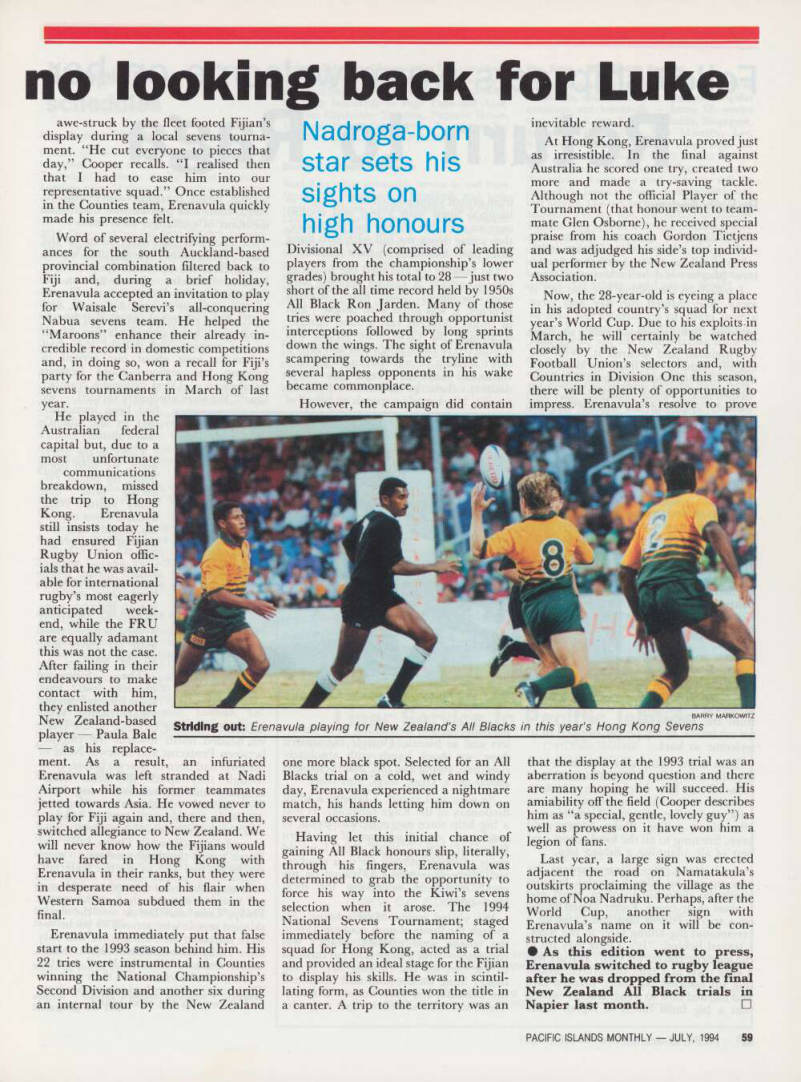
At Hong Kong, Erenavula proved just
as irresistible. In the final against Australia he scored one try, created two more and made a try-saving tackle.
Although not the official Player of the Tournament (that honour went to team mate Glen Osborne), he received special praise from his coach Gordon Tietjens and was adjudged his side’s top individ ual performer by the New Zealand Press Association.
Now, the 28-year-old is eyeing a place in his adopted country’s squad for next year’s World Cup. Due to his exploits in March, he will certainly be watched
closely by the New Zealand Rugby
Football Union’s selectors and, with Countries in Division One this season, there will be plenty of opportunities to impress. Erenavula’s resolve to prove
that the display at the 1993 trial was an aberration is beyond question and there are many hoping he will succeed. His amiability off the field (Cooper describes him as “a special, gentle, lovely guy”) as well as prowess on it have won him a legion of fans.
Last year, a large sign was erected adjacent the road on Namatakula’s outskirts proclaiming the village as the home of Noa Nadruku. Perhaps, after the World Cup, another sign with Erenavula’s name on it will be con
structed alongside.
• As this edition went to press, Erenavula switched to rugby league after he was dropped from the final New Zealand All Black trials in Napier last month. □
Barry Markowitz
Striding out: Erenavula playing for New Zealand’s All Blacks in this year’s Hong Kong Sevens