Land: a hot issue
p. 56 · Read in the full issue
Pohnpei/ Marshall Islands
By Tom Panholzer
LAND leasing is a hot topic throughout the Pacific as developing island states attempt to find a happy medium be tween controlling their land and attract ing development on the land.
Pohnpei, in the Federated States of Micronesia, is no different than the rest of the Pacific, and its legislators are studying an amendment to its consti tution to change its current land leasing legislation. Currently land may be leased for only 25 years. If amended, land could be leased for 55 years with options. If the
legislation goes through,
and smart money in Pohnpei bets it will, it is thought that this will at tract investors who nor mally would not invest for shorter terms.
One recently formed company, Land Source,
hopes to assist Pohnpeians
find leasers for land owners. Owned by Mark Lindlow and his wife, Jean, Land Source, located in Kolonia Town, was cre ated to act as a real estate agent, list available land, market, and attract inves tors.
Poisonous snake found
THE arrival of snakes to Pohnpei Island is a constant worry and islanders here work hard to keep the island snake-free.
This is why alarm was quickly spread from the radio station in early March when fishermen captured a live sea snake on the shoreline in Madolenihmw mu nicipality in the east of the island.
The 18-inch snake was identified as a yellow bellies sea snake by scientists at the College of Micronesia FSM science department. Don Buden, the college’s biology instructor, said the snake was highly poisonous.
Hope for 24-hour water
service in rural areas
“WATER, water everywhere, but barely a safe drop from a faucet to drink in the country side,” has been uttered often on this rain rich island, but change might be coming in the not too distant future.
Now that Pohnpei State capital, Kolonia Town, has 24-hour water ser vice throughout 100 per cent of the area, a concentrated effort is underway by the
Pohnpei Utilities Corporation (PUC) to give 24-hour safe-water service to the rural areas, according to Dan Perin, economic planning consultant to PUC.
“About 70 per cent of the out-patient load at our hospital is because of water related problems,” said Perin. Hence the push to bring safe drinking water to the entire island. Historically the effort has focused on bringing safe drinking water to Kolonia Town, and this has now been achieved.
“It’s not perfect yet,” admits Perin, “but the pipes no longer have a vacuum in them sucking in impurities from the surrounding ground.” Perin said the
attention was being directed to obtaining some United States Farmer’s Home Administration community development programme money. “We’re in the first step of the process and that is to go to each rural community and have the people .there make two decision.” Perin explained that the communities must decide if they wanted PUC to run the system and if they wanted to participate in a Farmer’s Home Administration rural water programme.
New ice plant for ships
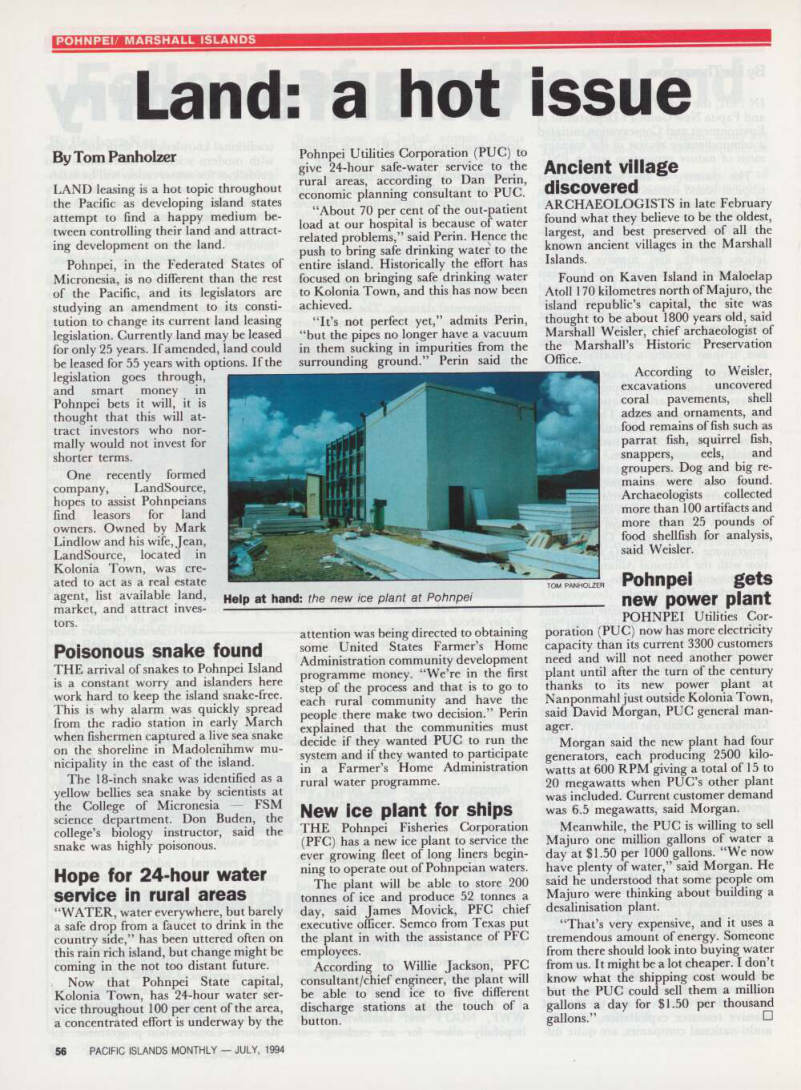
THE Pohnpei Fisheries Corporation (PFC) has a new ice plant to service the ever growing fleet of long liners begin ning to operate out of Pohnpeian waters.
The plant will be able to store 200 tonnes of ice and produce 52 tonnes a day, said James Movick, PFC chief executive officer. Semco from Texas put the plant in with the assistance of PFC employees.
According to Willie Jackson, PFC consultant/chief engineer, the plant will be able to send ice to five different discharge stations at the touch of a button.
Ancient village
discovered
ARCHAEOLOGISTS in late February found what they believe to be the oldest, largest, and best preserved of all the known ancient villages in the Marshall Islands.
Found on Kaven Island in Maloelap Atoll 170 kilometres north of Majuro, the island republic’s capital, the site was thought to be about 1800 years old, said Marshall Weisler, chief archaeologist of the Marshall’s Historic Preservation Office.
According to Weisler, excavations uncovered coral pavements, shell adzes and ornaments, and food remains of fish such as parrat fish, squirrel fish, snappers, eels, and groupers. Dog and big re mains were also found.
Archaeologists collected
more than 100 artifacts and more than 25 pounds of food shellfish for analysis, said Weisler.
Pohnpei gets
new power plant
POHNPEI Utilities Cor
poration (PUC) now has more electricity capacity than its current 3300 customers need and will not need another power plant until after the turn of the century thanks to its new power plant at Nanponmahl just outside Kolonia Town, said David Morgan, PUC general man ager.
Morgan said the new plant had four generators, each producing 2500 kilo watts at 600 RPM giving a total of 15 to 20 megawatts when PUC’s other plant was included. Current customer demand was 6.5 megawatts, said Morgan.
Meanwhile, the PUC is willing to sell Majuro one million gallons of water a day at $1.50 per 1000 gallons. “We now have plenty of water,” said Morgan. He said he understood that some people om Majuro were thinking about building a
desalinisation plant.
“That’s very expensive, and it uses a tremendous amount of energy. Someone from there should look into buying water from us. It might be a lot cheaper. I don’t know what the shipping cost would be but the PUC could sell them a million gallons a day for $1.50 per thousand
gallons.” D
Help at hand: the new ice plant at Pohnpei